
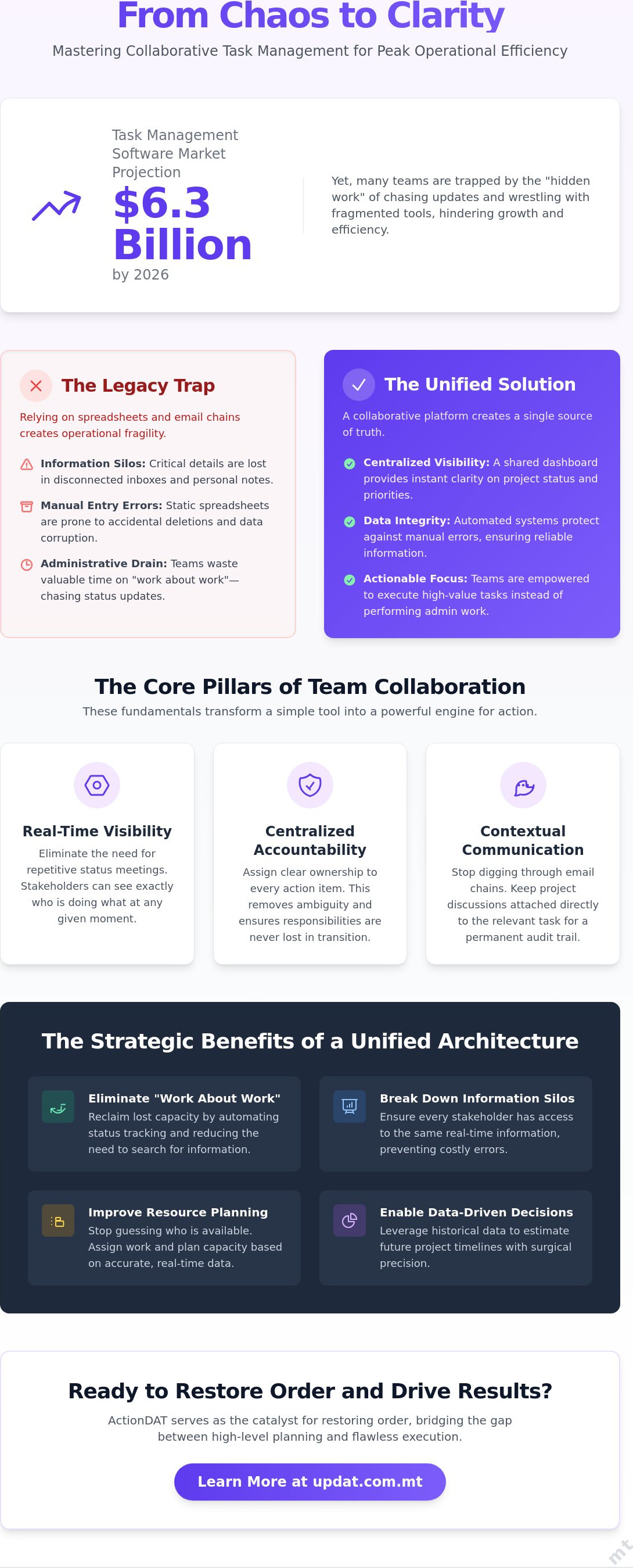
By 2026, the task management software market is projected to reach $6.3 billion, yet many teams still struggle with the "hidden work" of chasing status updates in fragmented email chains. Most leaders recognize that a simple list of tasks isn't enough to drive high-level efficiency. True collaborative task management serves as a visible architecture that eliminates information silos and restores order to complex projects. You've likely experienced the frustration of lost accountability and the administrative drain of manual tracking. It's a common barrier to growth, but it doesn't have to be your team's reality.
This article provides the essential frameworks and tools needed to transform internal communication into tangible operational results. We'll show you how to move away from chaotic spreadsheets and toward centralized visibility that empowers your staff. You'll discover how systems like ActionDAT and TimeDAT can reduce overhead and provide the clarity your business needs to scale. We're going to break down the strategic shift from basic coordination to a masterfully organized environment where every action is tracked and every result is measurable.
Key Takeaways
• Define the shift from fragmented, individual to-do lists to a unified digital architecture that supports team-wide synchronization.
• Identify how a strategic collaborative task management framework eliminates the "work about work" that drains team productivity.
• Analyze the hidden operational costs of maintaining manual legacy processes versus adopting modern, automated systems.
• Review a checklist of essential features designed to prioritize team action and accountability over simple data entry.
• Explore how ActionDAT serves as the catalyst for restoring order and bridging the gap between high-level planning and execution.
What is Collaborative Task Management?
Collaborative task management is not merely a digitized version of a personal to-do list. It is a strategic architecture designed to synchronize team efforts within a single, unified digital environment. While individual productivity tools focus on personal output, a collaborative framework prioritizes the collective movement of an entire organization. It removes the friction of "hidden work" by making every action item visible to those who need to see it. This transparency transforms team communication from a series of disjointed inquiries into a measurable flow of operational data.
Operational efficiency depends on this visibility. Traditional workflows often suffer from information silos where critical details live in personal notebooks or isolated email threads. This fragmentation forces managers into a reactive state of "firefighting" as they scramble to reconcile status updates. By contrast, a collaborative system enables proactive task orchestration. It allows leaders to identify bottlenecks before they stall progress. General Task management encompasses the full lifecycle of an activity, from planning to reporting. When applied to a team, this lifecycle requires a level of transparency that personal tools simply cannot provide.
The Core Pillars of Team Collaboration
Success in a shared digital workspace rests on three fundamental pillars. These elements ensure that the system remains a tool for action rather than a burden of data entry:
Real-time visibility
Eliminate the need for repetitive status meetings. Stakeholders can see exactly who is doing what at any given moment.
Centralized accountability
Assign clear ownership to every action item. This removes ambiguity and ensures that responsibilities are never lost in transition.
Contextual communication
Stop digging through email chains. Keep all project-related discussions attached directly to the task, providing a permanent audit trail of decisions.
Moving Beyond the Shared Spreadsheet
Many firms still rely on spreadsheets to manage complex projects. It's an approach that creates significant risk. Spreadsheets are static documents that struggle in dynamic, multi-user environments. They suffer from version control issues and the constant threat of "lost" data due to manual entry errors. One accidental deletion can derail an entire project's timeline. Transitioning to a business task management platform ensures data integrity and operational order. It provides the digital architecture necessary to master your operational environment without the fragility of legacy files.
The Strategic Benefits of a Unified Task Architecture
A unified task architecture does more than organize lists; it restores order to complex operational environments. When a business operates without a centralized system, complexity grows exponentially with every new project. Implementing collaborative task management provides the digital foundation needed to master this environment. It replaces the noise of constant status inquiries with a steady stream of actionable data. By establishing a single source of truth, you empower your team to focus on high-value execution rather than administrative coordination.
Eliminating "work about work" is perhaps the most immediate benefit of a structured system. This term describes the time employees spend searching for documents, chasing updates, and clarifying instructions. Academic research on team collaboration confirms that structured digital environments significantly reduce the cognitive load on staff. When you remove the friction of information gathering, you reclaim lost capacity. This reclaimed time allows for better resource allocation and more accurate capacity planning. You stop guessing who is available and start assigning work based on real-time data.
Eliminating Operational Information Silos
In high-stakes sectors like hospitality, manufacturing, and security, information silos create dangerous bottlenecks. A delay on a production line or a security incident in a remote facility must be communicated instantly. A shared platform ensures that every stakeholder has access to the same information at the same time. This visibility prevents the discrepancies that lead to costly errors. Beyond daily operations, these systems capture historical data. This data becomes a strategic asset, allowing you to estimate future project timelines with surgical precision based on past performance. If you are ready to remove complexity from your workflows, you can start building your unified workspace today.
Enhancing Team Accountability and Ownership
Clear ownership is the only effective antidote to the "bystander effect." When a task is vaguely assigned to a department, it often belongs to no one. A collaborative system ensures that every action item has a designated owner and a transparent deadline. This clarity boosts team morale by removing the stress of ambiguity. Tracking progress on team projects maintains momentum by providing real-time feedback on every milestone. Furthermore, automated audit trails provide management with total oversight without the need for micromanagement. You maintain control while giving your team the autonomy they need to succeed.
Overcoming Barriers to Effective Team Execution
The most frequent objection to implementing a new system is a perceived lack of time. Decision-makers often feel that their teams are too busy with daily operations to pause for training. However, this perspective overlooks the fact that the "busyness" is usually a symptom of the very inefficiency the software aims to solve. Transitioning to collaborative task management isn't an additional burden; it's the primary solution to the exhaustion of manual tracking. By shifting the focus from short-term disruption to long-term stability, you move your team from a state of constant catch-up to one of mastery.
Resistance to change is often rooted in the fear of micromanagement. Staff may view digital tracking as a way for leadership to monitor their every move. To overcome this, position standardization as a tool for empowerment. Clear systems provide employees with the autonomy to manage their own workflows without constant interference. When everyone knows the rules of the digital architecture, they spend less time asking for permission and more time delivering results. Order doesn't restrict movement; it facilitates it by providing a reliable foundation for growth.
The Hidden Cost of Manual Tracking
Maintaining manual legacy processes carries a heavy financial and operational price. Administrative hours vanish into the void of manual reporting, payroll preparation, and data reconciliation. In sectors like facilities management or manufacturing, a single entry error on a paper form can lead to hours of corrective work. Streamlining business operations with software pays for itself by reclaiming these lost hours. It eliminates the risk of human error and ensures that your data remains accurate and integrated across all departments. You stop paying for the friction of outdated habits and start investing in fluid execution.
Strategies for Successful Software Adoption
Successful digital transformation requires a deliberate approach to the human element. Leadership must model the use of the platform, demonstrating that the new system is the definitive source of truth for the organization. Start by deploying the software within a single department or for a specific project to secure quick wins. These initial successes provide the social proof needed to encourage wider adoption across the firm. Choosing intuitive, results-oriented interfaces like those found in TimeDAT or ActionDAT ensures that the learning curve remains manageable. When the benefits of collaborative task management become visible in the first week, resistance quickly turns into advocacy.
Essential Features of a Modern Task Resource
A modern task resource must serve as a catalyst for action, not a cemetery for data. Effective collaborative task management requires specific, non-negotiable features that bridge the gap between office planning and field execution. For security and facilities management teams, mobile accessibility is critical. It transforms the digital architecture into a portable tool, allowing staff to update statuses and report incidents directly from the site. This real-time connection ensures that the centralized source of truth remains accurate without the lag of manual office entry. It empowers field staff to remain productive without being tethered to a desk.
Automated alerts for upcoming or overdue deadlines are equally vital. These notifications serve as a digital safety net, ensuring that critical compliance tasks never go unnoticed. By automating these reminders, you reduce the administrative overhead of manual follow-ups. Managers can stop acting as human notifications and start focusing on high-level strategic direction. Reliability is the primary goal; the software handles the routine while the team focuses on the results. When the system manages the "when," your team can master the "how."
Prioritization and Progress Visualization
Understanding how to prioritize work tasks is essential for maintaining team focus in a shared tool. A professional platform should offer varied views, such as Lists for granular detail, Boards for workflow movement, and Timelines for long-term planning. Each view serves a unique purpose in a collaborative environment. Management benefits from at-a-glance progress indicators that provide an immediate pulse on project health. These visual cues allow for rapid intervention if a milestone is at risk. They provide clarity without the need for exhaustive status meetings.
Automated Notifications and Escalations
Automation prevents critical items from falling through the cracks. Beyond simple reminders, sophisticated systems include escalation protocols for high-priority compliance tasks. If a safety audit or a security check remains unaddressed past its deadline, the system can automatically notify a supervisor. This ensures a steady, predictable rhythm of execution across all departments. Implementing these features restores order to even the most chaotic operational environments. If you're ready to equip your team with these professional tools, register your account today to begin building your digital architecture.
Implementing ActionDAT for Seamless Team Execution
ActionDAT serves as the definitive catalyst for restoring operational order within your organization. While previous sections established the strategic necessity of collaborative task management, this platform provides the practical digital architecture to make it a reality. It bridges the gap between high-level planning and boots-on-the-ground execution by centralizing every action item in a single, reliable system. This alignment ensures that your strategic vision is never decoupled from daily work. By implementing a system designed for precision, you achieve true operational excellence. You move beyond the exhaustion of managing tasks and begin mastering your entire operational environment.
The transition to a unified system eliminates the friction that typically stalls progress. When your team operates within a structured environment, they spend less time clarifying instructions and more time delivering results. ActionDAT provides the keys to this mastery, offering a grounded and confident approach to team synchronization. It replaces complexity with clarity, allowing leaders to maintain total oversight without the need for micromanagement. This is the final step in transforming your team's communication into a measurable flow of operational results. It's about building a steady foundation that supports long-term growth and stability.
Tailored Solutions for Diverse Industries
ActionDAT is built for the rigors of high-stakes sectors where precision is a requirement, not an option. In hospitality, it manages the rapid turnover of service tasks and compliance checks with surgical accuracy. In manufacturing, it synchronizes complex production milestones with essential quality assurance audits. The platform's digital architecture scales effortlessly, supporting a single local team with the same "no-nonsense" efficiency it provides to national operations. The design prioritizes speed and immediate utility, removing the digital clutter that often hampers legacy software. It's a professional tool that adapts to your business architecture, ensuring that collaborative task management remains fluid and adaptive across all departments.
Take the First Step Toward Operational Clarity
Achieving operational clarity requires a deliberate choice to move away from inefficient legacy processes. Evaluate your current workflow against the strategic pillars of visibility and accountability. If your team still relies on disjointed email threads or fragile spreadsheets, you're operating at a self-imposed disadvantage. Transitioning to ActionDAT is a strategic investment in your organization's future capacity. It provides the reliable foundation needed to scale your operations without losing control of the details. The restoration of order is not a one-time event; it's a continuous state achieved through the right professional tools. Request a demo to see ActionDAT in action and take the first step toward total operational mastery.
Mastering Operational Excellence in 2026
Restoring order to a complex business environment requires a shift from reactive coordination to proactive orchestration. You've seen how a centralized digital architecture eliminates the administrative drain of chasing status updates and clarifies team accountability. By prioritizing visibility and mobile accessibility, your organization can bridge the gap between high-level planning and boots-on-the-ground execution. This strategic approach to collaborative task management ensures that no critical milestone falls through the cracks. It replaces complexity with a steady, predictable rhythm of work.
ActionDAT is designed for high-level operational efficiency and is already trusted by leaders in the hospitality, manufacturing, and security sectors. With Maltese-based support and bespoke software development options, we provide the steady foundation your business needs to scale. Stop paying for the friction of outdated legacy processes and start investing in fluid, measurable results. You have the tools to remove complexity and lead your team toward total operational mastery. Master your team’s execution with an ActionDAT demo. Your path to a more organized and empowered workplace begins today.
Frequently Asked Questions
What is the difference between individual and collaborative task management?
Individual management focuses on personal productivity and solo to-do lists that aren't visible to the wider organization. Collaborative task management prioritizes the collective movement of an entire team by providing a unified digital environment. It moves beyond private notebooks into a shared architecture where everyone sees the project's progress. This transparency eliminates the need for constant status inquiries and ensures that team members aren't working in isolation.
How does collaborative task management improve team accountability?
Accountability improves through the assignment of clear ownership to every action item within a shared space. When a task has a designated owner and a visible deadline, the bystander effect disappears. ActionDAT provides automated audit trails that track exactly when tasks are completed or updated. This system ensures that responsibilities are transparent to the whole team, which naturally encourages higher standards of execution and reduces ambiguity.
Can small businesses benefit from task management platforms, or is it only for large enterprises?
Small businesses benefit significantly from these platforms as they provide the necessary structure for rapid growth. While large enterprises use them to manage complex national operations, smaller firms use them to eliminate administrative overhead and manual tracking. Implementing professional systems early allows a small team to maintain order as they expand. It's a strategic investment that scales with your business architecture, regardless of the current employee count.
How do I stop tasks from falling through the cracks during busy periods?
Utilize automated alerts and escalation protocols to ensure deadlines are never missed. During high-intensity periods, manual follow-ups often fail. A digital system provides a safety net by sending notifications for upcoming or overdue tasks. Visualization tools like Boards or Timelines allow managers to spot bottlenecks instantly. This proactive orchestration prevents critical items from being lost in fragmented email chains or verbal requests.
What should I look for when choosing a team task management tool in 2026?
Prioritize mobile accessibility, automated workflows, and the ability to integrate with existing operational tools. In 2026, a tool must serve field-based teams as effectively as office staff. Look for platforms that drive action rather than just data entry. Ensure the software offers robust reporting and progress visualization that matches your specific industry nomenclature. These features turn a simple list into a powerful strategic resource for long-term stability.
How long does it typically take to transition from manual spreadsheets to a digital platform?
Initial setup and "quick win" projects can be operational within a few days. A full transition for an entire department typically takes two to four weeks, depending on the complexity of your current data. The process involves mapping your existing workflows into the new digital architecture. Starting with a single project allows the team to adapt quickly without disrupting the entire organization's momentum or productivity.
Is it possible to integrate task management with other business systems like payroll or audits?
Integration is possible and highly recommended for maintaining data integrity across the business. Systems like TimeDAT can synchronize with payroll, while AuditDAT bridges the gap between compliance checks and corrective actions. If a standard integration isn't available, bespoke software development can create custom links between your task management platform and legacy databases. This connectivity ensures that information flows seamlessly without manual re-entry.
How can I encourage my team to actually use a new task management system?
Encourage adoption by having leadership model the use of the platform as the sole source of truth. If managers only communicate through the system, the team will naturally follow. Demonstrate immediate value by showing how the tool reduces the need for repetitive status meetings. When staff see that the digital architecture makes their daily work easier and more organized, resistance typically shifts into long-term advocacy.





%201.svg)
