

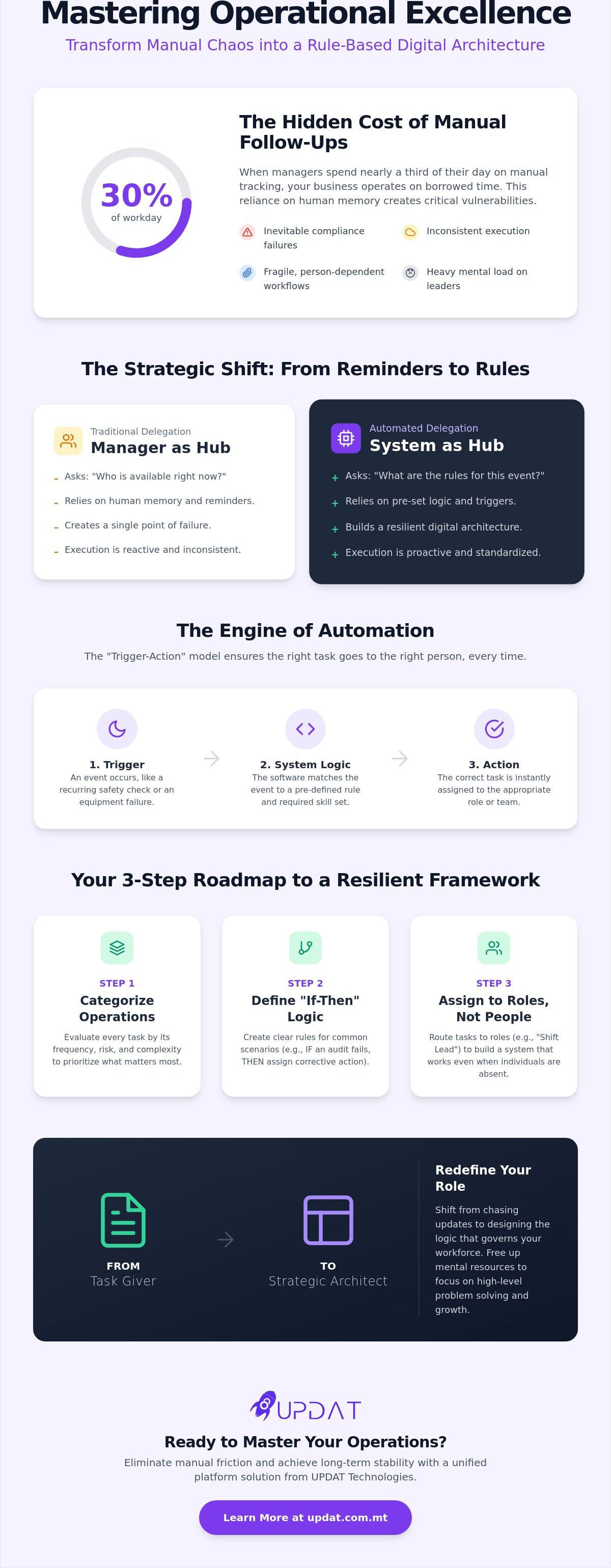
If your managers spend 30% of their workday performing manual follow-ups, your business is operating on borrowed time. Relying on human memory to bridge operational gaps creates a fragile environment where compliance failures and inconsistent execution become inevitable. Shifting to automated task delegation isn't just a technical upgrade; it's the restoration of order through a digital architecture. You've likely felt the heavy mental load of tracking every handoff, fearing that a single forgotten inspection could lead to a regulatory breach. It's a common pain point for leaders who value precision but find themselves trapped in the chaos of manual oversight.
This strategic guide provides the keys to master your operational environment by transitioning to rule-based systems. You'll learn how to implement a "set and forget" framework for recurring tasks that ensures real-time accountability for every team member. We'll examine how to integrate audits with corrective actions seamlessly, moving your organization toward the agentic AI standards of 2026. By the end of this article, you'll have a clear roadmap to eliminate complexity and empower your workforce with a system that drives itself.
Key Takeaways
• Move beyond manual handoffs by establishing a digital architecture that prioritizes rules over reminders.
• Categorize your operations by risk and complexity to design a robust automated task delegation framework.
• Leverage ActionDAT to convert high-level strategies into traceable, real-time actions that ensure team accountability.
• Execute a systematic operational audit to identify and eliminate manual friction points within your current workflows.
• Master long-term stability by choosing unified platform solutions over fragmented software stacks that create data silos.
What is Automated Task Delegation in a Modern Business Context?
In a high-growth environment, manual handoffs are a liability. Automated task delegation represents a fundamental shift in how work moves through an organization. It's the transition from a manager manually assigning a ticket to a software system distributing responsibilities based on pre-set triggers. This isn't just about efficiency; it's about building a digital architecture where rules, not reminders, drive execution. By removing the supervisor as the primary distribution hub, you eliminate the single point of failure that often stalls production. This transition highlights the role of automated task delegation in restoring operational order and providing a clear, unshakeable structure for every department.
Traditional delegation asks, "Who is available right now?" Modern delegation asks, "What are the rules for this specific event?" By 2026, the complexity of global supply chains and regulatory requirements like the Colorado Artificial Intelligence Act (CAIA) makes human oversight a dangerous bottleneck. Relying on a supervisor to remember every follow-up or inspection task invites compliance failure. Business process automation provides the foundation for this transition, ensuring that every operational crack is sealed by logic rather than effort. It restores order by removing the variability of human memory from the critical path of execution.
The "Trigger-Action" Model of Modern Workflow
Triggers are the heartbeat of this system. They can be time-based, such as a recurring safety check, or event-based, like an equipment failure detected by a sensor. Once a trigger is activated, the software matches the task to the specific skill set or role required for the job. This removes the guesswork and ensures the right person is notified instantly. It also provides real-time visibility, allowing leaders to see exactly when a task was assigned, started, and completed. This digital paper trail is essential for meeting the transparency requirements of the EU AI Act, which became fully applicable in August 2026.
The Strategic Shift: From Manager to Architect
This shift redefines the managerial role. You're no longer a "task-giver" chasing updates via Slack or email. Instead, you become a strategic architect. You design the logic that governs the workforce, allowing the system to handle the distribution of labor. This empowers teams because they receive clear, objective instructions without the "noise" of constant micro-management. It creates a steady, predictable rhythm that supports long-term operational excellence. By reducing the mental load on leadership, you free up resources to focus on high-level problem solving rather than routine coordination.
Designing Your Delegation Framework: Setting the Rules of Engagement
Building a digital architecture requires more than just software; it demands a clear set of rules. Effective automated task delegation begins with a rigorous categorization of every operational activity. You must evaluate tasks based on their frequency, the complexity of judgment required, and the inherent risk of failure. High-risk compliance tasks, for instance, require immediate assignment and strict verification, while low-complexity recurring maintenance can be handled by a more fluid schedule. By organizing your operations this way, you ensure the system prioritizes what matters most to your stability and growth.
Once categories are set, you define the "If-This-Then-That" logic for common scenarios. If an audit fails a safety check, then a corrective action is instantly assigned. This logic removes the ambiguity that often plagues manual handoffs. To ensure system resilience, always assign these tasks to roles rather than specific individuals. If a shift lead is unavailable, the system should automatically route the task to the next qualified person in that role. This creates a steady foundation for operational excellence that doesn't crumble when a single team member is absent.
Identifying Tasks Ripe for Automation
Start with high-frequency, low-judgment tasks. These are the "must-dos" that consume mental energy but don't require strategic thinking. Compliance-driven actions, such as daily temperature logs or security checks, are perfect candidates. Automating these ensures they're never forgotten. Core technologies for task distribution allow you to turn your calendar into your primary delegator. This ensures that recurring maintenance happens without a manager ever having to send a manual reminder or check a spreadsheet.
Mapping Escalation and Accountability
Accountability is the backbone of any automated system. You must define what happens when a task remains uncompleted. Building a safety net involves setting clear escalation paths. For example, if a high-priority task isn't acknowledged within 30 minutes, the system should automatically notify a supervisor. This isn't about micromanagement; it's about visibility. You can start building these rules today to find the right balance between automated notifications and necessary human intervention. Over time, use the data from these escalations to refine your logic and eliminate recurring bottlenecks.
Core Technologies for Seamless Task Distribution
To achieve automated task delegation, your technology stack must communicate across functional silos. Fragmented tools lead to information rot and operational delays. A unified system like ActionDAT transforms high-level strategic goals into actionable items that are tracked in real-time. This eliminates the need for manual data entry and ensures that no task falls through the cracks. By implementing automated workflows, you create a seamless loop between identifying a problem and assigning its resolution. This digital architecture provides the stability needed for long-term growth.
The synergy between AuditDAT and ActionDAT is where operational order is restored. Most businesses treat audits and task management as separate functions, which creates a gap where critical findings are forgotten. When a failed inspection occurs in AuditDAT, the system doesn't just record the error; it automatically triggers a corrective task delegation within ActionDAT. This creates an immediate response without management intervention. It ensures that every non-compliance issue is met with a tracked, verified action that remains visible until resolved.
Integrating TimeDAT ensures that these assignments are based on actual workforce availability. There's no point in delegating a high-priority task to someone who isn't on shift or is already over-capacity. The system checks real-time attendance data to ensure the right person receives the instruction at the right time. This level of precision reduces the mental load for managers who would otherwise spend hours cross-referencing schedules with task lists. It's a logic-driven approach that prioritizes execution over coordination.
ActionDAT for Real-Time Task Prioritisation
ActionDAT moves your business beyond the static to-do list. It functions as a dynamic, prioritized task engine that adjusts based on real-time operational needs. Team accountability improves because every member has a transparent view of their progress and upcoming requirements. This clarity reduces the friction of daily operations and empowers the workforce to act decisively. You can explore more about our business task management platform to see how it structures complex workflows for better results.
Audit-Triggered Delegation for Compliance
AuditDAT identifies operational gaps that require immediate attention. In sectors requiring GXP compliance and quality assurance, automated follow-ups are non-negotiable to maintain regulatory standing. The system closes the loop from inspection to resolution without any manual data entry. This ensures that every audit finding leads to a traceable delegation. It provides a robust safety net that protects your organization from the risks of human error and oversight.
A Step-by-Step Guide to Implementing Automated Workflows
Transitioning to automated task delegation requires a disciplined, phased approach. You can't simply install software and expect order to emerge from chaos. It begins with an Operational Audit to document every manual handoff point currently in use. In sectors like manufacturing or hospitality, these cracks often appear during shift changes or when a supervisor is pulled away for an emergency. By identifying these silos, you can design a system that bridges the gap without human intervention. This phase is about mapping the physical and digital architecture of your business to ensure no detail is overlooked.
Phase two involves Logic Configuration. This is where you build your rules within ActionDAT. You'll define the specific triggers discussed earlier, ensuring that every event has a corresponding, tracked action. Once the logic is set, move to the Pilot Phase. Test the automation on a single department or a specific shift. This allows you to observe the system in a controlled environment, ensuring the rules work as intended before a full-scale deployment. It's about building confidence in the digital architecture before expanding its reach across the entire organization.
The Audit: Finding the Cracks
Interview your team leads to find where tasks are most frequently forgotten. These are your "information silos." In high-pressure environments, the time lost to manual follow-ups can consume a significant portion of a manager's day. Quantifying this loss provides the business case for change. You're looking for recurring friction points where a lack of visibility leads to delays or compliance risks. This data informs the rules you'll eventually build to restore order and clarity.
Configuration and Testing
Start with simple recurring tasks to set up your first automated triggers. Success isn't just about completion; it's about the speed and accuracy of the response. Gather feedback from frontline workers to ensure the automation helps their workflow rather than hindering it. If the system creates more noise than clarity, your rules need refinement. You can set up your first automated workflow today to begin testing these logic gates in real-time.
The final phases involve Full Rollout and Continuous Optimization. Training is essential to align your culture with the "new order" of digital accountability. Once the team understands that the system is there to empower them, adoption follows naturally. Use bottleneck reports to tweak your delegation rules constantly. This feedback loop ensures your automated task delegation framework evolves alongside your business, maintaining high-level efficiency as you scale. By reviewing these reports, you turn raw data into a strategic advantage that drives long-term stability.
Mastering Operational Excellence with UPDAT Technologies
Achieving a state of operational order requires a foundation that is both robust and flexible. While many businesses attempt to patch together fragmented "app-stack" solutions, these often lead to data silos and integration failures that compromise your data integrity. A unified platform provides the necessary clarity for successful automated task delegation. By housing your audits, time tracking, and task management under one roof, you ensure that every piece of information informs the next logical action. This cohesive digital architecture is what allows a business to scale nationally without losing the precision that drove its initial success. Relying on cloud-based, reliable architecture ensures that your systems remain accessible and steady, regardless of your organization's geographic footprint.
For organizations with unique operational requirements, bespoke software development offers a tailored path to mastery. Sometimes off-the-shelf logic isn't enough to handle the intricacies of a specific industry or a complex regulatory environment. UPDAT acts as a strategic architect, building systems that mirror your exact workflows and pain points. This approach ensures that your delegation rules are as unique as your business model, providing a steady foundation for long-term growth. It's about removing the friction of "standard" tools that don't quite fit and replacing them with a system designed for high-level efficiency.
Integrating Workforce and Task Management
The effectiveness of any instruction depends on the availability of the person receiving it. TimeDAT ensures that tasks are only delegated to staff who are currently on-shift and available to execute. This level of integration significantly reduces administrative overhead by eliminating the need for manual schedule cross-referencing or constant follow-up calls. It also fosters a culture of empowerment. When team members have clear, digital instructions waiting for them, they can act with confidence and autonomy. Every person in the organization knows their "next move" without needing to wait for a supervisor's intervention, allowing management to focus on strategic growth rather than routine coordination.
Your Next Steps Toward Automation
Mastering your operational environment is a journey that begins with a single, well-placed rule. It's vital to start small but always think architecturally about how your systems connect. As you evaluate your current pricing and ROI, look beyond the immediate cost to the long-term value of removing complexity. The restoration of order is a tangible asset that pays dividends in compliance, efficiency, and workforce morale. The UPDAT promise is centered on restoring this order through sophisticated technology that remains accessible to those on the frontline. To see these systems in action and begin your transition, you can book a demo and discover how a unified platform can transform your operations.
Secure Your Operational Future
Building a resilient digital architecture is the final step in moving your business from reactive chaos to proactive order. By implementing automated task delegation, you replace the fragility of human memory with the reliability of rule-based logic. You've explored how a unified platform ensures that audit findings immediately trigger corrective actions, while real-time attendance data keeps assignments practical and achievable. This structured approach is why leaders in hospitality and manufacturing trust UPDAT to manage their most critical workflows.
As specialists in GXP and regulatory compliance, we remain dedicated to our Maltese-founded roots and the pursuit of operational excellence. You have the tools to eliminate administrative overhead and provide your team with the clarity they need to succeed. It's time to step into a more organized future where systems, not supervisors, drive daily execution. You have the keys to master your environment; now you simply need to turn them.
Book a Demo to Automate Your Task Delegation and start your transition today.
Frequently Asked Questions
What is automated task delegation exactly?
Automated task delegation
is the shift from manual work assignment to a software-driven distribution model based on pre-set logic. Instead of a manager deciding who does what, the system uses "If-This-Then-That" triggers to route tasks to the correct role. This ensures that every operational event, from a recurring maintenance check to an emergency repair, is handled instantly without human delay or the risk of being forgotten.
Can automated task delegation work for small teams?
Small teams benefit significantly because the system acts as a digital supervisor. It removes the administrative burden from owner-operators who would otherwise spend their day chasing updates. By automating routine handoffs, small organizations can maintain high-level efficiency and scale without needing to hire additional middle management. It provides a steady foundation for growth by ensuring tasks don't rely on a single person's memory.
How does automated task delegation improve compliance?
It improves compliance by creating a transparent, real-time audit trail for every delegated action. When a system like AuditDAT identifies a non-conformity, it automatically triggers a corrective task in ActionDAT. This "closed-loop" process ensures that regulatory requirements are met and documented without manual entry. It provides the visibility needed to satisfy standards like the EU AI Act or GXP quality assurance guidelines.
What is the difference between a to-do list and automated delegation?
A to-do list is a static, passive reminder that requires manual updates and constant oversight. In contrast, automated task delegation is an active, logic-driven engine that distributes work based on real-time triggers. It doesn't just list a task; it assigns it to the right person, tracks progress, and escalates if deadlines are missed. This move from "asking" to "delegating" restores operational order.
Will my employees feel micromanaged by an automated system?
Most employees find the system empowering rather than restrictive. It provides clear, objective instructions and removes the friction of constant micro-management or "check-in" emails. When every team member knows exactly what their "next move" is, they gain autonomy and focus. The software handles the coordination, allowing the workforce to concentrate on execution and high-quality results rather than administrative back-and-forth.
How do I choose the right triggers for task automation?
Start by identifying high-frequency, low-judgment tasks that follow a predictable pattern. Time-based triggers work well for recurring maintenance, while event-based triggers are ideal for responding to audit failures or equipment sensors. Focus on tasks where a delay would create a compliance risk or an operational bottleneck. These "must-do" actions provide the highest immediate utility for your digital architecture.
Is automated task delegation secure for sensitive industries like Oil & Gas?
Modern cloud-based architectures are designed to meet the rigorous security demands of sectors like Oil & Gas. These systems utilize advanced encryption and role-based access controls to protect sensitive operational data. By centralizing task distribution, you actually increase security by reducing the risk of "shadow IT" or unencrypted manual communications like SMS or unsecured spreadsheets.
What is the expected ROI of implementing automated task tracking?
The return on investment stems from reclaiming the 30% of a manager's workday typically lost to manual follow-ups. You also eliminate the high costs associated with compliance failures and operational downtime. While we don't quote specific pricing, industry professionals report that integrated task tracking significantly reduces administrative overhead. It transforms your business from a reactive environment into a high-efficiency, logic-driven organization.




%201.svg)
