
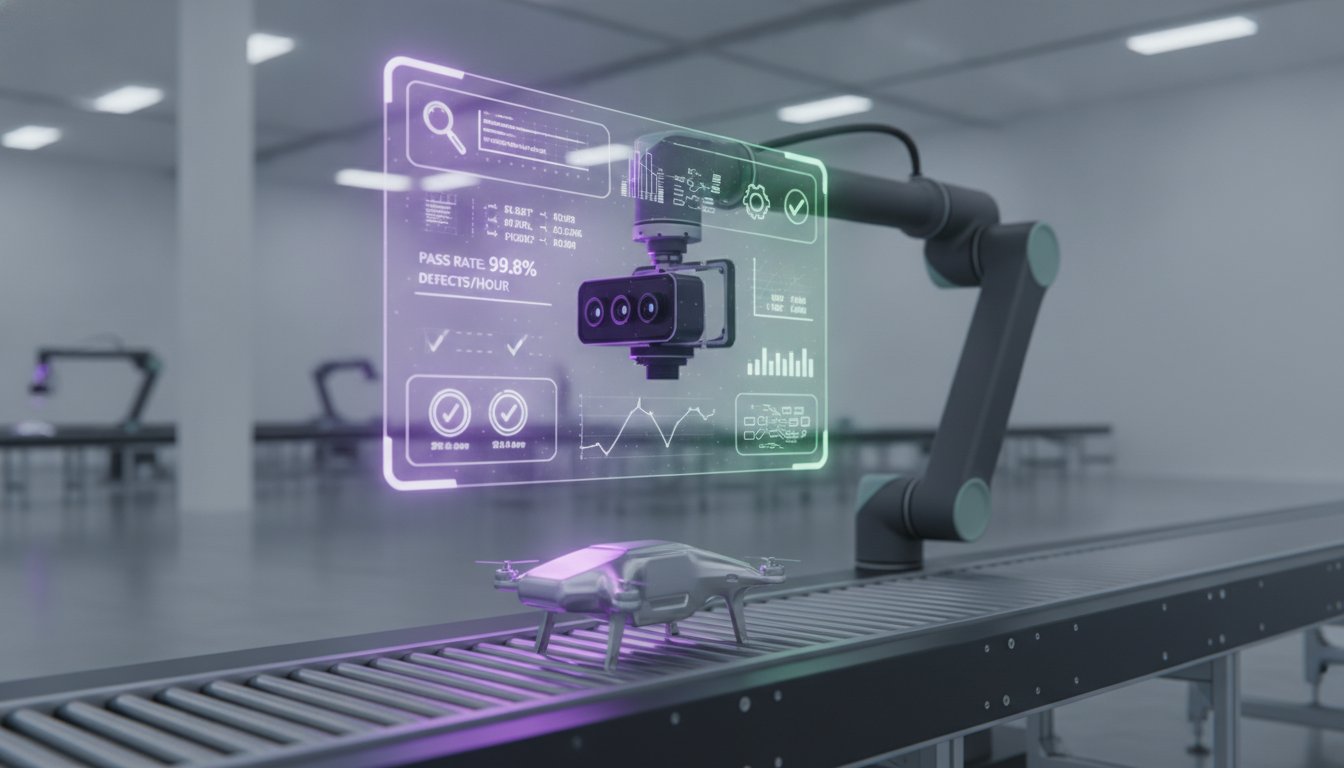
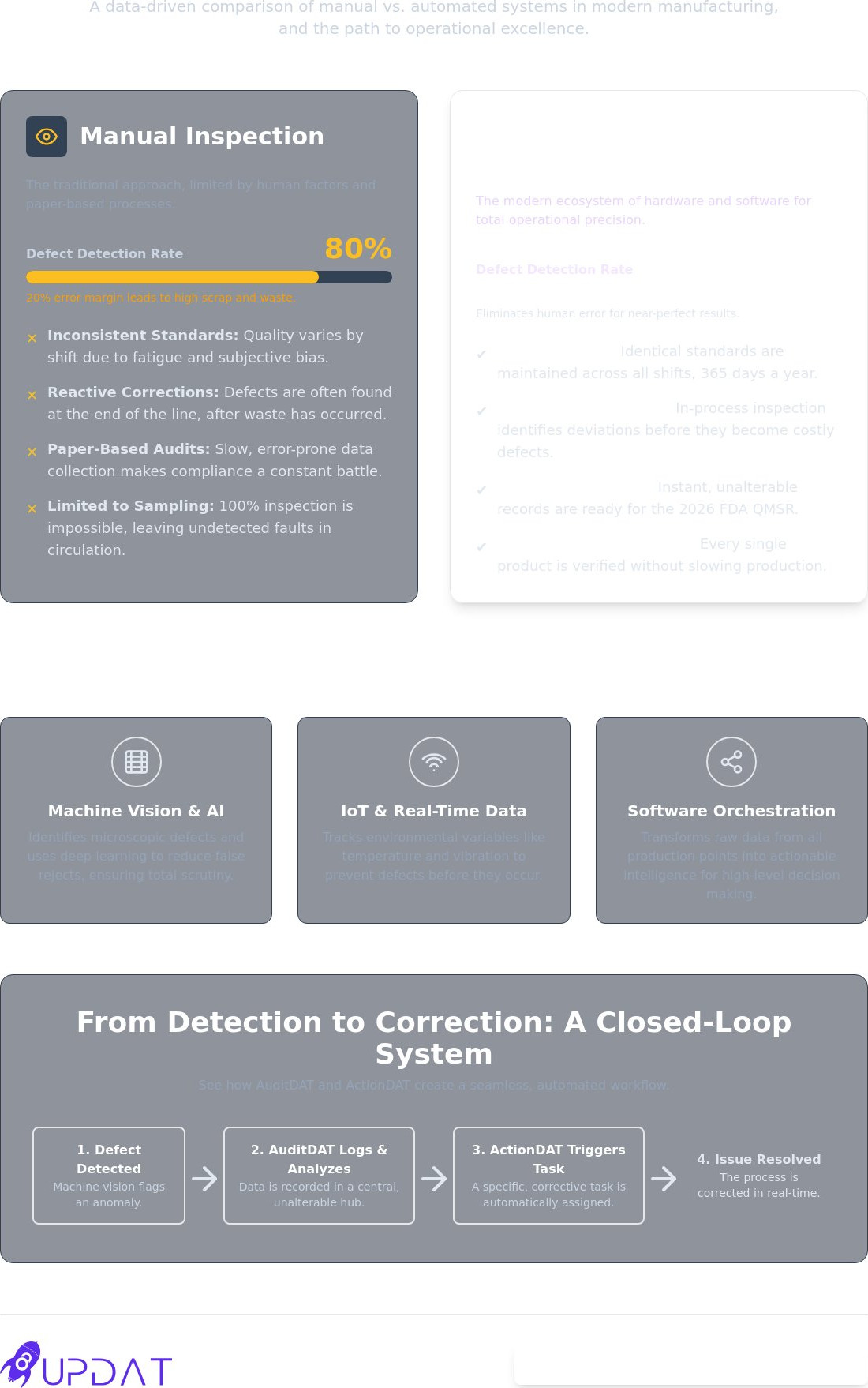
Machine vision in manufacturing now achieves a 99% defect detection rate, while manual visual inspection often plateaus at just 80%. You've likely seen how these manual gaps lead to high defect rates and the frustration of inconsistent standards across production shifts. Managing quality through paper-based audit trails feels like a constant battle against operational chaos.
Implementing automated quality control in manufacturing is the most direct path to restoring order and protecting your margins. This strategic shift eliminates human error and provides the instant, digital compliance reports necessary to thrive under the 2026 FDA Quality Management System Regulation. You'll discover how to lower operational costs by reducing scrap and waste while building a reputation for flawless product quality.
This guide serves as your architectural blueprint for a modern facility. We'll cover the transition from traditional sampling to 100% in-line inspection and how software like AuditDAT and ActionDAT can empower your team to master their operational environment with total precision.
Key Takeaways
• Shift your strategy from reactive end-of-line inspections to proactive in-process monitoring for immediate error correction.
• Discover how automated quality control in manufacturing leverages machine vision and AI to eliminate the 20% error margin typical of manual checks.
• Quantify the return on investment by exposing the hidden costs of paper-based audits and fragmented production shifts.
• Follow a security-first roadmap to digitize your workflows and ensure instant, digital access to regulatory compliance data.
• Learn how AuditDAT and ActionDAT create a closed-loop system where every detected defect automatically triggers a specific corrective task.
What is Automated Quality Control in 2026 Manufacturing?
In 2026, automated quality control in manufacturing is defined as a unified ecosystem where high-precision hardware and intelligent software operate in concert. It's no longer sufficient to treat quality as a final gatekeeper. Instead, modern systems utilize industrial process control methodologies to embed inspection into every stage of production. This transformation turns quality from a cost center into a strategic asset that preserves your brand's integrity.
The most significant shift this year is the move from reactive, end-of-line checks to proactive, in-process monitoring. Manufacturers are replacing siloed data points with integrated digital twins that mirror the physical assembly line in real-time. This level of visibility creates a steady foundation for operational excellence. By capturing data at the point of origin, you identify and rectify deviations before they become costly defects. This proactive stance is essential for meeting the stringent requirements of the 2026 FDA Quality Management System Regulation (QMSR).
The Evolution from Manual to Digital Inspections
Humans are naturally prone to fatigue and subjective bias. Research shows that machine vision can achieve a 99% defect detection rate, far surpassing the 80% typical of manual visual inspection. Automated systems provide 24/7 precision, maintaining identical standards regardless of the shift or the complexity of the part. Moving away from paper checklists toward digital audit solutions removes the friction of manual data entry. These digital frameworks provide immediate accountability. You gain a clear, unalterable record of every inspection. This transparency ensures that compliance is a continuous state, not just a preparation for an audit.
The Role of Software Orchestration
Hardware like 3D cameras and IoT sensors provide the eyes of the operation, but software serves as the brain. Software orchestration is what transforms raw data into actionable intelligence. AuditDAT acts as the central hub, pulling disparate data from every production point into a single, cohesive view. It eliminates the need for manual data aggregation and the errors that come with it. Instead of searching through filing cabinets or disconnected spreadsheets, managers receive automated reports that highlight trends and systemic risks. This centralized approach enables high-level decision-making based on real-time facts. It empowers you to master your operational environment by providing the clarity needed to lead with confidence.
Key Technologies Driving Modern Quality Systems
The efficacy of automated quality control in manufacturing relies on a sophisticated stack of hardware and software working in tandem. In 2026, the integration of these technologies has moved beyond simple pass/fail gates to complex, self-optimizing systems. This technological synergy allows you to remove the guesswork from your production lines and replace it with absolute data-driven certainty.
Machine Vision and AI Integration
Machine vision serves as the primary sensory input for modern production environments. High-speed cameras now capture frames with such clarity that they identify microscopic surface fractures or dimensional deviations invisible to even the most trained human eye. Implementing machine vision for quality control allows for 100% inspection rates without slowing down production throughput. It provides a level of scrutiny that manual labor simply can't replicate over a twelve-hour shift.
Deep learning models analyze these images to differentiate between actual defects and harmless surface variations. This nuance is critical. It significantly reduces "false rejects," which are a primary source of waste in traditional automated systems. Because these AI models are scalable, a successful deployment on one line can be rapidly replicated across different product categories. This ensures a consistent quality architecture throughout your entire organization.
IoT and Real-Time Data Streams
IoT sensors complement visual data by tracking environmental variables that directly impact product integrity. Sensors monitor temperature, humidity, and vibration levels in real-time. If a curing oven fluctuates by even a fraction of a degree, the system alerts operators before an entire batch is compromised. This proactive monitoring stops the cycle of reactive firefighting that plagues manual operations.
These real-time streams prevent the hidden failures that often occur during manual shifts. When integrated with systems for workforce management, quality data helps managers understand if specific defects correlate with staffing patterns or machine maintenance cycles. This level of connectivity ensures that every variable is accounted for, leaving no room for operational disorder.
Cloud-based platforms further extend this mastery by enabling remote monitoring across multiple national sites. You can oversee the performance of a facility hundreds of miles away from a single dashboard. However, this connectivity requires a security-first approach. Encrypted data channels and robust access controls are non-negotiable in an automated environment. Protecting your digital architecture is just as vital as maintaining your physical machines. If you're ready to modernize your production environment, you can start digitizing your quality workflows today.
Manual vs. Automated: Evaluating the ROI of Precision
Deciding between manual and automated systems requires looking beyond the initial setup. While the transition involves a commitment of resources, the long-term cost-per-unit tells a different story. In 2026, automated quality control in manufacturing is the only way to achieve 100% in-line inspection. This approach has been shown to reduce scrap costs by up to 40% compared to traditional sampling. Manual methods simply can't compete with the speed and accuracy of machine vision, especially when 85% of manufacturers report that labor shortages are actively damaging their product quality.
The hidden costs of manual audits often reside in the filing cabinet. Managers spend hours searching for paper trails during audits, time that could be spent on strategic growth. This administrative burden creates operational disorder and leads to high defect rates due to human oversight. Transitioning to business process automation in the quality lab allows your staff to focus on high-value analysis rather than paper-pushing. This shift improves employee morale by removing repetitive, error-prone tasks and replacing them with meaningful data oversight.
Eliminating the "Human Factor" in Compliance
Human fatigue is a variable you can't afford on a high-speed line. Automated systems remove the inherent bias from quality reporting, providing an objective standard that never wavers. When a machine detects a flaw, it records an unalterable digital timestamp. This provides a level of integrity that manual logs can't match. For manufacturers in highly regulated sectors, these systems ensure 100% adherence to GXP compliance. You're not just checking a box; you're building a fortress of data that stands up to any regulatory scrutiny.
Reducing Administrative and Operational Overhead
Automating report generation saves hundreds of hours annually. Instead of manually compiling data from multiple production shifts, managers receive instant digital summaries. This speed is vital when a deviation occurs. Instant alerts prevent the waste of entire production runs by stopping the line immediately. Once an issue is flagged, task prioritization ensures the right technician is dispatched to the specific machine. This closed-loop system transforms a potential disaster into a minor, documented correction that protects your brand's reputation.
A Strategic Roadmap for Implementing AQC Systems
Transitioning to automated quality control in manufacturing is a structural evolution that requires a deliberate, security-first mindset. You aren't simply adding cameras to a line. You're building a digital architecture that must be protected from external threats and internal data silos. Security ensures that your production data remains uncorrupted and your operations stay continuous. This foundation allows you to master your environment with total confidence.
Success often depends on the specificity of your tools. Generic, off-the-shelf software rarely accounts for the unique nuances of a specialized assembly line. Selecting bespoke software solutions ensures that your digital workflows mirror your physical reality. This tailored approach allows for a more fluid adaptation as your production capacity grows. It provides the scalability needed to expand from a single inspection point to an entire facility without losing operational order.
Assessing Digital Maturity and Infrastructure
Before deploying high-speed sensors, you must evaluate your existing network capabilities. Implementing automated quality control in manufacturing is a multi-phase process that begins with infrastructure readiness. Use this checklist to determine your starting point:
Network Bandwidth
Can your current system support real-time, high-definition image transfers without latency?
ERP Compatibility
Will your quality data flow seamlessly into your existing resource planning software?
Hardware IoT-Readiness
Are your current machines capable of hosting the necessary sensors?
Starting with a pilot module like AuditDAT is a strategic way to bridge the gap between manual and digital workflows. It allows you to digitize your inspection checklists first. This incremental step removes the complexity of a full-scale overhaul while immediately restoring order to your audit trails.
Ensuring Regulatory and ESG Compliance
In 2026, compliance is no longer a periodic event; it's a continuous state of operation. Automated systems simplify ESG and sustainability reporting by providing granular data on material waste and energy consumption. These systems also reinforce Health & Safety standards by monitoring machine health and preventing hazardous mechanical failures. Digital audit trails are now essential for meeting the FDA's QMSR requirements, which demand instant and verifiable data. If you're ready to secure your compliance future, you can register your organization on our platform today.
Orchestrating Quality with AuditDAT and ActionDAT
Hardware provides the vision, but software provides the strategy. In a high-speed production environment, automated quality control in manufacturing depends on a central nervous system that can interpret sensor data and assign resources instantly. AuditDAT and ActionDAT serve as this integrated core. They transform raw inspection metrics into a disciplined operational workflow. This orchestration removes the ambiguity of manual intervention and restores absolute order to the factory floor. You gain the tools to master your environment through precise, data-driven leadership.
A unified platform eliminates the friction between detecting a problem and solving it. When your digital architecture is centralized, information flows without interruption from the sensor to the supervisor. This connectivity is the final step in the strategic roadmap discussed earlier. It ensures that your investment in machine vision translates into tangible improvements in your manufacturing operations. By consolidating your quality data, you create a steady foundation for long-term growth and brand protection.
Real-Time Compliance Tracking
AuditDAT functions as the central repository for every quality touchpoint. It digitizes site inspections and supplier audits, ensuring that external components meet the same rigorous standards as internal production. Operations managers gain access to instant dashboards that visualize compliance across the entire facility. This visibility reduces systemic risk by identifying patterns of failure before they escalate into batch-wide defects. When compliance is tracked automatically, the burden of manual reporting vanishes. This allows your leadership team to focus on high-level optimization rather than data entry. You move from a state of constant firefighting to a state of calm, authoritative oversight.
Closing the Loop with Task Automation
A detected defect is merely a data point until it is resolved. ActionDAT closes this loop by ensuring that every anomaly triggers a specific, trackable corrective task. It eliminates the risk of critical issues "falling through the cracks" during shift changes or high-volume periods. By integrating these quality alerts with workforce attendance tracking through TimeDAT, the system identifies which qualified technicians are currently on-site. This precision ensures that the most capable personnel are always assigned to the most urgent tasks.
This automated approach encourages a culture of accountability and empowerment. Every task is prioritized based on its impact on production quality. This creates a transparent environment where every team member understands their role in maintaining excellence. Using AuditDAT to manage these workflows provides the clarity needed to maintain a flawless production cycle. You aren't just automating a process; you're orchestrating a self-correcting ecosystem that prioritizes logic, precision, and order above all else.
Master Your Operational Environment
Transitioning to a digital-first quality system is the most significant step you can take toward long-term operational stability. You've seen how integrating machine vision with intelligent software orchestration removes the complexity of manual reporting and inconsistent standards. By shifting to proactive, in-process monitoring, you protect your margins and ensure absolute compliance with the latest 2026 regulatory standards.
Mastering automated quality control in manufacturing allows you to lead with data-driven confidence. Our scalable bespoke solutions are tailored to national manufacturing standards and are trusted by leaders in both manufacturing and hospitality. These systems reduce administrative audit time by up to 70%, freeing your team to focus on high-value strategic growth. This transformation restores order to your facility and provides the steady, reliable foundation needed for future expansion.
You now have the architectural blueprint to eliminate manual errors and empower your workforce. Book a demo to see how AuditDAT restores order to your production line. Take the first step toward a more precise, efficient, and profitable future today.
Frequently Asked Questions
What is the primary benefit of automated quality control in manufacturing?
The primary benefit is the elimination of subjective error through 100% in-line inspection. Unlike manual sampling, automated quality control in manufacturing ensures every unit meets exact specifications before leaving the floor. This transformation restores operational order by providing a consistent, unalterable standard of precision that persists across all production shifts without the fatigue typical of manual labor.
How much does it cost to implement an automated quality control system?
Implementation costs vary based on line speed, inspection complexity, and the level of integration required. Industry data shows that a turnkey automated inspection cell can start around $150,000, while individual components like vision cameras range from $15,000 to $50,000. These investments provide a significant return by reducing scrap costs by up to 40% and eliminating the hidden expenses of manual rework.
Can automated quality control replace all human inspectors?
Automation shifts the role of human inspectors from manual observation to high-level data analysis and system oversight. While machines handle repetitive visual tasks with 99% accuracy, humans remain essential for complex decision-making and strategic process optimization. This human-centric approach empowers your workforce to manage more sophisticated systems rather than performing monotonous, error-prone manual checks.
Is automated quality control suitable for small-scale manufacturing?
Small-scale manufacturers benefit from modular systems that allow for incremental digitization. You don't need a full-scale robotic overhaul to see immediate results. Starting with digital inspection platforms allows smaller facilities to master their quality workflows and achieve professional-grade compliance without the initial capital expenditure required for a fully automated turnkey cell.
How does AQC improve regulatory compliance for manufacturing businesses?
Automated systems provide the digital audit trails required by modern regulations like the FDA’s Quality Management System Regulation (QMSR). These systems generate unalterable, time-stamped records that prove adherence to international standards like ISO 13485:2016. Automatic reporting ensures that your business remains in a constant state of audit-readiness, removing the complexity and risk associated with manual paper filing.
What technologies are required for a basic automated quality control setup?
A basic setup requires high-resolution vision cameras, IoT sensors for environmental monitoring, and an AI inference engine for defect detection. Software orchestration is the final critical component, acting as the brain that centralizes data from these hardware points. These technologies work together to create a self-correcting ecosystem that identifies and resolves production deviations in real-time.
How long does the transition from manual to automated quality control take?
The transition typically occurs in phases, with pilot modules often becoming operational within four to eight weeks. Full facility integration depends on the complexity of your production lines and existing digital infrastructure. A structured roadmap ensures that you restore order to your processes without causing significant downtime or operational disruption during the migration period.
Does automated quality control integrate with existing ERP systems?
Modern quality systems are designed to integrate seamlessly with existing Enterprise Resource Planning (ERP) software. This connectivity ensures that quality data flows into your broader business architecture, allowing for better demand forecasting and resource allocation. Integrated systems bridge the gap between the factory floor and the executive suite, providing a unified and accurate view of operational health.





%201.svg)
