
Operational chaos isn't a byproduct of success; it's the result of a fractured digital architecture. When your team relies on scattered spreadsheets and manual updates, accountability disappears and compliance risks escalate. In 2026, a high-performing business task management platform serves as more than a simple checklist. It functions as the central nervous system for your operations, turning disorganized effort into a structured, scalable engine for growth.
You've likely experienced the frustration of time lost to manual reporting and the persistent fear that a critical task will slip through the cracks. It's a common pain point for leaders who value precision but find themselves buried in administrative noise. This guide provides the blueprint to restore order and master your operational environment. You'll discover how to transition from reactive firefighting to proactive management by building a foundation of clarity and digital oversight.
We'll examine the strategies for centralizing task oversight, automating progress reports, and leveraging professional solutions like ActionDAT, AuditDAT, and TimeDAT to drive team accountability and sustainable growth.
Key Takeaways
• Identify the hidden costs of manual tracking and learn to shift from reactive firefighting to proactive operational control.
• Define the core pillars of a robust business task management platform to establish real-time oversight and a culture of team accountability.
• Evaluate essential frameworks for enterprise-grade security and scalability to ensure your digital architecture supports long-term growth.
• Master a strategic roadmap for transitioning your team from manual systems to synchronized workflows while addressing common adoption barriers.
• Discover how specialized tools like ActionDAT provide the necessary prioritization and structure to restore operational order in complex environments.
Beyond the To-Do List: Why Your Business Needs a Task Management Platform
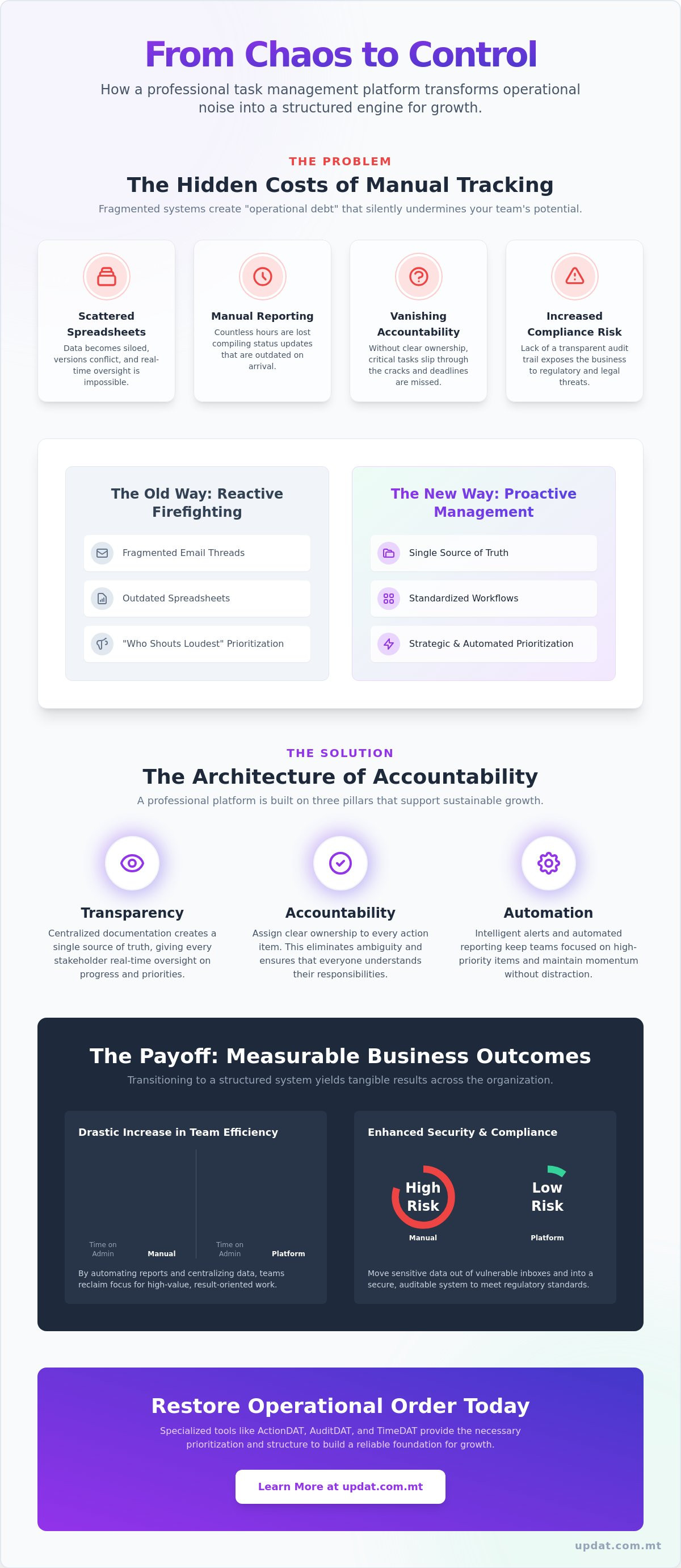
Operational leadership often mistakes task tracking for a personal productivity habit. In a professional environment, a robust business task management platform serves as the structural foundation for your entire organization. It moves your team beyond the limitations of memory and the mess of fragmented email threads. When information lives in disparate places, you lose visibility. A centralized system creates a single source of truth. It ensures every stakeholder understands their responsibilities without the need for constant manual intervention.
Order isn't just about tidiness; it's about focus. When workflows are chaotic, team morale suffers. Employees spend more time figuring out what to do than actually doing the work. By establishing a digital architecture, you remove this cognitive load. You provide your team with the keys to master their own workspace. This clarity transforms the workplace from a site of reactive firefighting into an environment of high-level efficiency and calm authority.
The High Cost of Operational Cracks
Fragmented systems create what architects call operational debt. This is the cumulative cost of inefficient workflows that slow down your growth over time. While a basic spreadsheet might suffice for a solo founder, these tools typically fail once a team exceeds five members. Data becomes siloed. Versions conflict. Real-time oversight becomes impossible. These operational cracks lead to missed deadlines that damage client trust and risk regulatory non-compliance. Professional task management prevents these failures by providing a transparent, unalterable record of every moving part in your business.
Restoring Order Through Digital Transformation
True digital transformation replaces paper-based chaos with digital transparency. It isn't just about moving lists to a screen; it's about changing how work flows through your company. In a disorganized setting, teams often confuse "busy work" with "result-oriented movement." A dedicated business task management platform clarifies this distinction. It allows management to dictate how to prioritize work tasks based on strategic value rather than whoever shouts the loudest.
Eliminate manual reporting
Stop wasting hours compiling status updates.
Standardize workflows
Ensure every team member follows the same logic and quality standards.
Enhance accountability
Assign clear ownership to every action item.
Secure your data
Move sensitive operational details out of vulnerable email inboxes.
By implementing a structured system, you stop guessing and start measuring. This transition isn't just a software upgrade. It's a strategic move to secure the stability and scalability of your business for the long term. You aren't just buying a tool; you're building a reliable foundation for growth.
The Architecture of Accountability: Key Features of a Professional Platform
A professional business task management platform functions as the digital skeleton of an organization. It provides the rigid structure necessary to support heavy operational loads and complex team dynamics. Unlike basic to-do apps, these professional platforms focus on three core pillars: transparency, accountability, and automation. By centralizing every piece of documentation within the task environment, you eliminate the risk of lost information and miscommunication. This centralized approach ensures that every team member has access to the same "single source of truth" at all times.
Notifications play a vital role in this digital architecture. However, a professional platform avoids the "notification fatigue" common in consumer-grade applications. It uses intelligent alerts to keep team members focused on high-priority items. These alerts serve as precise triggers that maintain momentum without causing unnecessary distraction. When combined with centralized documentation, these features ensure that a team member has everything they need to complete a task the moment they receive an alert. You don't have to search through separate email chains or file servers to find critical instructions.
Real-Time Tracking and Transparency
Managers often lose significant time in status meetings just to understand where a project stands. Effective systems for tracking progress on team projects eliminate this administrative waste. They offer a live, 24/7 view of your operational environment. You gain the ability to use "drill-down" views, moving from broad company objectives to the most granular individual actions in seconds. This level of visibility is one of the primary benefits of project management software. It allows you to identify bottlenecks through visual cues, such as status heatmaps, before they impact your bottom line.
Automated Workflows and Reporting
Automation removes the friction of manual task delegation. Instead of manually assigning every follow-up, you can set triggers that move work through a predefined pipeline automatically. This maintains momentum even when leadership is focused on high-level strategy. These automated workflows also create comprehensive audit trails. In 2026, regulatory compliance requires this level of precision for many industries.
Automated reporting converts these activity logs into actionable data. It helps you make strategic decisions based on actual performance rather than intuition. You can see exactly where resources are over-allocated and where workflows need refinement. If you're ready to move beyond manual oversight, ActionDAT offers the specific architecture needed to synchronize your workflows and restore operational order.
Evaluating Platforms: Security, Scalability, and Regulatory Compliance
Selecting a business task management platform requires a shift in perspective. You aren't just choosing a user interface; you're selecting a partner for your data sovereignty and operational continuity. While many global tools offer attractive features, as noted in Forbes Advisor's guide to task management software, businesses operating within the EU must prioritize specific regulatory and security parameters. In 2026, security isn't a feature you add later. It's the foundation upon which your entire digital architecture rests.
Compliance with GDPR is no longer a selling point; it's the absolute baseline for any professional operation. Many off-the-shelf global tools provide general compliance but lack the specific nuances required for localized regulatory environments. A strategic architect looks for solutions that offer local data residency and clear, unalterable audit trails. This level of precision ensures that your business remains resilient in the face of increasing regulatory scrutiny.
Security as an Operational Foundation
Enterprise-grade security starts with ISO-certified hosting and end-to-end encrypted data transmission. These protocols ensure that your proprietary workflows and client data remain protected from external threats. Role-based access control (RBAC) further strengthens this by ensuring employees only access the information necessary for their specific functions. This granular control reduces internal risks and maintains strict data hygiene. Integrating these tasks with digital audit solutions creates a comprehensive safety net. It allows you to track not just what was done, but who accessed the data and when, ensuring total transparency for regulatory bodies.
Scalability and Local Support
Growth often exposes the limitations of generic software. A platform that works for ten users might become a bottleneck at fifty if it lacks the flexibility to adapt. This is where bespoke software development becomes a strategic advantage. Instead of forcing your business into a rigid, pre-defined box, you can evolve the platform to match your unique operational needs. You can integrate specialized modules like AuditDAT or TimeDAT to handle professional-grade tracking and compliance as your requirements shift.
For businesses in Malta, local expertise provides a significant edge during implementation. "Malta-aware" support teams understand the specific regulatory landscape and industry pain points of the region. They offer a level of responsiveness that global giants cannot match. This proximity reduces implementation friction and ensures that your system remains a steady, reliable foundation for long-term growth. You don't want to migrate your entire operational history every time your business model shifts; an adaptable, supported solution prevents that disruption.
Implementing Task Management: From Chaos to Synchronized Workflows
Transitioning from manual chaos to a synchronized digital environment requires more than a software installation. It demands a strategic shift in how your team perceives work. Many organizations fail during implementation because they treat the business task management platform as a simple digital filing cabinet. In reality, it's the architectural blueprint for your operations. Success depends on overcoming psychological objections and following a structured roadmap that prioritizes clarity over speed.
Employees often resist new systems because they fear micromanagement or added complexity. You must reframe the conversation. Explain that a professional platform doesn't monitor people; it monitors processes. It removes the burden of manual reporting and gives individuals the autonomy to manage their own workloads without constant interference. By positioning the software as a tool for empowerment rather than surveillance, you secure the buy-in necessary for long-term stability.
The crawl-walk-run approach prevents team burnout. Don't attempt to automate every complex workflow on day one. Start with the most critical, high-friction manual tasks. Once the team experiences the immediate relief of reduced administrative noise, they'll naturally seek to expand the system's utility. This gradual integration ensures that the platform becomes a steady foundation rather than a disruptive burden.
The Implementation Roadmap
Begin by auditing your existing manual processes to identify high-friction points where data is frequently lost. Map these workflows directly to the digital architecture of your business task management platform, ensuring each step has a clear owner. Finally, train your staff on the principles of digital accountability. Focus on the "why" behind the system, emphasizing how it protects their time and ensures their contributions are visible and valued.
Ensuring Long-Term Adoption
Successful implementation requires "process champions" within your organization. These are internal advocates who lead by example and help colleagues master the new system. Focus on streamlining business operations with software rather than simply adding another layer of digital tools. Establish feedback loops to refine task structures over time, ensuring the system evolves alongside your business. This turns the software from a mere tool into a core part of your operational culture.
If you're ready to transform your operational chaos into a structured digital architecture, ActionDAT provides the professional framework needed to achieve lasting order and accountability.
ActionDAT: The Result-Oriented Platform for Maltese Business Excellence
ActionDAT represents the definitive evolution of the business task management platform for the Maltese market. While global tools offer generic features, ActionDAT is engineered for the specific complexities of professional environments that demand precision. It acts as the anchor for your operational structure, ensuring that strategic goals translate into daily execution. By integrating seamlessly with AuditDAT for regulatory compliance and TimeDAT for resource oversight, it provides a comprehensive ecosystem for total business control.
If your operational requirements extend beyond standard functionality, UPDAT’s bespoke software development ensures your business task management platform remains perfectly aligned with your growth. You don't have to compromise your workflows to fit a software’s limitations. Instead, the platform adapts to your unique business logic, providing a steady foundation that evolves as you do. This adaptability ensures that your digital architecture remains a strategic asset rather than a technical burden.
Precision Task Tracking with ActionDAT
ActionDAT utilizes a "calm authority" user interface designed to reduce cognitive load and enhance focus. It eliminates the noise of traditional task lists, presenting information in a structured, digestible format. Specific features, such as automated follow-up triggers and priority heatmaps, stop critical tasks from falling through the cracks. The platform’s reporting engine provides managers with high-level efficiency, delivering data-driven insights into team performance without the need for manual data entry or constant status meetings.
The UPDAT Advantage
Choosing ActionDAT means partnering with a national software leader that understands the nuances of the local business landscape. You gain the peace of mind that comes from local implementation and support. There are no time-zone delays or generic helpdesk responses. UPDAT provides a direct line to experts who ensure your transition from chaos to synchronized workflows is seamless and sustainable. This local presence is vital for businesses that require immediate accountability and professional-grade reliability.
Experience the tangible impact of a well-organized system. We invite you to master your operational environment and restore order to your team. Contact UPDAT today for a personalized demo of ActionDAT and discover how a structured digital architecture can drive your business excellence.
Architecture for Operational Excellence
Restoring order to your business requires a transition from reactive lists to a structured digital architecture. A professional business task management platform provides the transparency and accountability necessary to scale without losing control. By centralizing documentation and automating workflows, you remove the complexity that hinders growth and team focus. This shift ensures every team member understands their role within a single source of truth, allowing you to lead with calm authority.
Founded in 2019, UPDAT serves as a strategic partner for the Maltese hospitality and manufacturing sectors. We provide national support and bespoke development options that global tools often lack. It's time to move beyond fragmented systems and embrace a foundation built for precision and long-term stability. You now have the blueprint to transform your operational environment into a high-efficiency engine. Master your operational environment with ActionDAT and experience the clarity of a truly synchronized workplace. Your journey toward operational mastery starts with a single, structured step.
Frequently Asked Questions
What is the difference between a task manager and a business task management platform?
A business task management platform provides an organizational architecture that personal task managers lack. It centralizes workflows and documentation into a single source of truth for the entire company. While individual apps focus on personal productivity, professional platforms emphasize managerial oversight, resource allocation, and team-wide transparency. This structural difference ensures that tasks move from individual checkboxes to strategic business assets.
How does a task management platform improve team accountability?
These platforms improve accountability by assigning clear, unalterable ownership to every action item. Managers gain a live view of progress, which eliminates the ambiguity often found in email chains or verbal updates. Automated notifications ensure that deadlines remain visible. This transparency fosters a culture of responsibility where every team member understands their specific contribution to the organization's goals.
Is it difficult to migrate from spreadsheets to a digital platform like ActionDAT?
Transitioning from spreadsheets to ActionDAT is a structured process designed to minimize operational downtime. The implementation roadmap uses a phased approach, auditing existing processes before mapping them to the digital architecture. Local support in Malta ensures that your team receives direct guidance during the migration. This methodology prevents the confusion and data loss often associated with rapid software adoption.
Can ActionDAT be customized to fit specific industry workflows in Malta?
ActionDAT is highly adaptable and can be tailored to the unique workflows of Maltese businesses through bespoke software development. It already serves the specific needs of the local hospitality and manufacturing sectors. Whether you require specialized reporting or unique data fields, the platform evolves to match your operational logic. You don't have to change your business to fit the software; the software adapts to you.
How does task management software help with regulatory compliance?
Task management software ensures regulatory compliance by creating comprehensive, unalterable audit trails. It records who performed a task, when it was completed, and what documentation was attached. Integrating ActionDAT with AuditDAT provides an extra layer of security for industries under heavy scrutiny. This centralized record-keeping simplifies the audit process and reduces the risk of non-compliance penalties.
What security standards should a business task management platform meet in 2026?
In 2026, a professional platform must utilize ISO-certified hosting and end-to-end encrypted data transmission. Role-based access control (RBAC) is also essential to ensure that sensitive data is only accessible to authorized personnel. GDPR compliance remains the absolute baseline for protecting data sovereignty. These standards provide a reliable foundation for long-term growth and protect your business from internal and external security threats.
Does ActionDAT support collaborative work for remote or hybrid teams?
ActionDAT fully supports collaborative work for remote and hybrid teams through its cloud-based architecture. It provides real-time updates that ensure every team member stays synchronized regardless of their physical location. Centralized documentation and automated notifications keep communication fluid and transparent. This accessibility allows distributed teams to maintain high-level efficiency without the need for constant, manual status updates.






%201.svg)
