
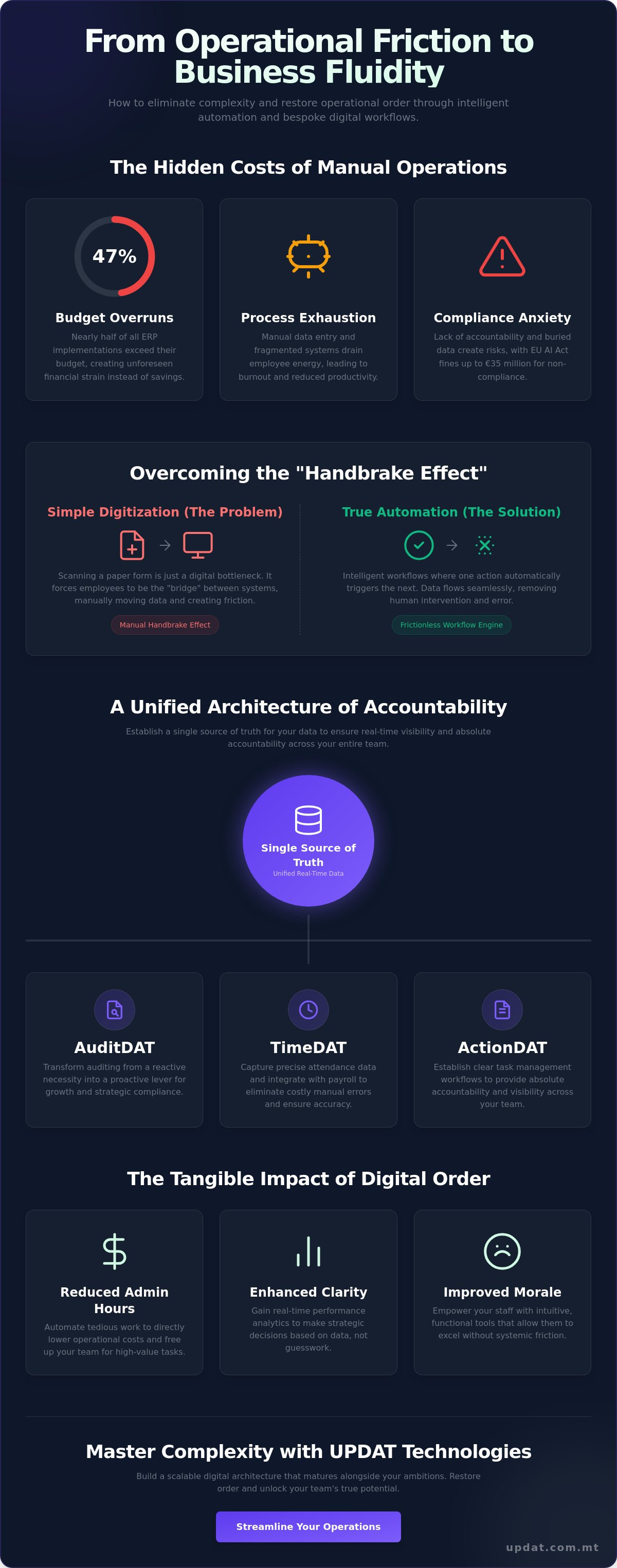
What if the tools you bought to save time are actually the primary source of your operational friction? With 47% of ERP implementations exceeding their budgets, many leaders find that streamlining business operations with software feels like managing a new set of problems rather than solving old ones. You've likely felt the exhaustion of manual data entry or the quiet anxiety of an upcoming audit. It's difficult to maintain accountability when tasks are buried in spreadsheets and compliance feels like a moving target, especially with the EU AI Act's potential fines of up to €35 million for non-compliance.
We agree that your time is too valuable for administrative clutter. This strategic guide shows you how to eliminate complexity and restore operational order through intelligent automation and bespoke digital workflows. You'll learn how to transition from fragmented processes to a centralized architecture of accountability. We'll explore how tools like AuditDAT, TimeDAT, and ActionDAT provide real-time visibility into your performance, reduce payroll errors, and ensure you remain on the right side of evolving regulations in the Maltese market and beyond.
Key Takeaways
• Differentiate between simple digitization and true automation to remove the manual handbrake effect from your core workflows.
• Discover how streamlining business operations with software transforms auditing from a reactive necessity into a proactive lever for growth.
• Identify high-friction manual processes through a structured audit to target measurable reductions in administrative overhead and payroll errors.
• Establish a single source of truth for your data to ensure real-time visibility and absolute accountability across your entire team.
• Build a scalable digital architecture using a unified ecosystem of tools for audits, attendance tracking, and task management.
The Architecture of Efficiency: Defining Streamlined Operations
Streamlining is often reduced to simple "digitization," but it's actually the deliberate removal of digital and physical friction from your core workflows. For many Maltese enterprises, the biggest obstacle to growth is the "handbrake effect." This occurs when manual data entry and paper-based tracking create a constant drag on every department. It's the difference between a business that reacts to daily crises and one that operates with calm, strategic foresight.
When you're streamlining business operations with software, you're replacing fragmented legacy systems with integrated, cloud-based environments. Legacy systems often require employees to act as the "bridge" between software programs, manually copying data from one screen to another. This is a waste of human potential. By adopting principles found in Business Process Management, you create a system where data flows automatically. Rather than forcing your business to fit a rigid template, bespoke software development allows the technology to mirror your unique operational DNA. Operational streamlining is the strategic alignment of software and human effort.
This process isn't a "set and forget" task. It's a continuous strategic necessity that requires regular refinement to stay ahead of competitors. As your team expands and new compliance requirements emerge, your digital architecture must evolve to maintain its efficiency. Streamlining business operations with software ensures that your infrastructure matures alongside your ambitions.
Recognizing the Signs of Operational Stagnation
Operational stagnation is often invisible until it impacts your bottom line. You might notice persistent delays in reporting, where data retrieval takes days instead of seconds. High error rates in payroll and attendance tracking are also red flags, usually caused by manual intervention in the data chain. In the MT market, even minor payroll discrepancies can lead to significant administrative friction and employee dissatisfaction. Finally, monitor your team's energy. Team burnout is frequently caused by tedious administrative "busywork" that prevents them from focusing on their core, high-value tasks.
The Tangible Impact of Digital Order
Establishing digital order yields immediate, measurable results that empower your entire organization. First, you'll see a reduction in administrative hours, which directly lowers your operational costs. Second, leadership gains enhanced clarity. Real-time performance analytics mean you no longer have to guess about your company's health or wait for end-of-month reports. Finally, it improves employee morale. Staff feel empowered when they have intuitive, functional tools like TimeDAT or ActionDAT that allow them to do their jobs without fighting against a broken system.
Core Mechanics: How Software Automates Business Fluidity
True operational efficiency requires a shift from simple digitization to active automation. Many organizations mistake scanning a paper form for a digital breakthrough. In reality, that's just a digital version of a manual bottleneck. Streamlining business operations with software involves creating intelligent workflows where one action triggers the next without human intervention. This shift is a cornerstone of modern digital transformation strategies that prioritize agility over static record-keeping.
Central to this architecture is the "Single Source of Truth." When your audit data, attendance logs, and task lists live in isolated silos, errors are inevitable. Streamlining business operations with software ensures a unified system where every department looks at the same real-time data. This clarity is especially vital for businesses operating across multiple sites or managing remote teams. Cloud-based accessibility allows managers to oversee operations from any location. A decision made in a central office is instantly reflected in a remote warehouse or another branch location. Mobile-first tools further empower field staff, allowing them to complete inspections or log time without returning to a central office.
Workforce Management and Automated Payroll
Managing a workforce manually is an invitation for complexity. Automated roster management eliminates the "handbrake" of scheduling conflicts and accidental overstaffing. By moving away from manual punch cards to digital attendance tracking via TimeDAT, you capture precise data at the point of entry. Integrating this time-tracking data directly into your payroll system removes the risk of manual transcription errors. This ensures your team is paid accurately and on time, which is essential for maintaining stability in a competitive labor market.
Task Prioritization and Team Accountability
Email threads are where accountability goes to die. Centralizing task management through ActionDAT moves your team from reactive communication to proactive execution. Every action item is assigned, tracked, and logged within a digital audit trail. This transparency ensures that complex projects don't develop "cracks" where tasks are forgotten. Automated reminders and status updates keep everyone aligned without the need for constant follow-up meetings. If your current systems feel fragmented, exploring bespoke software development can help you build the specific digital architecture your business requires to scale.
Strategic Compliance: Auditing as a Lever for Growth
Compliance shouldn't be a reactive burden that slows your momentum. When viewed through the lens of efficiency, auditing becomes a powerful tool for maintaining professional order. Streamlining business operations with software allows you to move away from the anxiety of manual record-keeping toward a proactive stance. By utilizing automated inspections through AuditDAT, you significantly reduce the risk of regulatory fines that often stem from simple human oversight. A paperless audit system is the foundation of modern risk management.
The most immediate benefit of this transition is speed. Traditional paper audits often require days of manual collation and data entry before a report is even visible to leadership. Digital systems generate these reports instantly. This immediacy is bolstered by concrete evidence; photographic attachments and GPS tagging provide an indisputable record of when and where an inspection occurred. Streamlining business operations with software ensures that your data isn't just fast, it's verifiable. This level of transparency builds immediate credibility with both internal stakeholders and external regulators.
High-Stakes Compliance in Hospitality and Manufacturing
In sectors like hospitality and manufacturing, the margin for error is non-existent. Automating HACCP and food safety checks ensures your team is 24/7 ready for a surprise inspection by Maltese health authorities. Digital checklists standardize quality control on the factory floor, ensuring every product meets your exact specifications. You can maintain this consistency across multiple locations without needing a physical supervisor at every site. The software acts as your eyes and ears, enforcing standards through digital accountability.
The Power of Automated Reporting
Raw inspection data is only valuable if it leads to better decisions. Automated reporting transforms these data points into actionable business intelligence. Instead of filing away a completed form, the system analyzes it to identify recurring bottlenecks before they escalate into crises. If a specific safety check fails consistently in one department, the software flags the trend for immediate intervention. You can then use these digital audit trails to prove your compliance history to regulators effortlessly, turning a complex legal requirement into a simple, automated process.
The Roadmap to Implementation: A 2026 Strategic Plan
Transitioning to a digital architecture requires a surgical approach rather than a broad overhaul. To avoid the common pitfall of budget overruns, which impact nearly 47% of ERP implementations, you must begin with a cold assessment of your current state. Audit your manual processes to pinpoint exactly where the "handbrake effect" is most severe. Is it the three days your HR team spends on payroll reconciliation? Is it the lack of clear accountability in your field inspections? Once you've identified these friction points, define clear Key Performance Indicators (KPIs). Aim for measurable outcomes like a 30% reduction in administrative hours or a 100% digital completion rate for safety audits. Streamlining business operations with software is most effective when you have a defined target.
Success depends on user adoption. If a tool is difficult to use, your team will find workarounds that recreate the very silos you're trying to eliminate. Select software that prioritizes an intuitive user experience. This ensures that field staff and office managers alike can master the system quickly. To minimize disruption, execute a phased rollout rather than a company-wide "big bang" launch. This allows you to maintain daily operations in Malta while gradually shifting your workflows into a more organized, digital environment.
Assessment and Software Selection
Choosing between off-the-shelf SaaS platforms and bespoke software development depends on your unique operational DNA. While SaaS offers quick deployment, bespoke solutions allow you to build a system that mirrors your specific business logic. Prioritize integration capabilities above all else. Your new tools must communicate seamlessly with your existing accounting or CRM software to maintain a single source of truth. Before signing any contracts, conduct "stress tests" using real-world scenarios from your busiest season. This ensures the architecture can handle the actual pressure of your daily business requirements.
Phased Migration and Training
Start your implementation with a pilot department. This small-scale launch allows you to identify and resolve technical hurdles before a company-wide rollout. Identify "internal champions" within this group. These are tech-savvy team members who can advocate for the software and provide peer-to-peer support. Once the pilot is successful, move to a phased implementation across the rest of the organization. Use the software's own analytics to monitor adoption rates and refine the new workflows in real time. If you're ready to build a more resilient digital foundation, consult with an operational architect at UPDAT to explore your options.
Mastering Complexity with UPDAT Technologies
UPDAT Technologies Ltd. serves as the strategic architect for Maltese enterprises seeking to eliminate operational friction. We don't offer generic fixes. Instead, we provide a structured digital environment designed to restore professional order. Streamlining business operations with software requires more than just code; it requires an understanding of how your team moves and how your data flows. Our ecosystem, comprising AuditDAT, TimeDAT, and ActionDAT, works as a unified solution to replace fragmented manual processes with a centralized digital architecture.
Choosing a national partner for your digital transformation provides a distinct advantage. We understand the specific regulatory landscape in Malta and the operational challenges unique to our local market. Our approach is strictly results-oriented and no-nonsense. We focus on delivering tangible impact, ensuring your software investment translates into reduced administrative overhead and improved accountability. By working with a local team, you gain a partner that is accessible and deeply invested in the stability of your long-term growth.
SaaS Excellence vs. Bespoke Innovation
AuditDAT and TimeDAT provide rapid, high-impact deployment for businesses needing immediate order in their inspections and attendance tracking. These tools are built for speed and ease of use, allowing for a quick transition away from paper-based systems. However, we recognize that some organizations possess highly specific operational logic that standard platforms cannot accommodate. This is where our bespoke software development comes in. We build custom solutions that mirror your unique business architecture, ensuring your technology adapts to you, not the other way around. This flexibility provides the steady foundation necessary for scaling in a competitive environment.
The Future of Your Operations
The journey from administrative chaos to digital mastery begins with a single strategic decision. You've identified the signs of stagnation and the "handbrake effect" of manual tracking. Now, you have the keys to master your own operational environment. We invite you to a consultation to map your specific path toward efficiency. We'll help you identify your highest friction points and design a system that removes them permanently. Transitioning to a streamlined digital workflow isn't just about speed; it's about building a business that is resilient, compliant, and ready for the future.
Streamline your operations today with UPDAT Technologies Ltd.
Securing Long-Term Operational Stability
The transition from administrative friction to digital fluidity is a strategic necessity. You now understand that true efficiency requires more than just scanning paper; it demands a unified architecture where data flows automatically. By integrating proprietary platforms like AuditDAT, TimeDAT, and ActionDAT, you replace manual bottlenecks with a single source of truth. Since 2019, UPDAT has focused on delivering this level of operational excellence to the Maltese market, specifically within the high-stakes hospitality, manufacturing, and security sectors.
Streamlining business operations with software ensures your organization remains adaptable to evolving regulations and market demands. This guide has provided the roadmap for a phased, user-centric implementation that minimizes disruption while maximizing accountability. You have the tools to remove complexity and restore professional order to your workflows.
Restore order to your business operations; contact UPDAT today
Your path to a more organized, resilient business starts with a single digital shift.
Frequently Asked Questions
What does streamlining business operations actually mean in 2026?
Streamlining business operations with software in 2026 means building an integrated digital architecture that removes manual friction from every workflow. It's no longer just about scanning documents; it's about creating a system where one action automatically triggers the next. This approach ensures that your data remains fluid and your team stays focused on high-value strategic tasks rather than repetitive administrative entry. It's the restoration of professional order through intelligent automation.
How much time can a business realistically save by automating manual tasks?
Businesses often target a 30% reduction in administrative time through effective automation. By eliminating manual data transcription and paper-based tracking, you reclaim hours previously lost to "busywork." This reclaimed time allows leadership to focus on growth initiatives rather than daily fires. The actual savings depend on your starting point, but moving to an automated environment typically results in immediate improvements in reporting speed and data accuracy.
Should I choose bespoke software or an off-the-shelf SaaS platform?
Choose a SaaS platform like AuditDAT or TimeDAT if you need rapid deployment and standardized operational order. These tools offer immediate utility for common business functions. If your organization has unique, industry-specific logic that standard tools can't handle, bespoke software development is the superior choice. This ensures your digital architecture mirrors your specific business DNA rather than forcing you to adapt your workflows to a rigid, pre-built template.
How does digital auditing software improve regulatory compliance?
Digital auditing software improves compliance by creating an indisputable, real-time audit trail of all inspections and safety checks. Tools like AuditDAT ensure your business is 24/7 ready for surprise inspections from Maltese authorities. By using GPS tagging and photographic evidence, you provide regulators with verifiable proof of compliance history. This proactive approach significantly reduces the risk of human error and the potential for heavy regulatory fines often associated with manual record-keeping.
Will streamlining my operations disrupt my current business workflow?
Streamlining business operations with software shouldn't disrupt your daily activities if you follow a phased implementation strategy. By starting with a pilot department, you can refine the digital workflow before a company-wide launch. This modular approach allows your team to adapt gradually to new systems without stopping production. Proper planning and the use of intuitive, user-centric tools ensure that the transition enhances your productivity rather than causing unnecessary operational downtime.
How does software improve team accountability and task management?
Software like ActionDAT improves accountability by centralizing all tasks in a transparent digital environment. Every action item is assigned to a specific owner with a clear deadline and a visible status update. This eliminates the confusion often found in long email threads or verbal instructions. Automated reminders ensure that nothing falls through the cracks, while digital logs provide leadership with clear visibility into individual performance and overall team momentum.
What is the first step in digitizing a paper-based business?
The first step is conducting a thorough audit of your current manual processes to identify the highest friction points. You must pinpoint exactly where paper-based tracking is causing delays, data silos, or recurring errors. Once these bottlenecks are identified, you can select a specific tool like TimeDAT or AuditDAT to digitize that single workflow. Success in one department builds the confidence and momentum needed for a full digital transformation across the organization.
How can workforce management software reduce my administrative overhead?
Workforce management software reduces overhead by automating roster creation and attendance tracking. Using a tool like TimeDAT eliminates the need for manual punch card reconciliation and transcription into payroll systems. This automation removes the risk of costly payroll errors and significantly reduces the hours HR staff spend on administrative tasks. It provides a steady, reliable foundation for managing your team across multiple sites while ensuring you remain compliant with local labor regulations.






%201.svg)
