

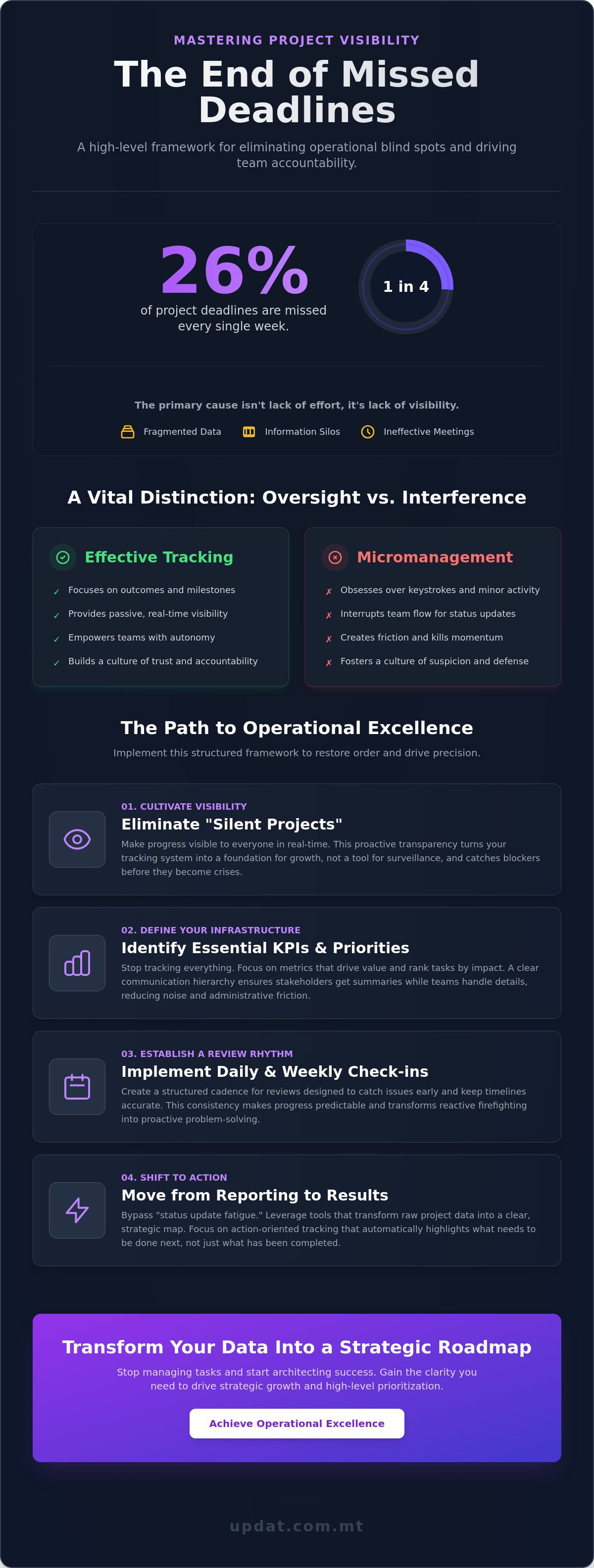
Recent data confirms that 26% of project deadlines are missed every single week. This failure rarely stems from a lack of effort. Instead, it's often the result of fragmented data and information silos that obscure the true status of your initiatives. Effectively tracking progress on team projects requires more than just a shared spreadsheet. It demands a strategic architecture that provides real-time visibility without the need for constant micromanagement or manual data entry.
You're likely exhausted by "status update" meetings that consume your morning while offering very little actionable insight. It's a common frustration for leaders who want to focus on strategic growth but find themselves trapped in daily firefighting. We've designed this guide to help you master the art of project visibility through a professional, high-level framework. You'll learn how to implement the 2026 Operational Excellence Checklist to eliminate operational blind spots, drive team accountability, and ensure every milestone is met with precision.
Key Takeaways
• Understand why visibility is the heartbeat of operational health and how to eliminate the "silent projects" that derail budgets.
• Identify the essential KPIs and communication hierarchies needed for effective tracking progress on team projects without causing information overload.
• Implement a structured daily and weekly review rhythm designed to catch blockers early and keep timelines accurate.
• Learn to bypass the trap of "status update fatigue" by shifting from passive reporting to action-oriented results.
• Discover how leveraging tools like ActionDAT transforms raw project data into a clear map for strategic growth and high-level prioritization.
The Strategic Importance of Progress Visibility in 2026
Operational health relies on a steady flow of information. Think of progress tracking as the pulse of your business. Without it, you're operating in the dark. In 2026, the complexity of cross-departmental work means that tracking progress on team projects isn't a luxury; it's the foundational layer of your strategic architecture. When you can see the movement of every task, you can predict obstacles before they become crises. This level of clarity allows for the removal of complexity and the restoration of order across the entire organization.
Silent projects are the primary cause of missed deadlines. These are initiatives that appear to be moving forward but are actually stalled due to uncommunicated blockers. Lack of visibility creates a vacuum where small errors compound into systemic failures. Moving beyond static spreadsheets is essential. You need a digital environment that reflects the current reality of your workflow; it shouldn't be a snapshot from last week's meeting. Precise tracking progress on team projects ensures that these "silent" failures are caught before they impact the bottom line or the client relationship.
Transparency fosters a culture of empowerment rather than suspicion. When everyone can see the status of a project, there's no need for defensive reporting. Teams feel more confident when they know their hard work is visible and their blockers are recognized. This shift in perspective transforms the tracking system from a tool of surveillance into a steady foundation for long-term growth. It allows leaders to act as strategic architects rather than reactive firefighters. It hands the keys of operational mastery back to the people doing the work.
The Anatomy of a Transparent Project
Every action item requires a clear owner. Ambiguity is the enemy of momentum. Real-time data ensures that every team member understands their role within the larger framework. This is why streamlining business operations with software serves as the bedrock of modern tracking. It removes the guesswork and replaces it with verifiable facts that keep everyone aligned. High-level efficiency is only possible when the digital architecture supports immediate utility and movement.
Tracking vs. Micromanagement: A Vital Distinction
There's a vital distinction between oversight and interference. Effective tracking focuses on outcomes and milestones. It doesn't obsess over individual keystrokes or minute-by-minute activity. By adhering to core project management principles, leaders can establish systems that provide passive visibility. This means stakeholders can see progress through automated dashboards without interrupting the team's flow. It shifts the expectations toward autonomous progress reporting, where the system handles the heavy lifting of communication.
Defining Your Tracking Infrastructure
A tracking system only works if it's built on a foundation of relevant data. Many leaders fall into the trap of monitoring every minor activity, which creates administrative friction and hides actual results. To succeed at tracking progress on team projects, you must first identify the Key Performance Indicators that drive value. Establish a communication hierarchy that dictates who needs to know what, and when. This ensures that high-level stakeholders receive strategic summaries while project leads handle the granular details. A well-designed hierarchy reduces the noise and allows everyone to focus on their specific area of responsibility.
Effective tracking is impossible without clear priorities. If your team treats every task as urgent, your progress data will be skewed and misleading. Understanding how to prioritize work tasks is a prerequisite for accurate reporting. When you rank tasks by impact, your tracking infrastructure highlights the movement that actually matters. This alignment prevents the "busy work" trap and ensures that your resources are always directed toward high-value milestones. It turns a simple list of tasks into a strategic roadmap for success.
Selecting the Right Metrics for Your Industry
Metrics must be tailored to your specific operational environment. In manufacturing, you might prioritize time-to-completion and defect rates to ensure efficiency. In the hospitality or security sectors, compliance milestones and response times are the critical markers of health. Tracking budget burn rates and resource allocation provides a broader view of project sustainability. Using specialized project tracking and evaluation tools allows you to visualize these metrics without the overwhelming complexity of traditional Gantt charts. Focus on the data that triggers action rather than just observation.
Building the Digital Architecture
Centralizing your project data is the only way to eliminate information silos. When data lives in disparate emails and messaging apps, it becomes impossible to maintain a single source of truth. Your digital architecture should be accessible and intuitive. For field-based teams in security or facilities management, mobile accessibility is non-negotiable. Real-time updates from the site ensure that the office has an accurate view of progress. It allows for immediate intervention if a project veers off course. If your current systems feel fragmented, bespoke software development can bridge the gaps and create a unified operational environment that scales with your growth.
The Essential Progress Tracking Checklist for Team Leads
Operational excellence is built on a foundation of consistency. While software provides the digital architecture, your managerial rituals drive the actual results. Tracking progress on team projects requires a structured cadence that identifies issues before they become systemic failures. Use the following checklist to maintain a clear, birds-eye view of your operations throughout 2026. This framework ensures that your tracking remains a strategic asset rather than an administrative burden.
Daily
Perform a 5-minute "Blocker Check." Identify stalled tasks and clear the path for your team.
Weekly
Conduct a "Milestone Review." Recalibrate timelines based on real-time data and adjust resource allocation.
Monthly
Execute an "Operational Audit." Look for recurring bottlenecks and use data from AuditDAT to pinpoint workflow inefficiencies.
Quarterly
Review "Strategic Alignment." Ensure every active project still serves the primary business objectives for the year.
Post-Project
Host a "Retrospective." Refine your tracking framework by analyzing where visibility was lost or data was inaccurate.
Daily Rituals for Maximum Momentum
Momentum is fragile. It breaks when team members spend hours waiting for approvals or clarification. Review high-priority action items every morning to ensure the most critical work moves first. Identify and remove bottlenecks before they escalate into project-wide delays. It's also vital to verify that your time-tracking data in TimeDAT aligns with actual task completion. If a task takes 30% longer than estimated, investigate the cause immediately. This proactive approach prevents small delays from cascading into missed deadlines. It turns tracking from a passive observation into an active tool for project health.
Weekly and Monthly Governance
Shift your focus from "what happened" to "what is next" during your progress meetings. Use important project tracking metrics to provide stakeholders with objective, data-driven updates. Automated reporting reduces the administrative burden and eliminates the risk of human error in data entry. A monthly audit is your opportunity to step back from the daily grind. Use this time to identify systemic bottlenecks that a weekly review might miss. If three different projects are stalled at the same approval stage, you've found a process failure. Regular governance ensures that tracking progress on team projects stays accurate and actionable. It provides a steady, reliable foundation for long-term growth and keeps the entire organization focused on strategic execution rather than daily firefighting.
Common Pitfalls: Why Progress Tracking Fails
Systems fail not because of a lack of intent, but because of poor design. Many leaders implement frameworks that are too complex for their teams to maintain. When a system requires more time to manage than the actual work takes to complete, adoption drops. Tracking progress on team projects becomes a burden instead of a benefit. This over-complication leads to "Status Update Fatigue," where team members provide vague or delayed information just to satisfy a requirement. Automation is the only cure. By using tools like ActionDAT to capture data passively, you remove the friction that kills momentum.
Inconsistent data entry creates the "Garbage In, Garbage Out" problem. If one department tracks milestones while another only logs hours, your birds-eye view becomes distorted. This fragmentation makes it impossible to link tracking with digital audit solutions. For industries in Malta that face heavy regulatory oversight, this gap is a significant risk. You cannot maintain compliance if your project data is siloed or incomplete. High-level efficiency requires a unified approach where every data point serves a dual purpose: project clarity and audit readiness.
The Human Element of Tracking Failure
Resistance to new digital workflows is often a symptom of poor training. Teams need to understand the "Why" behind the tracking, not just the "How." If they view the system as a tool for surveillance, they'll offer the bare minimum. Leadership must lead by example. If managers don't use the system to pull their own reports, the team won't value the data entry process. Clear communication shifts the perception of tracking from a chore to an empowering tool for autonomy. It provides the steady foundation your team needs to manage their own workloads effectively.
Technical and Process Bottlenecks
Off-the-shelf tools often fail to account for the unique operational landscape of Maltese businesses. You might find yourself juggling three different platforms to track time, compliance, and task progress. This fragmentation leads to technical bottlenecks and data loss. When generic software no longer fits your specific needs, custom software development in Malta offers a path to restoration. A bespoke solution ensures that your tracking infrastructure mirrors your actual workflow. It eliminates unnecessary features and focuses on the metrics that drive your strategic growth. Secure your operational future and eliminate information silos by integrating ActionDAT into your daily workflow today.
Action-Oriented Tracking: Transforming Data into Results
Data is useless if it doesn't trigger an immediate response. Conventional tracking often looks backward; it documents mistakes after they've already impacted your timeline. Action-oriented tracking reverses this flow. It shifts the focus from "what happened" to "what is next." By maintaining a forward-looking perspective, you transform tracking progress on team projects into a proactive engine for growth. This approach ensures that every data point captured leads directly to an operational decision, removing the lag between identifying a problem and implementing a solution.
Leveraging ActionDAT allows you to manage this transition with precision. It provides the high-level task prioritization needed to keep your team focused on the most impactful work. Instead of wading through a sea of status updates, you receive a clear view of which actions will move the needle today. Automating the reporting loop is the final step in this transformation. It saves dozens of administrative hours every month, allowing your leadership team to move away from spreadsheet maintenance and back toward strategic expansion. As your organization grows, your tracking system must adapt; a modular digital architecture ensures that increased complexity doesn't lead to decreased visibility.
The Power of ActionDAT for Team Progress
Clarity is the ultimate driver of accountability. ActionDAT visualizes task status through intuitive, no-nonsense dashboards that eliminate the need for interpretation. When every team member can see clear ownership and firm deadlines, the culture shifts toward results. The software integrates task tracking seamlessly with workforce and compliance modules, ensuring that progress never comes at the expense of regulatory standards. It provides a steady, reliable foundation for teams to operate with autonomy while keeping leadership fully informed. This level of transparency restores order to even the most complex multi-departmental initiatives.
Next Steps for Operational Mastery
Restoring operational health begins with an honest assessment of your current tools. Audit your existing tracking methods to identify where data is lost or where manual entry creates bottlenecks. Transitioning from fragmented spreadsheets to an automated platform is a strategic move that pays dividends in both time and accuracy. If your workflow involves unique challenges that off-the-shelf software cannot solve, it's time to seek a tailored approach. You can consult with our team of experts to design a bespoke tracking solution that aligns perfectly with your business goals. Start building a more resilient, visible, and efficient future for your team today.
Mastering Operational Order in 2026
Operational excellence isn't a static goal; it's a continuous process of refinement. You've learned that effective tracking progress on team projects requires more than just a list of tasks. It demands a strategic infrastructure that prioritizes high-level visibility and removes the friction of manual data entry. Transitioning from backward-looking reports to forward-looking action ensures that your team stays aligned with core business objectives. By implementing a structured ritual of daily checks and monthly audits, you move from reactive firefighting to proactive leadership.
Our Maltese expertise in complex sector automation ensures that your digital architecture is built for stability and compliance. We provide action-oriented software designed for high-level efficiency. ActionDAT offers seamless integration across our AuditDAT and TimeDAT platforms; this creates a unified source of truth for your entire organization. This connectivity eliminates information silos and restores order to your daily workflows. Discover how ActionDAT restores order to your team projects and empowers your team to focus on strategic growth. You have the framework to eliminate blind spots. Now, it's time to master your operational environment.
Frequently Asked Questions
What is the most effective way to track progress on team projects?
The most effective method involves utilizing a centralized digital architecture that provides real-time data visibility. This approach eliminates the information silos that typically occur when data is scattered across emails and messaging apps. By implementing a tool like ActionDAT, you create a single source of truth that allows all stakeholders to monitor status updates without manual intervention or constant meetings.
How do I track project progress without micromanaging my team?
You can avoid micromanagement by shifting to a system that provides passive visibility through automated dashboards. Instead of asking for constant updates, leaders can check the digital status of milestones at any time. This method respects the team's autonomy while ensuring that leadership remains informed about high-level progress. It fosters a culture of trust and focuses on outcomes rather than monitoring individual keystrokes.
What are the key metrics to track in a team project?
Focus on metrics that trigger strategic action, such as milestone completion rates, budget burn, and resource allocation. Effectively tracking progress on team projects requires monitoring the "time-to-completion" for critical path items. These data points allow you to identify systemic bottlenecks early. Avoid vanity metrics that don't contribute to the overall operational health or the restoration of order within your workflows.
Can I track progress on team projects using manual spreadsheets in 2026?
Manual spreadsheets are no longer viable for tracking progress on team projects in 2026 due to the high risk of version control errors and data silos. Static documents fail to provide the real-time insights needed for fast-paced operational environments. Transitioning to an automated platform ensures data integrity and allows for seamless integration with compliance modules, which is essential for maintaining long-term business stability.
How often should a project manager update the progress of a project?
Project managers should ensure that task status is updated in real-time through automated workflows. While the digital system captures daily movements, a formal recalibration of the timeline should occur weekly during milestone reviews. This cadence ensures that stakeholders have accurate information for decision-making without overwhelming the team with administrative reporting tasks. It keeps the communication flow fast-paced and modular.
What should I do if a team project is falling behind schedule?
Immediately conduct a "Blocker Check" to identify the specific cause of the delay. Use data from AuditDAT to determine if the issue is a resource shortage, a technical bottleneck, or a process failure. Once identified, re-prioritize the remaining tasks to focus on the critical path. This proactive intervention prevents small delays from cascading into a total project failure and restores momentum to the initiative.
How does digital task tracking improve team accountability?
Digital task tracking improves accountability by establishing clear ownership for every action item. When deadlines and responsibilities are visible to the entire team, there's no ambiguity regarding who's responsible for a specific result. This transparency encourages team members to manage their own workloads effectively. It ensures that every milestone is met with precision and that the team remains focused on high-level efficiency.
What is the difference between project tracking and time tracking?
Project tracking monitors the completion of specific tasks and milestones, while time tracking records the actual hours spent on those activities. Both are essential for operational mastery. Using TimeDAT in conjunction with your project framework allows you to compare estimated efforts against actual performance. This comparison is vital for refining future project timelines and improving the accuracy of your resource allocation.




%201.svg)
