

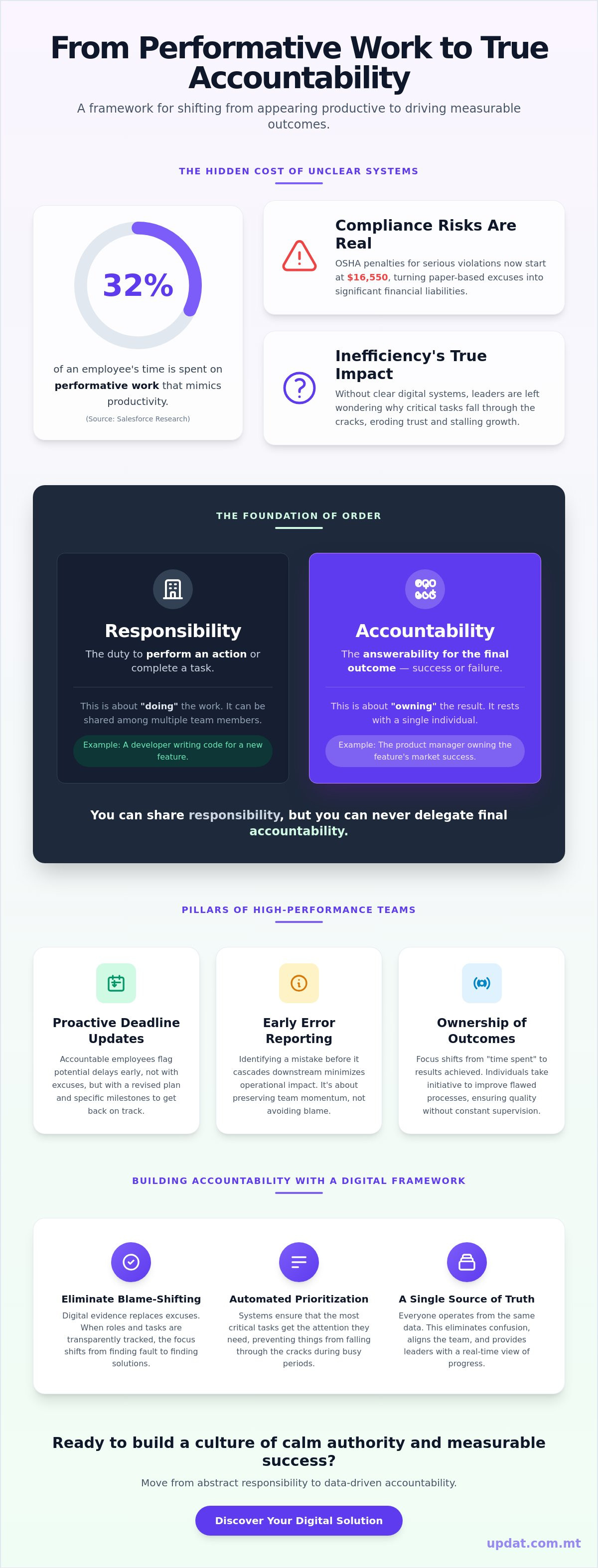
Salesforce research indicates that 32% of an employee's time is now spent on performative work that mimics productivity without advancing actual goals. This inefficiency often stems from a lack of clear systems, leaving leaders to wonder why critical tasks continue to fall through the cracks. When you manage hybrid teams, studying specific accountability in the workplace examples helps you bridge the gap between intent and execution. True accountability isn't about personality; it's an architectural choice that requires the right digital infrastructure to move from abstract responsibility to measurable success.
You likely understand the frustration of manual tracking and the compliance risks that follow, especially with OSHA penalties now starting at $16,550 for serious violations. This article promises to show you how to replace paper-based excuses with digital evidence and clear operational frameworks. We'll preview ten strategic examples that shift the focus from time-based metrics to verifiable outcomes. You'll discover how to implement systems like RACI to improve efficiency and restore a sense of calm authority to your daily operations.
What You Will Learn
• Master the critical distinction between responsibility and answerability to establish a foundation of operational order.
• Review high-performance accountability in the workplace examples, such as proactive deadline updates and early error reporting.
• Transition from subjective performance reviews to data-driven leadership by setting measurable KPIs and providing necessary success resources.
• Leverage ActionDAT to eliminate blame-shifting and ensure tasks never fall through the cracks via automated prioritization and a single source of truth.
Understanding Accountability: The Foundation of Operational Order
Accountability represents the obligation to account for one's actions and results. It's the invisible thread that holds a high-performance organization together. By examining the Foundational Principles of Accountability, we find it's more than just following rules; it's about the final answerability for an outcome. In many organizations, tasks fail because this answerability is obscured by complex hierarchies or vague directives. Establishing clear accountability in the workplace examples during the planning phase ensures every team member knows exactly where the buck stops. This clarity serves as the primary backbone for business process automation in Malta, where digital systems enforce the order that manual processes often lose. Transparency acts as the catalyst here. Without visible data, accountability remains an abstract concept rather than a functional reality.
Accountability vs. Responsibility
You can share responsibility, but you can never delegate final accountability. Responsibility is the duty to act or perform a task. Accountability is the answerability for the success or failure of that task. Modern agile teams often use the RACI model to clarify these roles. R stands for Responsible (the doers), A for Accountable (the owner), C for Consulted, and I for Informed. Consider a project manager responsible for maintaining a timeline. While they do the work, an executive remains accountable for the overall budget. If the timeline slips, the PM acts; if the budget fails, the executive answers for the strategic impact. This distinction prevents the "everyone is responsible, so no one is accountable" trap that stalls growth.
The Psychological Impact of Ownership
Clear ownership reduces workplace anxiety and decision fatigue. When employees understand exactly what they own, they don't waste energy guessing where their boundaries lie. This structure fosters a "no-blame" culture focused on solutions. Instead of shifting fault, teams look for fixes because the transparency of the system makes excuses impossible. High accountability directly correlates with employee retention. People want to work in environments where their contributions are visible and their roles are defined. It shifts the entire organization from a reactive "fix-it" mindset to a proactive "own-it" strategy. You move from managing daily crises to managing sustainable systems.
Individual Accountability Examples for High-Performance Teams
High-performance teams don't wait for a manager to spot a problem. They operate on a foundation where individual actions align directly with organizational goals. These accountability in the workplace examples demonstrate how personal ownership transforms daily operations from a series of tasks into a cohesive strategy. It starts with proactive communication. If a deadline is at risk, an accountable employee flags it early. They don't offer vague excuses; they offer a revised plan with specific milestones. Admitting errors early is another hallmark of a mature professional. By identifying a mistake before it cascades downstream, an employee minimizes operational impact and preserves the team's momentum. This proactive behavior is the antithesis of the "performative work" that Salesforce research suggests consumes 32% of an average employee's day.
Ownership of Outcomes, Not Just Hours
Moving beyond "putting in time" requires a shift toward outcome-based thinking. Consider an employee who identifies a potential compliance gap before an official audit occurs. They don't ignore the issue because it falls outside their immediate job description. Instead, they take initiative to improve the flawed process without being prompted. This proactive stance ensures that quality standards are met consistently without constant external supervision. Self-accountability is the internal drive to meet commitments regardless of oversight. It's about internal quality control. When individuals self-correct, they reduce the burden on leadership and create a more resilient business architecture. This is especially vital in sectors where OSHA violations now carry penalties of $16,550 per occurrence.
Effective Communication as an Accountability Tool
Communication is the mechanism that makes accountability visible across remote or hybrid environments. Status updates should never be mere formalities or lists of completed hours. Instead, they should focus on "blockers" and "solutions." This approach keeps the team moving forward rather than dwelling on why a task is stalled. Active listening also plays a critical role in this framework. Truly understanding delegated expectations prevents the costly rework that often follows miscommunication. Implementing a task tracking software for teams helps maintain this individual visibility. It provides a digital trail that replaces verbal ambiguity with objective data. To start building this level of transparency within your own team, you can register for a digital workspace account to begin centralizing your operational data and removing the friction of manual tracking.
Leadership Accountability: Setting the Standard for Excellence
Leadership accountability dictates the cultural ceiling of any organization. Vague directives like "improve performance" or "be more productive" breed operational chaos because they lack a measurable end state. Effective leaders replace these ambiguities with clear, measurable KPIs that define success in objective terms. This transition is one of the most critical accountability in the workplace examples, as it removes the subjectivity that often leads to friction during performance reviews. If a leader expects a specific outcome but fails to provide the necessary resources or training, the accountability for that failure rests at the top. True leadership involves holding consistent one-on-one reviews that prioritize data-driven results over gut feelings. When a strategy fails, the leader models the desired behavior by owning the failure publicly. This builds the psychological safety necessary for teams to take calculated risks and admit their own errors without fear of retribution.
The Manager as a Strategic Architect
Modern management requires a shift from "checking in" on people to "checking the system" they inhabit. High-level efficiency is only possible when the underlying architecture supports it. Utilizing workforce management software in Malta enables leaders to ensure fair workload distribution based on real-time data rather than assumptions. This transparency prevents burnout and demonstrates that the leader is committed to a balanced, high-functioning environment. When leadership follow-through is consistent, team morale stabilizes. Employees don't have to guess if their hard work is noticed or if the rules apply to everyone equally; the system provides the evidence.
Setting Expectations with Precision
Precision in delegation is a hallmark of an accountable leader. Many teams adopt the "Commander’s Intent" approach, which focuses on the desired end state of a project rather than a rigid list of steps. This allows staff to remain agile and use their expertise to solve problems as they arise. For every major project, a leader must define exactly what "done" looks like to prevent scope creep and wasted effort. Leaders can utilize TimeDAT to monitor attendance and performance trends objectively. This data isn't used for micromanagement; it's a diagnostic tool to identify where the system might be failing the person. By addressing these patterns early, leaders maintain the integrity of the operational environment and ensure that accountability remains a supportive framework for growth rather than a punitive one.
Operational and Compliance Accountability: A Digital Framework
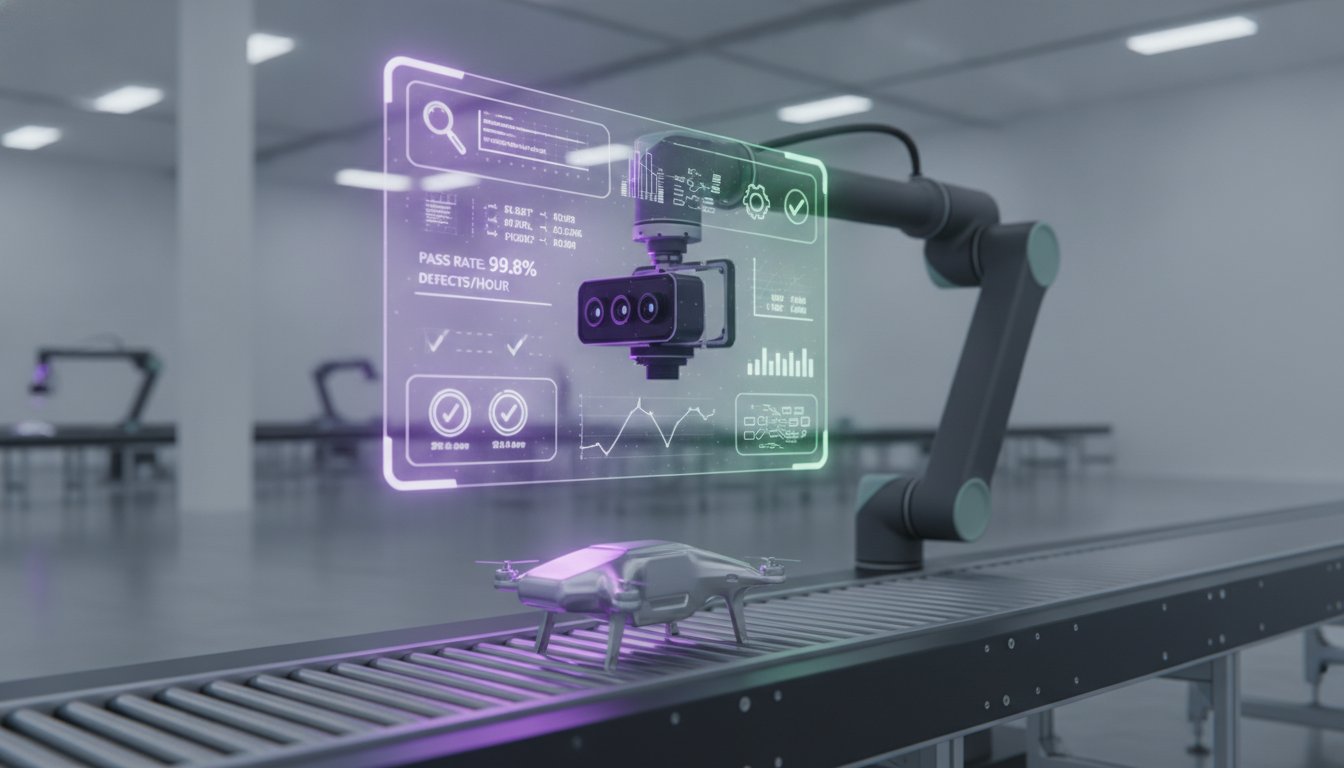
Operational accountability isn't a personality trait; it's a digital architecture. While many view accountability as a soft skill, high-stakes industries like manufacturing and hospitality treat it as a survival requirement. Implementing digital audit solutions removes the risk of human error by standardizing how data is captured and verified. These accountability in the workplace examples move beyond verbal promises into the category of tamper-proof, time-stamped records. Maintaining accurate logs provides the legal and financial protection necessary to navigate a 2026 regulatory environment where OSHA penalties for willful violations have reached $165,514. When systems automate the "who, what, and when," leaders can focus on the "why" and "how" of business growth.
Compliance in High-Stakes Industries
In the hospitality sector, food safety isn't optional. AuditDAT ensures HACCP compliance by replacing unreliable paper logs with real-time digital inspections. This shift represents one of the most effective accountability in the workplace examples for modern hospitality, as it ensures critical control points are monitored precisely when required. In Health & Safety contexts, accountability means ensuring every checklist is completed with integrity, not just checked off to meet a quota. Digital frameworks provide a single source of truth that manual systems can't replicate. They create a culture where compliance is a natural byproduct of the workflow rather than an administrative burden. This level of mastery over operational data allows for rapid adaptation when regulatory standards shift.
The Cost of Accountability Gaps
Administrative friction is a silent profit killer. Businesses often lose hundreds of hours annually chasing missing reports or verifying manual data entries. These gaps do more than just slow operations; they expose the organization to significant regulatory risk. Automated reporting protects the business by providing immediate visibility into compliance status. This links accountability directly to governance, risk, and compliance (GRC) strategies. By removing the ambiguity of manual record-keeping, you build a steady, reliable foundation for long-term expansion. Order is restored when the system itself enforces the standard. To secure your operational environment and eliminate the risk of human error, register for a digital audit account today and begin digitizing your compliance workflows.
Building a Systemic Culture of Accountability with UPDAT
Culture is the byproduct of the digital infrastructure your team utilizes every day. While many organizations rely on coaching to improve trust, true accountability requires a single source of truth that removes the possibility of blame-shifting. When every action is recorded and every priority is visible, excuses vanish. These systemic accountability in the workplace examples show that order is a choice made through software, not just a shift in mindset. Real-time analytics allow you to identify performance bottlenecks before they escalate into operational crises. By observing real-time accountability in the workplace examples through a digital lens, you can eliminate the friction of manual follow-ups. Partnering with UPDAT allows national businesses to move from fragmented manual workflows to a unified digital strategy that empowers every level of the organization.
ActionDAT: Task Tracking for Total Clarity
Transparency is the enemy of the "I didn't know" excuse. ActionDAT provides total clarity by centralizing task assignments and automating prioritization. This ensures that high-impact actions always receive the attention they require for business continuity. ActionDAT turns abstract goals into a sequenced list of accountable tasks. It replaces verbal ambiguity with documented digital handovers that leave no room for interpretation. Teams can monitor the progress of cross-departmental projects in a single view, identifying exactly which stages of a process are causing delays using objective data. This level of visibility fosters a sense of empowerment, as employees know their contributions are tracked and valued within a fair system.
• Eliminate the "lost in email" trap with centralized task ownership.
• Automate reminders for critical deadlines to maintain operational momentum.
• Review task completion history to identify training needs or process flaws.
The Path to Digital Transformation
Integrated systems consistently outperform siloed manual workflows because they provide a steady foundation for growth. Scaling accountability from a small department to a national enterprise is impossible without a digital architecture that adapts to your specific needs. This transformation replaces paper-based friction with high-level efficiency and calm authority. You move from a state of constant reaction to one of strategic mastery. The transition to a digital framework ensures that your business remains resilient in the face of shifting regulatory or market demands. To see how these systems can restore order to your specific environment, you may request a tailored demo to explore these tools in action.
Master Your Operational Architecture
Moving from abstract responsibility to measurable success requires more than just a change in mindset. It demands a digital infrastructure that enforces clarity and eliminates ambiguity. By implementing the accountability in the workplace examples discussed, you transition from managing daily crises to architecting a sustainable system of order. You've seen how individual ownership, leadership precision, and rigorous compliance frameworks protect your business from the rising costs of human error and regulatory penalties.
True operational excellence is within reach when you stop chasing reports and start trusting your data. AuditDAT provides 100% compliance transparency; ActionDAT ensures zero-crack task management; and TimeDAT delivers accurate workforce analytics. These tools empower you to lead with confidence and precision. It's time to replace paper-based excuses with a single source of truth that drives long-term growth.
Restore operational order and drive accountability with UPDAT. You've been handed the keys to master your own operational environment. Take the next step toward total clarity today.
Frequently Asked Questions
What are some common examples of accountability in the workplace?
Common accountability in the workplace examples include owning a budget variance during a quarterly review or proactively flagging a supply chain delay before it halts production. It also involves admitting a data entry error early to prevent downstream reporting issues. These actions prioritize the health of the system over personal ego. By taking ownership of these moments, employees demonstrate that they value organizational integrity over avoiding temporary discomfort.
How do you demonstrate accountability in a job interview?
Demonstrate accountability by using the STAR method to describe a specific professional failure. Focus on how you identified the error, took immediate ownership of the solution, and implemented a new process to ensure the mistake didn't happen again. Interviewers value the ability to self-correct without external pressure. Highlighting your commitment to the final result shows that you're a results-oriented professional who doesn't shy away from difficult conversations.
What is the difference between responsibility and accountability?
Responsibility is the obligation to perform a specific task or duty within your role. Accountability is the final answerability for the outcome of that task, whether it succeeds or fails. While you can share the responsibility for doing the work with a team, the accountability for the result rests with a single individual. This distinction ensures that someone is always looking at the big picture and the ultimate impact on the business.
How can managers improve team accountability without micromanaging?
Managers improve accountability by defining the desired end state rather than prescribing every specific step. Use digital dashboards to monitor project milestones in real time to maintain visibility. This allows you to step in only when data indicates a deviation from the plan, preserving employee autonomy while ensuring goals are met. Clear expectations combined with the right tools remove the need for constant, intrusive check-ins.
What are the consequences of a lack of accountability at work?
A lack of accountability leads to task duplication, eroded team trust, and significant financial leakage. Without clear ownership, critical compliance deadlines often pass unnoticed, exposing the firm to regulatory risk. This creates a reactive culture where leaders spend more time fixing past errors than architecting future growth. Eventually, high performers leave because they're tired of carrying the weight of unaddressed inefficiencies and broken systems.
Can software really improve workplace accountability?
Software improves accountability by providing an objective, time-stamped record of actions and decisions. It replaces verbal ambiguity with a single source of truth that everyone can access. When tasks are assigned and tracked digitally, the "I didn't know" excuse is eliminated, allowing teams to focus on execution. Automated systems ensure that every action is logged, making it easy to identify where processes are working or failing.
How do you hold someone accountable for a missed deadline?
Hold someone accountable by focusing on the systemic impact of the delay rather than placing personal blame. Review the digital trail to identify if the failure was due to a lack of resources, unclear expectations, or poor prioritization. Use the conversation to refine the workflow for future projects and ensure the individual understands their role in the broader success of the company. It's about solving the problem permanently.
What are some accountability examples for remote employees?
Remote accountability in the workplace examples include providing consistent status updates on project blockers and proactively notifying the team of shifts in availability. Accountable remote workers maintain high visibility through digital tools, ensuring their progress is measurable without the need for constant supervision. They treat digital communication as a primary professional duty. This proactive approach builds trust and ensures that distance doesn't become a barrier to operational excellence.





%201.svg)
