
Manual scheduling isn't just a tedious administrative chore; it's a structural vulnerability that threatens your compliance with the 2026 Maltese employment standards. You likely recognize the frustration of fixing roster errors that lead to staff shortages or spending days on manual payroll preparation. Implementing the right workforce management software in Malta is the only way to eliminate these inefficiencies and protect your business from regulatory risks under the latest legal updates.
This strategic guide shows you how to transition from administrative chaos to a structured, digital workforce architecture. You'll learn to master your operational environment and restore order to your daily workflows through high-level automation. We'll explore how to create error-free schedules, integrate payroll with precision, and maintain full compliance with the 2026 sectoral employment standards. You'll gain the tools to manage everything from the €213.54 weekly minimum wage requirements to the new transparency reporting obligations with absolute confidence. It's time to replace complexity with a steady, reliable foundation for your long-term growth.
Key Takeaways
• Understand the transition from manual rosters to a digital workforce architecture that restores organizational clarity.
• Identify the core pillars of roster management and task prioritization needed to stabilize sectors like hospitality and manufacturing.
• Resolve the SaaS versus bespoke software debate by choosing the solution that best fits your specific business model.
• Secure your operations by using workforce management software malta to automate DIER compliance and prevent costly legal disputes.
• Master your operational environment by integrating TimeDAT and ActionDAT as the dual engines of your digital infrastructure.
The Evolution of Workforce Management in Malta for 2026
Modern Workforce Management acts as a catalyst for restoring organizational clarity. It represents a fundamental shift from simply monitoring staff to building a digital architecture that supports sustainable growth. In Malta, the transition from paper-based rosters to digital systems is accelerating as business leaders recognize the inherent risks of manual coordination. Paper rosters aren't just outdated; they're a source of operational friction that leads to staff shortages, payroll errors, and compliance gaps. By adopting workforce management software malta, companies move beyond basic tracking and focus on creating a seamless operational flow that respects both the business's needs and the employee's time.
From Administrative Chaos to Operational Order
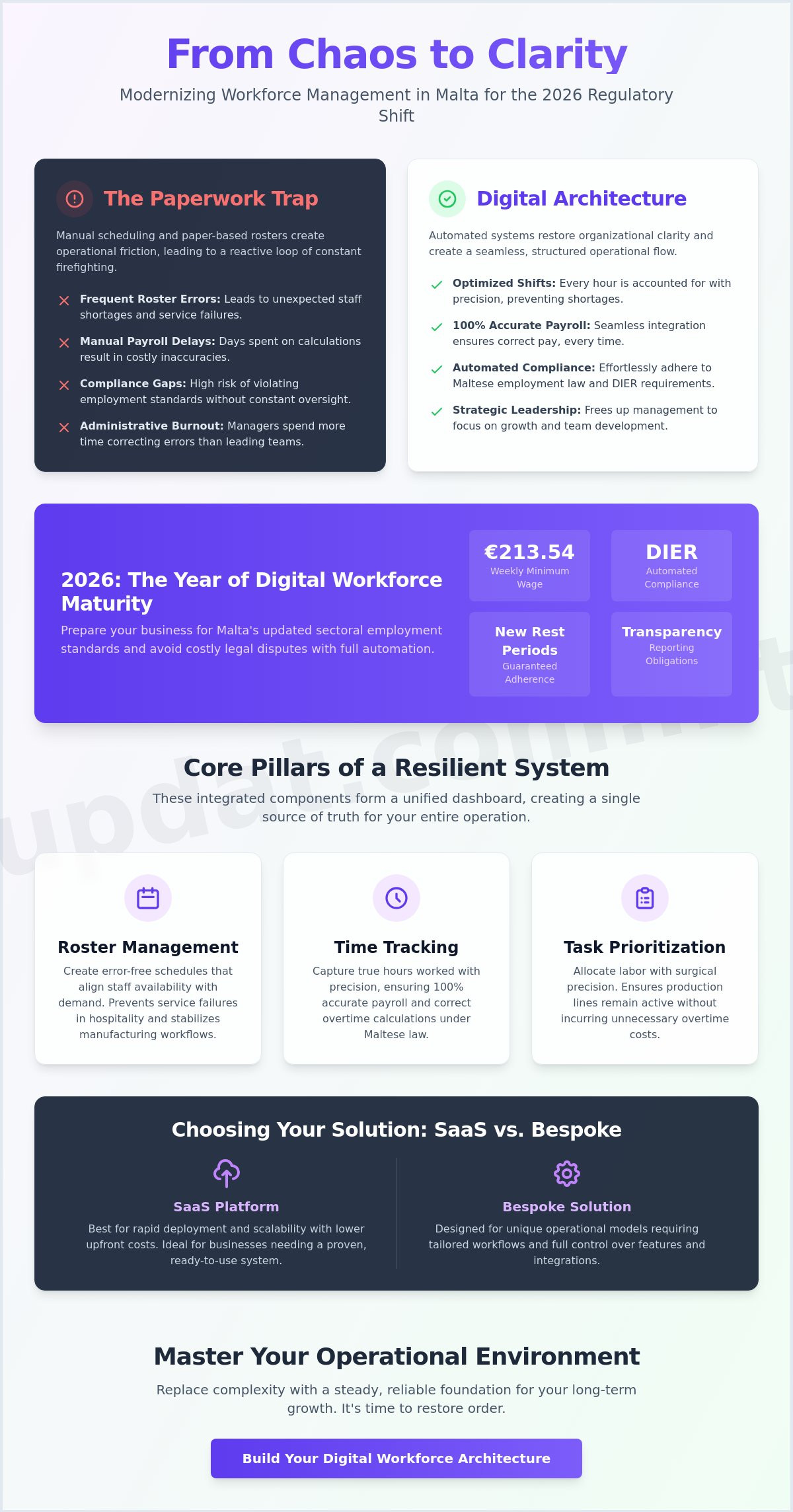
Maltese businesses often reach a breaking point when administrative overhead begins to stifle expansion. The common triggers for digital transformation include frequent roster disputes, manual payroll delays, and the difficulty of managing shift-based employees across multiple sites. This "paperwork trap" forces managers into a reactive loop of constant firefighting, where they spend more time correcting errors than leading their teams. Fluid, automated systems break this cycle. They empower you to act as a strategic architect for your business, replacing administrative chaos with a structured environment. Instead of reacting to staff shortages, you're designing a system where every shift is optimized and every hour is accounted for with precision.
Why 2026 is the Year of Digital Workforce Maturity
2026 represents the year of digital workforce maturity for the local market. The Maltese tech ecosystem has evolved to support sophisticated, cloud-based infrastructures that ensure long-term stability. Adopting operational excellence solutions is now a competitive necessity in a labor market with an unemployment rate below 3%. These platforms allow you to handle complex regulatory requirements, such as the 2026 sectoral employment standards overhaul, without manual intervention. Cloud-based tools provide a steady, reliable foundation, ensuring your business remains compliant with new weekly wage and rest period standards. This level of maturity allows you to scale operations without increasing the burden on your HR and finance departments.
Tracking is no longer the primary goal of professional management; operational fluidity is. In a high-efficiency environment, the focus shifts to how well the system supports the people doing the work. Automation reduces administrative overhead by handling the heavy lifting of payroll integration and compliance checks. This ensures that payroll is not just fast, but 100% accurate, reflecting the true hours worked and the premium rates required for overtime under Maltese law. It's about moving from a state of constant surveillance to one of total mastery over your operational environment.
Core Pillars of a Resilient Workforce Management System
Building a resilient business requires more than just hiring the right people; it demands a digital architecture that supports them. A truly effective system rests on three essential pillars: Roster Management, Time Tracking, and Task Prioritization. These components shouldn't exist in silos. Instead, they must feed into a unified dashboard that provides high-level visibility across your entire organization. By standardizing these digital workflows, you remove the unnecessary complexity that leads to administrative burnout and operational bottlenecks. This centralized approach ensures that your workforce management software malta becomes the single source of truth for your daily operations.
These pillars provide the stability needed to navigate the unique challenges of different industries. In hospitality, where demand fluctuates by the hour, having a clear view of staff availability prevents service failures. In manufacturing, precise labor allocation ensures that production lines remain active without incurring unnecessary overtime costs. When these systems are integrated, they create a fluid environment where labor meets demand with surgical precision. If you're ready to move beyond manual spreadsheets, you can establish your digital foundation here.
Automated Roster Management and Scheduling
Effective scheduling is about more than just filling slots on a calendar. You need to optimize staff scheduling to prevent gaps that lead to shortages or non-compliance. Automated systems allow for instant shift sharing and rapid replacement management. By automating these processes, you drastically reduce human error in complex shift patterns. This ensures rosters are balanced, compliant, and visible to the entire team in real time.
Attendance Tracking and Operational Precision
Operational order depends on transparency. Implementing accurate time tracking for employees is the most reliable way to eliminate payroll disputes. Digital timesheets provide an unalterable record required under Maltese employment law. For mobile workforces, biometric-free verification offers flexibility without hardware complexity. This precision ensures payroll is error-free and aligned with 2026 statutory standards.
Strategic Evaluation: Choosing Between SaaS and Bespoke Solutions
Business leaders often hesitate to adopt new systems because they fear their operational model is too unique for standard software. While many foundational needs are universal, the choice between a Software-as-a-Service (SaaS) platform and bespoke development is a critical strategic decision. You must determine whether your workflows can adapt to a pre-built tool or if your competitive advantage depends on a tool that adapts to you. Selecting the right workforce management software malta requires a cold, objective audit of your internal complexity and your long-term growth objectives.
The Utility of Ready-to-Use Platforms
Standardized platforms like TimeDAT offer immediate utility through rapid deployment and proven modules. These systems are ideal for businesses that prioritize cost-efficiency and want to restore order quickly without a lengthy development phase. Subscription-based tools provide a steady, reliable foundation for companies with straightforward shift patterns and standard payroll requirements. They allow you to implement professional-grade automation within days, ensuring your operations remain aligned with the standards set by the Department of Industrial and Employment Relations (DIER) without the overhead of custom engineering.
When to Invest in Bespoke Software Development
Off-the-shelf solutions eventually reach their limits when faced with highly specialized industry requirements. If your business involves complex multi-site coordination in security or specialized service level agreements in facilities management, a generic platform may create more friction than it removes. Bespoke software development allows you to build a custom digital architecture that mirrors your exact business logic. This investment transforms your software from a simple utility into a strategic asset that scales with your unique operational demands. It provides the mastery needed to handle intricate labor laws and sector-specific regulations that standard workforce management software malta might overlook.
Before choosing your path, audit your operations by asking these three questions:
• Do our shift patterns require manual intervention daily despite using basic tools?
• Are our payroll calculations hindered by non-standard allowances or complex overtime rules?
• Does our current software force us to change our proven business processes to "fit" the system?
If you answered yes to any of these, your business has likely outgrown standardized modules. Transitioning to custom architecture isn't just about adding features; it's about removing the final layers of administrative complexity that prevent your organization from reaching its full potential.
Navigating Compliance and Payroll Integration in Malta
Compliance in the Maltese labor market is a task of extreme precision. The 2026 overhaul of sectoral employment standards, enacted through Legal Notices 112 to 143, introduced rigorous requirements for weekly wages, rest periods, and leave allowances. Adhering to these Department of Industrial and Employment Relations (DIER) standards is no longer optional for businesses seeking operational stability. Using workforce management software malta ensures your organization remains on the right side of the law by automating the calculation of premium rates for overtime and night shifts. It provides a no-nonsense audit trail for every hour worked, which transforms potential legal disputes into simple data verifications. This level of transparency is essential for maintaining trust within a workforce that is increasingly mobile and diverse.
The introduction of the Equal Pay (Transparency and Reporting) Regulations in June 2026 adds another layer of complexity for employers with 100 or more workers. These regulations demand a data-driven approach to justify pay differentials and report on gender pay gaps. Digital systems capture the necessary data points automatically, ensuring you're prepared for these new reporting obligations without additional administrative burden. By moving away from manual tracking, you eliminate the risk of human error that often leads to compliance fines. If you're ready to secure your business against regulatory risks, you can automate your compliance and payroll integration today.
Ensuring Regulatory Compliance through Automation
Digital transformation acts as a shield against the rising tide of regulatory scrutiny. When you integrate AuditDAT and TimeDAT, you create a comprehensive compliance ecosystem that handles the heavy lifting of record-keeping. This synergy allows for total oversight of worker hours, ensuring that mandatory rest periods are respected and documented. During official inspections, having instant access to digital records is invaluable. It demonstrates a commitment to fair labor practices and ensures that health and safety documentation is always up to date. This structured approach prevents the chaos that typically follows a surprise audit.
Streamlining the Payroll Workflow
The journey from a digital timesheet to payroll-ready data should be seamless and invisible. Manual data entry remains the primary cause of payroll errors, which can lead to significant friction with employees who expect their €213.54 weekly minimum wage to be calculated with absolute accuracy. By leveraging employee productivity tracking software in Malta, you ensure every minute of labor is captured at the source. This data exports directly to your payroll system, accounting for the 10% social security contribution and the 0.3% maternity fund payment automatically. This restoration of administrative time allows your team to focus on high-value strategic growth rather than correcting tedious roster errors.
Restoring Operational Order with UPDAT’s Integrated Ecosystem
The transition from administrative chaos to a structured digital architecture requires more than just a collection of tools; it demands a unified ecosystem. Many businesses struggle with fragmented systems that don't communicate, creating new silos instead of removing old ones. By choosing a holistic workforce management software malta, you consolidate your operations under a single point of contact for software, support, and custom development. This integrated approach ensures that your data flows seamlessly from the initial roster to the final payroll export. It replaces the friction of manual coordination with a steady, reliable foundation designed for long-term growth.
Restoring order isn't a one-time event but an ongoing state of mastery. When your systems are aligned, you gain the clarity needed to make strategic decisions rather than reactive fixes. This digital infrastructure acts as the steady hand of a strategic architect, allowing you to scale your Maltese enterprise without the traditional growing pains of increased paperwork. You're not just buying a product; you're implementing a professional environment where efficiency is the standard and compliance is automatic. It's time to move beyond the limitations of basic tracking and command your operations with absolute precision.
TimeDAT for High-Level Workforce Efficiency
TimeDAT serves as the primary engine for your workforce efficiency. It handles the complexities of roster management and attendance tracking with a sense of calm authority. Managers who use the platform report a significant reduction in the mental load of scheduling, as the system identifies gaps and ensures compliance with 2026 standards before they become issues. Whether you're managing a small team or a large, multi-site enterprise, the system scales with you. It provides the high-level visibility required to maintain operational fluidity, ensuring that your labor resources are always where they're needed most.
ActionDAT for Collaborative Task Mastery
Operational "cracks" often appear when tasks are assigned but not tracked with accountability. ActionDAT closes these gaps by providing a structured environment for collaborative task mastery. It empowers your team through clear expectations and real-time progress updates, ensuring that every priority is met without the need for constant micromanagement. When paired with TimeDAT, it creates a dual-engine system that masters both time and output. This level of organization is what separates market leaders from those still trapped in administrative loops. We invite you to book a demo to see this architecture in action and discover how it can transform your business into a model of digital excellence.
Secure Your Strategic Architecture for Long-Term Growth
Transitioning from administrative chaos to a structured digital architecture is the most significant move you can make for your business in 2026. You've seen how a unified ecosystem eliminates roster errors and ensures total compliance with Maltese employment regulations. By integrating TimeDAT and ActionDAT, you replace reactive firefighting with the calm authority of a strategic architect. This restoration of order allows you to focus on high-level decision-making rather than manual data entry.
UPDAT has provided Maltese-founded expertise since 2019, offering specialized solutions for the hospitality, security, and manufacturing sectors. Implementing a robust workforce management software malta is the definitive way to stabilize your operations and scale your enterprise with confidence. Our integrated AuditDAT, TimeDAT, and ActionDAT ecosystem provides the steady foundation your organization needs to thrive in a mature digital economy. You've been handed the keys to master your own operational environment; it's time to put them to use.
You're now equipped to lead your team with precision, clarity, and professional mastery.
Frequently Asked Questions
What is the best workforce management software for Maltese businesses in 2026?
TimeDAT is the leading solution for businesses seeking operational order and digital clarity. It provides an integrated ecosystem that handles roster management, attendance tracking, and compliance checks within a single platform. This Maltese-founded expertise ensures the software aligns perfectly with local regulatory requirements and specific industry workflows. It offers a steady, reliable foundation for enterprises ready to scale their operations with professional precision.
How does workforce management software ensure compliance with Maltese employment law?
Digital systems automate the application of Legal Notices 112 to 143, which regulate weekly wages and rest periods. By using workforce management software malta, you ensure that overtime rates and night shift premiums are calculated accurately according to statutory requirements. This creates an unalterable audit trail that protects your business during DIER inspections and prevents costly legal disputes through transparent record-keeping.
Can workforce management software integrate with my existing payroll system?
Professional platforms facilitate seamless data exports to most major payroll systems used across the Maltese islands. This eliminates manual data entry and reduces the risk of human error during the preparation of monthly pay slips. The system automatically accounts for the 10% social security contributions and maternity fund payments based on the precise hours captured in digital timesheets.
Is bespoke software development better than a standard SaaS subscription?
SaaS platforms provide immediate utility for standard operations, while bespoke development offers long-term mastery for unique business models. If your shift patterns or industry requirements are highly specialized, custom architecture ensures the software adapts to your logic rather than forcing you to change your proven processes. Most growing enterprises begin with modular SaaS and transition to bespoke features as they scale.
How much time can a business save by automating roster management?
Automating rosters can reduce the time spent on administrative scheduling by several hours every week. Instead of manually cross-referencing staff availability and compliance rules, managers use automated templates and instant shift sharing. This restoration of time allows leadership to focus on strategic growth and team empowerment rather than getting trapped in a cycle of repetitive paperwork and error correction.
What industries in Malta benefit most from digital workforce solutions?
The hospitality, security, and manufacturing sectors see the most significant impact from adopting digital workforce solutions. These industries often deal with complex shift patterns, high staff turnover, and strict regulatory standards. Implementing a structured system ensures these sectors maintain operational fluidity even during peak demand periods, allowing for precise labor allocation and reduced administrative overhead.
Does workforce management software help with health and safety compliance?
AuditDAT integrates directly with workforce systems to manage health and safety documentation and mandatory risk assessments. It ensures that every employee has the necessary certifications and training before they are assigned to specific shifts. This proactive approach to governance reduces workplace risks and maintains a steady, reliable foundation for long-term safety compliance across diverse sites.
How do I choose between a ready-made platform and a custom-built solution?
Audit your internal complexity to determine if a ready-made platform meets 100% of your operational needs. If you find that standard workforce management software malta requires significant workarounds to fit your business, a custom-built solution is the better strategic investment. Focus on long-term scalability and the specific competitive advantages your digital architecture must provide to sustain your growth.






%201.svg)
