

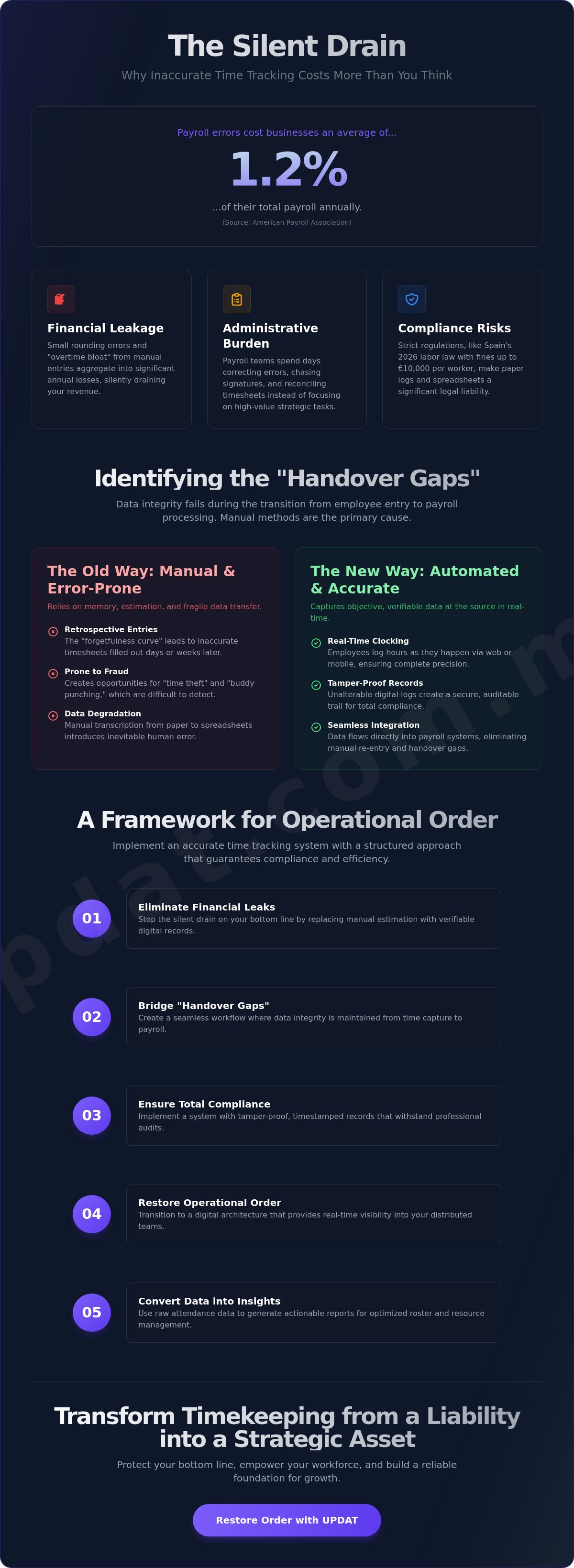
According to the American Payroll Association, payroll errors cost U.S. businesses an average of 1.2% of their total payroll annually. Most of these financial leaks stem from inaccurate data entry at the source. You likely understand the frustration of resolving manual payroll disputes or the difficulty of monitoring distributed teams. With 2026 labor regulations in Spain now mandating unalterable digital records and imposing fines up to €10,000 per worker, the margin for error has vanished.
Implementing accurate time tracking for employees is the most direct route to restoring operational order. This guide shows you how to replace manual guesswork with a structured digital architecture that ensures regulatory compliance and eliminates administrative overhead. We'll cover the transition to automated payroll data, methods for securing real-time visibility into staff attendance, and the steps required to build a reliable foundation for long-term growth. Learn to transform your timekeeping from a liability into a strategic asset that empowers your workforce and protects your bottom line.
Key Takeaways
• Identify and eliminate the financial leaks caused by manual estimation to stop the silent drain on your bottom line.
• Locate the "Handover Gaps" in your workflow where data integrity fails during the transition to payroll.
• Use our 5-step framework to implement accurate time tracking for employees while ensuring total regulatory compliance.
• Learn how TimeDAT converts raw attendance data into actionable insights for optimized roster management.
• Transition to a digital architecture that doesn't rely on retrospective entries to restore operational order.
The Silent Drain: Why Inaccurate Time Tracking Costs More Than You Think
Operational precision begins with a clear definition of what we measure. Accurate time tracking for employees is the objective, verifiable recording of labor hours without the interference of human estimation or memory. Many organizations operate under a cloud of "approximate" data, relying on retrospective entries that fail to capture the reality of the workday. This lack of precision doesn't just create messy spreadsheets; it introduces a systemic weakness that erodes your bottom line and organizational trust.
When records are based on guesswork, "time theft" and "buddy punching" become invisible taxations on your revenue. These aren't always malicious acts. Often, they're the result of a culture that lacks the digital architecture to support honesty and precision. Without a structured approach to time and attendance systems, friction becomes inevitable. Management questions the validity of overtime claims, while staff feel undervalued when manual errors lead to underpayment. Restoring operational order is the only sustainable antidote to this administrative chaos.
Financial Leakage: Payroll Inaccuracies and Overtime Bloat
The cost of inaccuracy is rarely a single, large event. It's a slow drip of capital. Small rounding errors, such as employees consistently adding 15 minutes to their start or end times, aggregate into significant annual losses. For a medium-sized enterprise, these minutes can translate into thousands of pounds in unearned wages. Without real-time visibility, you're often paying for "overtime bloat" that wasn't authorized or necessary.
Beyond the direct wage cost, the administrative burden of manual corrections is immense. Payroll teams often spend days every month chasing managers for missing signatures or reconciling conflicting paper timesheets. This manual intervention is expensive and prone to further error. By implementing accurate time tracking for employees, you remove the "Handover Gap" where data typically degrades, allowing your team to focus on high-value strategic tasks rather than forensic accounting.
Compliance Risks: Navigating National Labor Standards
Regulatory environments are becoming increasingly rigorous. In Spain, for example, the 2026 labor law mandates that all companies utilize digital, unalterable time tracking systems accessible by the Labor Inspectorate in real-time. Failing to meet these standards carries heavy penalties, with fines reaching up to €10,000 per affected worker. In the UK, the duty to keep adequate records of holiday pay and working hours for up to six years adds another layer of complexity.
Paper-based logs and Excel files are no longer sufficient to withstand a professional audit. Modern digital audit solutions ensure that your records are tamper-proof and timestamped at the point of origin. These systems automatically flag breaches in rest periods or overtime limits, protecting you from the risk of unfair dismissal claims or statutory pay disputes. Precision isn't just about saving money; it's about building a fortress of compliance that protects your business from legal volatility.
Choosing the Right Foundation: Methods for Capturing Precise Employee Data
Establishing a reliable operational environment requires a foundation built on high-fidelity data. Traditional methods, such as paper logs or Excel spreadsheets, are static and inherently fragile. They rely on manual entry, which invites transcription errors and data loss. Transitioning to automated digital capture replaces these vulnerabilities with a fluid, secure architecture. By capturing data at the point of origin, you ensure that accurate time tracking for employees becomes a byproduct of the workday rather than an administrative burden.
Precision is only possible when your system is accessible. Modern workforces are often distributed across multiple sites or remote environments. A robust foundation must offer web-based and mobile interfaces that allow staff to log hours regardless of their physical location. This accessibility ensures that data flows into your system in real-time, feeding directly into your payroll workflows without the need for manual reconciliation or data re-entry.
Digital Timesheets vs. Real-Time Clocking
The "forgetfulness curve" is a significant threat to data integrity. When employees fill out timesheets at the end of the week, they rely on memory, which leads to "rounding up" and estimation. Real-time clocking eliminates this memory gap. It creates a definitive digital audit trail that stands up to scrutiny. This level of detail is essential for meeting the Recordkeeping Requirements under the Fair Labor Standards Act (FLSA), which mandates complete and accurate records for all non-exempt staff.
For organizations with staff moving across different national sites, geofencing adds a necessary layer of verification. By restricting clock-ins to specific geographic parameters, you ensure that labor hours are attributed to the correct project or location. This prevents "buddy punching" and ensures that your operational visibility remains sharp. Implementing accurate time tracking for employees through real-time methods provides the clarity needed to manage a modern, mobile workforce effectively.
The Role of Automation in Eliminating Human Error
Automation acts as a silent supervisor, handling complex calculations that typically lead to manual math mistakes. Automated systems calculate breaks and overtime based on pre-set rules, ensuring that staff are paid correctly according to their specific contracts. This removes the complexity from the payroll cycle and reduces the risk of disputes. You can also configure automated alerts for missed clock-outs or unauthorized overtime, allowing managers to address anomalies as they happen rather than discovering them weeks later.
Cloud-based storage ensures that this data remains tamper-proof and immediately accessible for reporting. Unlike physical files that can be misplaced, digital records are stored in a centralized, secure environment. This architecture supports long-term growth by providing a scalable way to manage attendance data. If you're looking to upgrade your current infrastructure, exploring a solution like TimeDAT can help you transition from administrative chaos to a state of total operational control.
Auditing Your Current Workflow: Identifying the Friction Points
Identifying systemic failures requires a detached, analytical approach to your current processes. Most businesses suffer from what we define as the "Handover Gap." This is the critical juncture where raw attendance data moves from the employee to the payroll department. If this process involves manual intervention, data integrity inevitably degrades. Auditing your workflow starts with tracing the journey of a single hour from the moment it's worked to the moment it's paid. Every manual touchpoint, whether it's an email attachment or a physical signature, represents a point of potential failure.
Systems that rely on trust alone, without a verifiable digital handshake, create a vacuum where accountability disappears. To restore operational order, you must look for where the system relies on human memory rather than objective recording. Transitioning to a digital model is essential for streamlining business operations with software and closing these operational gaps. Implementing accurate time tracking for employees replaces these fragile links with a resilient digital architecture that ensures every minute is accounted for correctly.
The Spreadsheet Trap: Why Manual Entry is an Operational Risk
Excel is a powerful tool for financial analysis, but it's a dangerous database for time records. HR teams often lose dozens of "hidden" hours every month transcribing paper notes or emailed timesheets into master spreadsheets. This manual re-entry is the primary source of transcription errors that lead to payroll disputes. Version control also becomes a significant risk; when multiple managers edit different copies of a file, conflicting payroll data is the inevitable result.
Traditional spreadsheets lack the security and auditability required for modern compliance. They don't provide a timestamped history of changes, making it impossible to prove data integrity during a regulatory inspection. By moving away from the spreadsheet trap, you eliminate the risk of unauthorized edits and ensure that your accurate time tracking for employees remains a single, unalterable source of truth.
Accountability Gaps: Solving the Estimation Problem
Estimation bias is a psychological reality in manual systems. When employees are asked to recall their hours retrospectively, they naturally round in their own favor. This isn't necessarily a sign of dishonesty; it's a flaw in human memory. However, these small discrepancies have a massive impact on project costing and resource allocation. If your data is off by even 5%, your project profitability forecasts are built on a foundation of sand.
While precision is the strategic goal, it's vital to maintain a balanced culture. Industry leaders often discuss the potential downsides of obsessive time tracking that can damage employee morale if implemented as a surveillance tool. The objective should always be clarity and fairness. Standardized, non-negotiable digital entry points remove the burden of estimation from the employee, providing them with a clear, transparent record of their work while giving management the precise data needed for accurate resource planning.
How to Implement an Accurate Time Tracking System: A 5-Step Framework
Moving from a manual, estimation-based culture to a state of operational precision requires more than just new software. It demands a systematic transition. By following a structured framework, you can eliminate the "Handover Gap" and ensure that accurate time tracking for employees becomes a permanent feature of your business architecture. This process replaces administrative chaos with a fluid, reliable data stream.
Steps 1-3: Setting the Digital Architecture
The first step is to audit your current regulatory requirements and internal policy needs. You must define clear rules for overtime, breaks, and lateness before going digital. For example, if you operate in Spain, your system must comply with the 2026 mandate for unalterable digital records. In the UK, your records must support the £12.71 National Living Wage and store adequate holiday pay data for six years. Setting these parameters early prevents logic errors in your automated workflows.
Next, select a platform that supports national labor laws and offers easy integration with your existing payroll software. Look for a solution that balances ease of use for the employee with robust reporting for management. Once selected, you must standardize the clock-in process across all departments and roles. A fragmented system where some teams use apps while others use paper is a recipe for data corruption. Establishing a single source of truth for all attendance data is the only way to maintain a definitive audit trail.
Steps 4-5: Ensuring Long-Term Accuracy and Adoption
Training staff on the "Why" is critical for high adoption and low resistance. Transparency reduces employee anxiety by demonstrating that a digital system protects their right to accurate pay and fair treatment. When staff understand that the system eliminates underpayment and ensures compliance with rest period regulations, they are more likely to engage with the tool correctly. This cultural alignment is as important as the digital architecture itself.
Finally, review and refine your data weekly to optimize scheduling and budgets. Use weekly reports to identify staffing patterns, such as recurring overtime bloat or frequent lateness, and adjust your rosters accordingly. Management must play an active role in validating and approving digital timesheets promptly to keep the payroll cycle moving without friction. If you're ready to modernize your workforce management, explore our custom software solutions to build a foundation for operational excellence.
Beyond the Clock: Transforming Data into Operational Excellence with TimeDAT
Operational precision reaches its peak when data stops being a record of the past and starts becoming a blueprint for the future. TimeDAT serves as the definitive solution for workforce management in 2026, moving beyond simple attendance logs to provide a sophisticated digital architecture for your business. By establishing accurate time tracking for employees at the core of your operations, you create a reliable data stream that informs every subsequent management decision. This transition replaces reactive troubleshooting with proactive, strategic planning.
High-level efficiency requires a system that adapts to your specific digital environment. While TimeDAT provides a robust foundation, some organizations possess unique operational complexities that demand a tailored approach. Investing in custom software development in Malta allows you to build proprietary features into your tracking system, ensuring that your software mirrors your exact business logic. This bespoke capability ensures that your timekeeping remains fluid and scalable as your company expands.
Integrating Time Tracking with Payroll and Roster Management
TimeDAT automates the entire journey of labor data, ensuring a seamless flow from the initial clock-in to the final payroll report. This integration removes the "Handover Gap" discussed earlier, as data moves through the system without manual intervention or transcription. HR teams experience a drastic reduction in administrative labor, freeing them from the burden of reconciling conflicting timesheets. When your payroll data is unalterable and timestamped, the risk of disputes vanishes, and regulatory compliance becomes an automated byproduct of your daily workflow.
The synergy between attendance data and future scheduling is a significant driver of profitability. By analyzing historical trends within TimeDAT, managers can create smarter rosters that align perfectly with actual labor needs. You can identify periods of unnecessary overtime bloat or staffing shortages with surgical precision. This data-driven approach to scheduling ensures that you're never overstaffed during quiet periods or under-resourced during peak demand, directly optimizing your labor costs.
Restoring Order: The Strategic Advantage of Unified Data
Unified data provides directors with the "big picture" visibility required for effective leadership. High-level reporting tools allow you to monitor labor costs across different departments or national sites in real-time, providing a clear view of your operational health. This transparency empowers management to make informed decisions based on facts rather than intuition. To achieve total oversight, business task management platforms like ActionDAT can work alongside TimeDAT, connecting attendance records with specific task completion and project milestones.
Implementing accurate time tracking for employees is the first step toward a fully optimized business environment. It restores order by removing the complexity of manual systems and replacing it with a steady, reliable foundation. Whether you're utilizing TimeDAT for its robust out-of-the-box features or commissioning a bespoke build to meet unique industry needs, the result is the same: clarity, stability, and total operational control. Restore order to your business today by adopting a unified digital platform that prioritizes precision above all else.
Master Your Operational Environment
Precision is the foundation of a scalable business. You've seen how estimation and manual entry create a silent drain on your resources, leading to payroll disputes and regulatory risks. Transitioning to a structured digital architecture is no longer optional; it's a strategic necessity for maintaining order in a complex labor market. Implementing accurate time tracking for employees allows you to bridge the "Handover Gap" and transform raw attendance data into a tool for smarter roster management.
We provide the specialized tools to make this transition seamless. Our Maltese-based support and regulatory expertise ensure you remain compliant with evolving national laws. You'll benefit from cloud-based accessibility that keeps you connected to distributed teams while enjoying seamless integration across the AuditDAT and ActionDAT platforms. This unified approach removes complexity and empowers you to manage your workforce with total confidence.
Restore operational order with TimeDAT workforce management. It's time to replace administrative chaos with a steady, reliable foundation for growth.
Frequently Asked Questions
Is accurate time tracking for employees legally required in Malta?
Under the Organisation of Working Time Regulations (S.L. 452.87), Maltese employers must keep records to prove compliance with maximum weekly working hours and mandatory rest periods. These records must be available for inspection by the Department for Industrial and Employment Relations (DIER). Maintaining accurate time tracking for employees is the most reliable way to fulfill these statutory obligations and avoid penalties for non-compliance.
How does digital time tracking prevent buddy punching?
Digital systems eliminate "buddy punching" by utilizing geofencing and unique digital identifiers. When a staff member clocks in, the system verifies their geographic location against pre-set work zones. This ensures that the record is only created when the employee is physically present at the site. This architecture replaces the vulnerable trust-based paper system with a verifiable digital handshake that protects the integrity of your payroll data.
Can time tracking software handle complex shift patterns and night work?
TimeDAT is specifically engineered to manage complex operational environments, including rotating rosters and overnight shifts. The software automatically recognizes when a shift crosses into a new day and applies the correct pay rules for night work or public holidays. This automation removes the mental load from managers who previously had to calculate these hours manually. It ensures that every minute is attributed to the correct pay cycle without error.
Will my employees find digital time tracking too intrusive?
Employee resistance usually stems from a lack of clarity rather than the technology itself. When you frame accurate time tracking for employees as a tool for fairness, it shifts the perspective. Staff appreciate that their overtime is recorded precisely and that their pay is always correct. Transparency builds trust, as employees can view their own records in real-time, ensuring that their rights to rest periods are respected.
What is the best way to track time for remote or field-based staff?
Cloud-based web interfaces are the most effective solution for distributed workforces. Field staff can access the system from their browser at specific client locations, with geofencing ensuring they are on-site before a clock-in is accepted. This provides management with real-time visibility into staff distribution without requiring physical attendance at a central office. It creates a unified digital record for all employees, regardless of where they are working.
How much time can a business save by automating timesheets?
Businesses typically save several days of administrative labor per month by moving away from manual timesheets. Automation removes the need for HR teams to chase physical signatures, transcribe paper notes, or resolve transcription errors in Excel. By streamlining the flow of data from the initial clock-in to the final payroll report, you allow your team to focus on high-value strategic growth rather than repetitive data entry.
Does accurate time tracking help with HACCP or ISO compliance?
Precision in labor records is a critical component of ISO 9001 and HACCP standards. These frameworks require proof that specific tasks were performed by qualified staff during designated shifts. Accurate time records provide a timestamped audit trail that demonstrates compliance with safety and quality protocols. Integrating this data with AuditDAT further strengthens your position during external inspections by providing a single, unalterable source of operational truth.
Can TimeDAT integrate with my existing payroll software?
TimeDAT is designed to act as a bridge between your operations and your finance department. It exports verified attendance data directly into most major payroll platforms, eliminating the "Handover Gap" where errors often occur. This seamless integration ensures that your payroll department receives clean, ready-to-process data without the need for manual reconciliation. Our team also offers bespoke software development to create custom integrations for proprietary internal systems.




%201.svg)
