

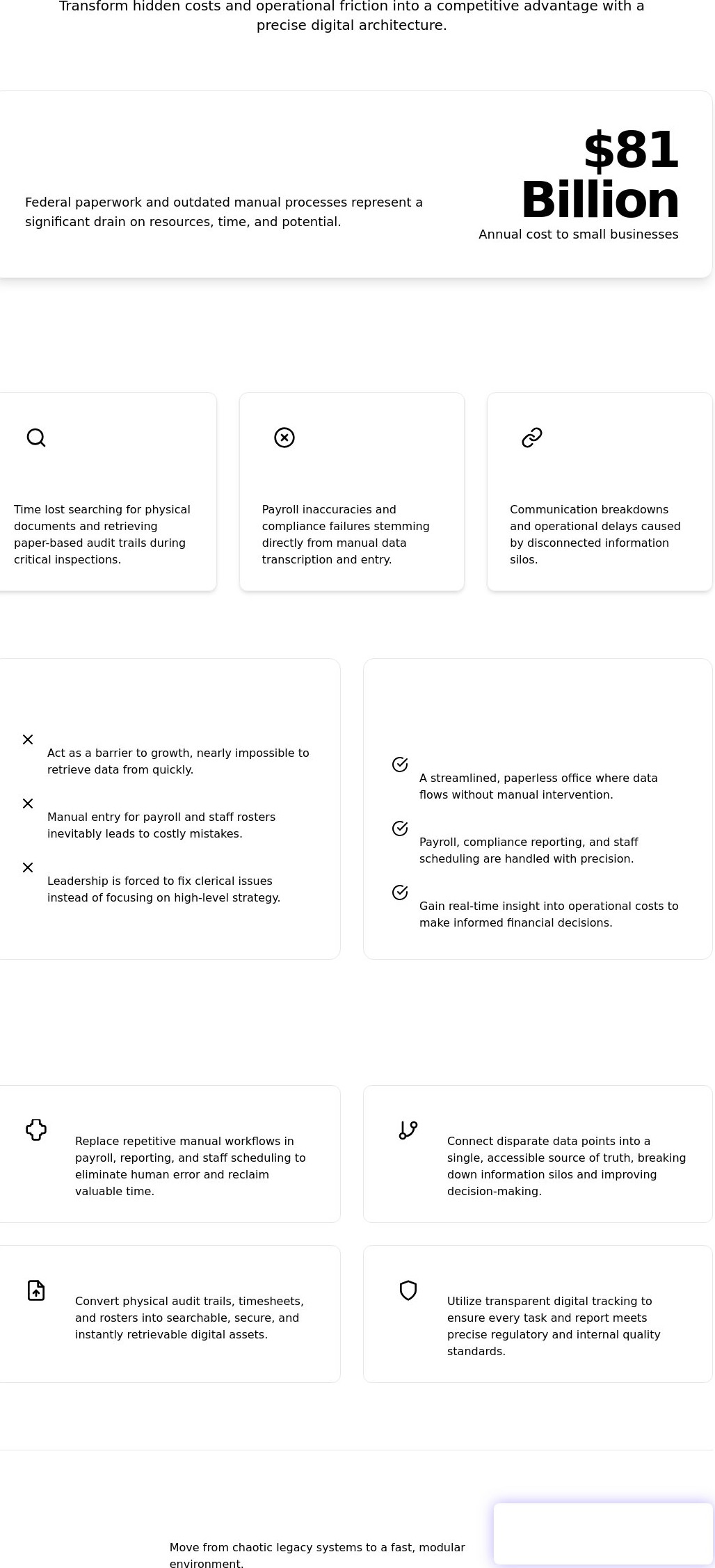
Federal paperwork collections cost small businesses over $81 billion in 2025. This staggering figure represents more than just a regulatory burden; it signals a systemic drain on resources caused by outdated manual processes. You likely recognize the symptoms in your own office: manual data entry errors that disrupt your workflow, difficulty tracking staff rosters, or paper-based audit trails that are nearly impossible to retrieve during inspections. Finding the right administrative cost reduction strategies isn't about reducing your headcount. It's about replacing operational friction with a precise digital architecture that works for you.
We'll show you how to eliminate these complexities and restore order to your bottom line through automation. This article provides a roadmap to a streamlined, paperless office where payroll and compliance reporting are handled with a single click. You'll learn how to gain total visibility into your operational costs and build a reliable foundation for long-term growth. We'll explore the move from chaotic legacy systems to a fast-paced, modular environment that prioritizes logic and precision. By the end of this guide, you'll have the keys to master your own operational environment and turn administrative drag into a competitive advantage.
Key Takeaways
• Identify the hidden tax of manual data entry and learn why paper-based systems act as a barrier to business growth.
• Discover how to implement administrative cost reduction strategies through the automation of repetitive tasks like payroll and staff scheduling.
• Contrast the efficiency of digital hospitality audits against paper trails to reduce error rates and retrieval times.
• Establish a lean framework by conducting workflow audits and defining precise KPIs to track your operational improvements.
• Build a resilient digital architecture using modular systems like AuditDAT and TimeDAT to centralize your operational data.
The Hidden Tax of Administrative Friction in 2026
Administrative friction is the cumulative cost of manual data entry and retrieval. It acts as a persistent drag on your company's ability to scale. Traditional paper-based systems function as a hidden tax; they siphon away time and capital that should be invested in expansion. This friction doesn't just impact your ledger. It erodes employee morale and slows down operational velocity by forcing skilled staff to perform repetitive, low-value tasks. To combat this, you must establish "Operational Order." This is the state where systems are predictable, data is accessible, and friction is eliminated through a structured digital architecture.
Effective administrative cost reduction strategies move beyond simple budget cuts. They focus on removing the structural barriers that prevent your team from working at peak efficiency. When you eliminate manual bottlenecks, you restore clarity to your operations and allow your leadership to focus on high-level strategy rather than clerical firefighting.
Identifying Indirect Administrative Costs
Think about the hours your managers spend on manual roster adjustments. Every timesheet approval performed on paper is a missed opportunity for higher-level work. These indirect costs often go unmeasured, yet they deeply affect your bottom line. In high-stakes sectors, the cost of compliance failures due to missing or illegible paper audits can be devastating. When you apply fundamental cost reduction principles, you start to see these gaps clearly. Administrative friction is the silent profit-killer in Maltese enterprises.
Consider these specific friction points:
• Hours lost to searching for physical documents during inspections.
• Payroll errors stemming from manual data transcription.
• Communication breakdowns caused by information silos.
The Shift Toward Digital Operational Architecture
Modern leaders are moving away from reactive cost-cutting. The 2026 trend focuses on proactive process automation and the building of a digital operational architecture. This approach ensures that information flows without manual intervention. By implementing digital audit solutions, you transform overhead into strategic assets. These systems provide real-time data, which allows you to make informed financial decisions instantly.
Proactive administrative cost reduction strategies rely on this visibility to identify and remove bottlenecks before they become expensive problems. Using real-time reporting ensures that you're no longer looking at your costs through a rearview mirror. Instead, you gain the foresight needed to maintain stability and drive long-term growth in an increasingly complex regulatory environment.
Strategic Pillars of Administrative Cost Reduction
Many legacy approaches suggest cutting costs by decree or simply outsourcing functions to third parties. These methods often fail because they don't solve the underlying inefficiency. High-level administrative cost reduction strategies focus instead on streamlining processes, data, and technology within your own digital infrastructure. By building internal automation, you maintain total control over your quality standards while permanently lowering overhead. This shift from manual intervention to digital architecture is the foundation of a modern, scalable business.
Success in this transition rests on four primary pillars:
Automation
Replacing manual workflows in payroll, reporting, and scheduling.
Centralisation
Connecting disparate data points into a single, accessible source of truth.
Digitisation
Converting physical audit trails into searchable, secure digital assets.
Accountability
Using transparent tracking to ensure every task meets regulatory standards.
Automating the Payroll and Attendance Lifecycle
Manual timesheets are a primary source of labor cost leakage. Managers often spend hours every week reconciling paper rosters with actual attendance records. This process is prone to human error and deliberate inflation. TimeDAT removes this complexity by automating the entire calculation process. It eliminates the manual hours typically lost to data entry and ensures that payroll is based on verified attendance data. Transitioning to self-service digital rosters further empowers your employees to manage their own availability. This reduces the administrative burden on HR departments and ensures your payroll lifecycle is fast, accurate, and transparent.
Digitising Compliance and Inspections
Compliance shouldn't be a source of administrative bloat. Compiling spreadsheets for regulatory filings is an inefficient use of management time that slows down your operational velocity. AuditDAT digitizes inspection trails, allowing for instant reporting and immediate data retrieval during audits. This approach supports a broader strategy of operational excellence by turning compliance from a chore into a competitive advantage. You gain a centralized repository of data that eliminates information silos and clarifies individual accountability. When every task is tracked transparently, you foster a culture of precision and order. If you're ready to start building this framework, you can explore our platform options to see how these tools integrate into your current workflow.
Implementing these administrative cost reduction strategies ensures that your business remains agile. You're no longer bogged down by the weight of paper-based systems. Instead, you're operating with a lean, automated framework that prioritizes logic and precision. This architectural approach provides the stability needed for long-term growth and protects your bottom line from the "hidden tax" of administrative friction.
Manual vs. Automated: A Practical Comparison
Manual administration relies on a linear relationship between workload and headcount. As your business grows, your overhead increases at the same rate. This model is unsustainable in a competitive landscape. Effective administrative cost reduction strategies break this cycle by decoupling operational growth from administrative staffing. When you automate, your capacity expands while your fixed costs remain stable. This shift provides the agility needed to respond to market changes without the burden of excessive payroll.
In the hospitality sector, the difference is stark. A manual HACCP audit requires physical signatures, manual filing, and hours of retrieval time during an inspection. If a document is missing or illegible, the cost of non-compliance is high. Digital systems provide instant verification. You can retrieve years of Health & Safety data in seconds, ensuring that regulatory inspections are handled with precision rather than panic. This transition turns a reactive chore into a proactive asset.
Workforce management follows a similar pattern. Paper timesheets are prone to transcription errors and "buddy punching," which inflate labor costs. Using automated workforce management software eliminates these leakages. It ensures that every minute paid is a minute worked, providing a level of accuracy that manual systems cannot match. By removing the human element from data entry, you eliminate the friction that leads to payroll disputes and financial waste.
Efficiency Metrics in High-Volume Sectors
Manual task prioritisation often leads to "lost tasks," which are critical actions that fall through the cracks because they weren't logged centrally. Implementing business task management platforms ensures that every operational requirement is assigned, tracked, and completed. This transparency removes the need for constant follow-up emails and status meetings. It restores order to chaotic environments where multiple sites or departments must stay aligned. Audit retrieval time drops from hours with paper to seconds with digital systems.
Long-Term ROI of Bespoke Software
Custom solutions provide a unique advantage by adapting to your specific growth trajectory. While off-the-shelf products might require you to change your workflows, Bespoke Software Development builds the system around your needs. This architectural approach aligns with the U.S. Federal Government Framework for Reducing Administrative Burdens, which emphasizes the removal of unnecessary steps. The cost-benefit analysis heavily favors digital investment. Subscription fees or development costs are significantly lower than the recurring expense of manual labor hours. Data-driven decision-making further reduces operational waste by identifying inefficiencies that are invisible in a paper-based environment. This allows you to scale your operations with confidence and precision.
Implementing a Lean Administrative Framework
Transitioning to a lean framework requires a structured, step-by-step approach. High-level administrative cost reduction strategies are only effective when they're built on a foundation of logic and precision. You must move away from reactive fixes and toward a deliberate digital architecture. This process begins with an honest assessment of your current state and ends with a self-sustaining system of continuous improvement.
Step 1: Conduct a workflow audit.
Identify every "friction point" where data is manually transcribed or physical documents are moved between departments.
Step 2: Define clear KPIs.
Establish measurable benchmarks for administrative efficiency, such as the average time spent per audit or the speed of payroll reconciliation.
Step 3: Select integrated modules.
Avoid disjointed "point" solutions that don't communicate. Choose modular software that centralizes data across your entire operation.
Step 4: Prioritize staff training.
High adoption rates are critical for accountability. Ensure your team understands how digital tools simplify their daily tasks.
Step 5: Monitor and refine.
Use data analytics to identify remaining bottlenecks and further automate repetitive processes.
Designing Your Digital Workflow
Effective design starts by distinguishing core functions from administrative overhead. Your skilled staff should focus on the former while technology handles the latter. Map out the journey of a single audit report from the field to the boardroom. Every manual hand-off is a potential point of failure and a source of waste. By integrating governance, risk, and compliance directly into these daily activities, you ensure that oversight happens automatically. This architectural approach creates a "lower-friction operating system" where compliance is a byproduct of the workflow rather than an additional task.
Managing the Cultural Transition
Resistance to digitisation often stems from a fear of complexity or job displacement. Address these objections by focusing on empowerment. Explain that automation doesn't replace people; it removes the "grunt work" that leads to burnout and errors. Technology restores order for everyone by providing clarity and reducing the burden of manual data entry. A calm, reassuring transition plan helps your workforce see digital tools as a steady foundation for their own professional growth. When employees spend less time on clerical firefighting, they can focus on the high-value work they were hired to do. If you're ready to modernize your operations, you can get started with our digital framework to build a more efficient future.
Continuous monitoring is the final piece of the puzzle. Once your framework is in place, your systems will generate the data needed to refine your administrative cost reduction strategies further. You'll gain the visibility to see exactly where your resources are going and the agility to adjust your processes in real-time. This level of mastery ensures your business remains resilient and profitable regardless of external economic pressures.
Building Your Operational Architecture with UPDAT
UPDAT Technologies Ltd. acts as the strategic architect for your operational efficiency. We don't just provide software; we design the digital framework that removes complexity and restores order. Our approach is modular, allowing you to scale your administrative cost reduction strategies at your own pace. Whether you require standardized tools or Bespoke Software Development for unique industry requirements, we provide a steady foundation for long-term growth. Digital transformation is a journey toward stability and clarity that empowers your leadership to focus on high-level strategy.
The UPDAT Technologies Ltd. ecosystem is built on logic and precision. AuditDAT digitizes your compliance trails, while TimeDAT automates the attendance and payroll lifecycle. ActionDAT ensures every operational task is tracked and completed with total transparency. This modular architecture allows you to connect disparate data points into a single, accessible source of truth. It eliminates the information silos that often lead to administrative bloat and manual error. By building your systems on this digital architecture, you ensure your business remains agile and resilient.
Industry-Specific Solutions for Malta
Local enterprises face unique regulatory and operational pressures that require specialized tools. We tailor our automation for the hospitality and manufacturing sectors to ensure peak efficiency. In hospitality, this means moving from paper HACCP logs to instant digital verification. For manufacturing, it involves streamlining floor-to-boardroom reporting to reduce operational waste. Security operations also benefit from digital patrol tracking and real-time incident reporting, which eliminates the need for unreliable manual logbooks. Managing large-scale facilities management becomes a structured process through integrated task tracking. Every module is designed to fit the specific digital architecture of your business, ensuring that your systems adapt as you grow.
Next Steps: Restoring Order Today
Restoring order to your bottom line requires a proactive mindset. You've seen how manual friction acts as a hidden tax on your growth and morale. Now is the time to replace that friction with a precise digital architecture. We invite you to explore UPDAT pricing to find a scalable solution that fits your specific operational needs. Every investment in automation is a step toward permanent overhead reduction and increased operational velocity. It's time to hand your staff the keys to a more efficient, empowered environment.
Don't let administrative bloat slow your progress. You can book a demo today to see operational order in action. Our team will guide you through our modular systems and show you how to eliminate manual friction for good. Start your journey toward a streamlined, paperless office and reclaim the time needed to master your market. UPDAT Technologies Ltd. provides the steady, reliable foundation you need for long-term success.
Mastering Your Operational Architecture
Transitioning from manual friction to a digital architecture is the most effective way to protect your profit margins. You've seen how legacy systems act as a hidden tax on growth; whereas automation restores clarity and precision. By implementing modern administrative cost reduction strategies, you empower your team to focus on high-value work rather than clerical firefighting. UPDAT Technologies Ltd. provides a modular SaaS architecture designed for scalable growth, backed by deep Maltese expertise in regulatory compliance. Our systems are already trusted across the hospitality, security, and manufacturing sectors to maintain stability in a complex landscape.
Choosing a digital operating system ensures that your business remains agile as regulatory demands evolve. You've learned that cost reduction isn't about cutting quality; it's about building a better foundation for your team. You can restore operational order with a personalized UPDAT Technologies Ltd. demo and begin your journey toward a leaner, more predictable future. Take the first step toward total mastery of your business environment today. Order and efficiency are within your reach.
Frequently Asked Questions
What are the most effective administrative cost reduction strategies for 2026?
The most effective strategies involve replacing manual friction with a structured digital architecture that prioritizes automation. By digitizing audit trails and using workforce management tools, you eliminate the hidden tax of manual data entry. These administrative cost reduction strategies focus on centralizing operational data to remove information silos and permanently lower your overhead.
How does workforce management software reduce administrative overhead?
Workforce management software like TimeDAT automates the calculation of hours and reduces the need for manual roster adjustments. It eliminates human error in data entry and prevents labor cost leakage caused by inaccurate tracking. This shift allows HR departments to focus on strategic growth instead of spending hours on repetitive clerical tasks.
Can digital audit solutions help avoid regulatory fines?
Yes, digital audit solutions like AuditDAT ensure that your compliance records are legible, secure, and instantly retrievable. During inspections, you can provide proof of adherence to regulations in seconds rather than hours. This level of precision prevents the heavy fines often associated with missing or incomplete paper-based audit trails.
Is bespoke software development more cost-effective than off-the-shelf tools?
Bespoke software development is often more cost-effective in the long term because it adapts exactly to your specific growth trajectory. Unlike off-the-shelf tools, it doesn't force you to change your workflows or pay for features you don't use. It builds a steady foundation that scales with your business without requiring an increase in administrative headcount.
How much time can a business save by automating its payroll and attendance?
Businesses typically save several hours per week for every department head by automating these processes. Instead of manually reconciling paper timesheets, the system handles calculations instantly and accurately. This shift reduces the payroll processing lifecycle significantly, allowing for faster financial reporting and improved operational velocity.
What is the first step in conducting an administrative cost audit?
The first step is to conduct a thorough workflow audit to identify specific friction points where manual data transcription occurs. You should map the journey of key documents, such as audit reports or timesheets, to see where delays and errors happen. This clarity allows you to prioritize the automation of high-friction tasks that drain your resources.
How do I ensure my team adopts new automation software effectively?
Effective adoption requires clear training that emphasizes how the software removes repetitive "grunt work" and simplifies daily routines. When your staff see that technology restores order and reduces their clerical burden, they're much more likely to embrace the change. High adoption rates are critical for ensuring your administrative cost reduction strategies deliver a strong return on investment.






%201.svg)
