
In 2026, the margin for administrative error in the Maltese business environment has effectively vanished. With the full implementation of the EU's Pay Transparency Directive as of June 7, automated payroll processing malta is no longer a luxury for the tech-forward; it is the essential architectural foundation for every compliant enterprise. Managing the 2026 COLA increase of €4.66 per week alongside complex DIER regulations requires a level of precision that manual data entry simply cannot sustain.
You understand the friction of reconciling varied shift patterns or the anxiety that precedes the February 15 deadline for FS3 and FS7 submissions. This guide provides a strategic roadmap to eliminate that administrative weight and restore operational order to your HR department. You'll learn how to implement systems like TimeDAT to guarantee error-free payroll runs, automate the generation of critical tax documents, and create a fluid integration between real-time attendance tracking and final salary calculations. We will break down the transition from manual friction to automated mastery.
Key Takeaways
• Identify how shifting from fragmented spreadsheets to centralized cloud architectures restores order and eliminates operational bottlenecks.
• Automate the production of essential FSS filings, including FS3 and FS5 forms, while maintaining real-time alignment with Maltese Social Security updates.
• Follow a structured implementation roadmap to audit existing manual workflows and define technical specifications for system integration.
• Synchronize workforce performance and payroll accuracy by integrating TimeDAT for attendance and ActionDAT for performance-based compensation.
• Master the complexities of the local market by choosing bespoke software development for automated payroll processing malta instead of limited off-the-shelf products.
The Evolution of Payroll in Malta: Restoring Order to Workforce Management
The Maltese business landscape has undergone a radical transformation. For decades, payroll was a localized, manual chore managed through fragmented spreadsheets and physical filing cabinets. This approach was sufficient for small, static teams, but today's operational environment demands far more. The Evolution of Payroll globally has moved toward centralized, cloud-based architectures that treat salary data as a dynamic asset rather than a static monthly task.
Manual payroll remains a significant strategic bottleneck for growing Maltese enterprises. When data is siloed in disconnected documents, leadership loses visibility into real-time labor costs. Transitioning to automated payroll processing malta allows businesses to eliminate the "human error" variable that often plagues manual salary calculations. By establishing a single source of truth for employee data and attendance, you restore order to your workforce management. This isn't just about paying people on time. It's about building a digital foundation that supports rapid scaling without adding equivalent administrative weight.
The High Cost of Manual Administrative Friction
Hours lost to manual timesheet reconciliation represent a hidden drain on profitability. When payroll inaccuracies occur, the damage extends beyond the balance sheet; it erodes employee trust and damages morale. Administrative bloat prevents HR leaders from engaging in high-level strategic focus. Instead of building culture or optimizing performance, they're trapped in a cycle of data entry and correction. Reliable systems remove this friction. They allow your team to shift their energy toward initiatives that drive value, such as talent development and operational excellence. You can't lead effectively when you're buried in paper.
Transitioning to a Digital-First Operational Environment
Modern excellence requires moving beyond basic accounting toward integrated workforce management. This involves a psychological shift from "running payroll" to "monitoring systems." In the context of Maltese business, operational excellence means having a fluid digital architecture that adapts to regulatory changes automatically. You don't just process payments; you manage a system designed for stability and growth. Implementing automated payroll processing malta creates a predictable rhythm by automating the data flow from clock-in to payslip. This shift empowers managers to make decisions based on accurate, real-time data rather than historical guesswork. It's the difference between reacting to problems and architecting solutions.
Core Features of a Compliant Maltese Payroll System
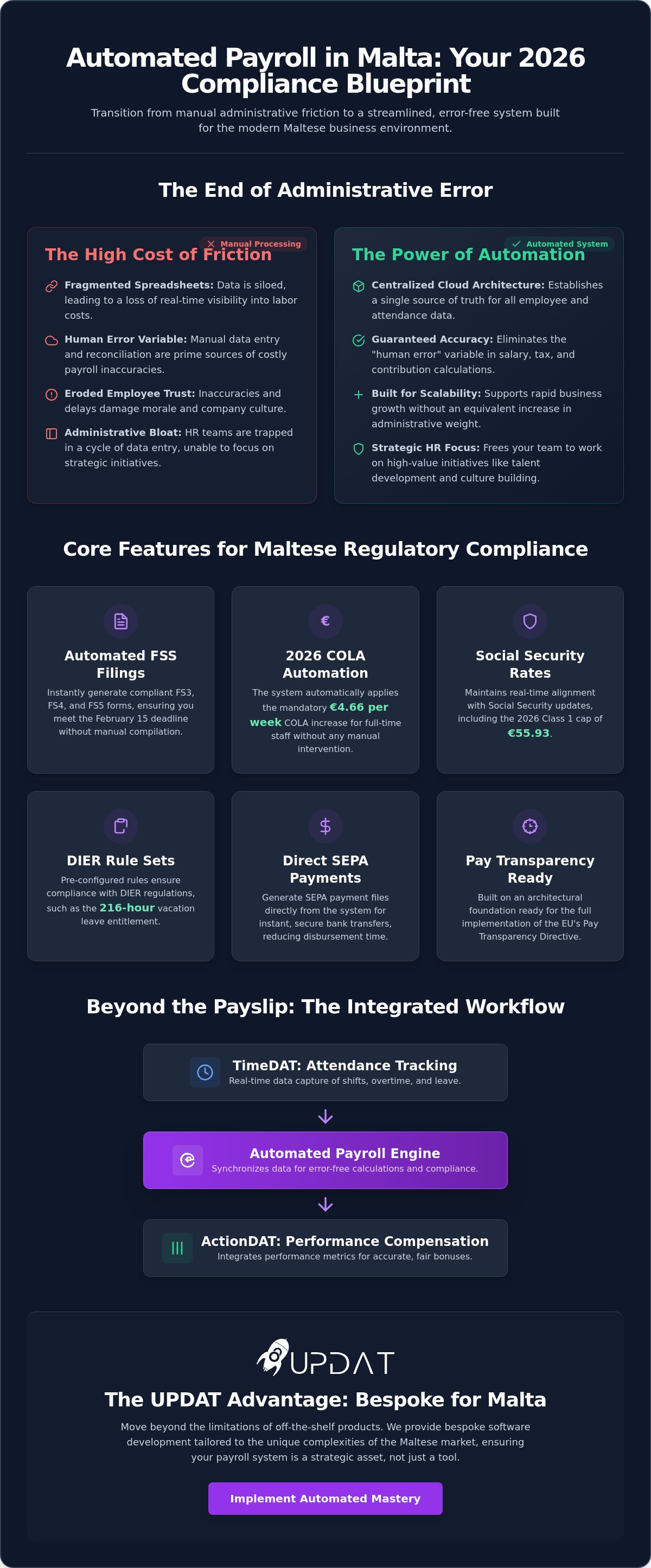
A high-performance payroll system acts as the central nervous system of your business operations. It must do more than just calculate net pay; it must serve as an automated safeguard against regulatory drift. Effective automated payroll processing malta requires the immediate generation of FSS documents. This includes the automated creation of FS3, FS4, and FS5 forms to ensure you meet the February 15, 2026, deadline for annual reconciliation statements. By digitizing these outputs, you eliminate the frantic manual compilation that typically defines the fiscal year-end.
Seamless integration with the latest Maltese Social Security rates is non-negotiable. For 2026, your system must automatically account for the updated Class 1 contribution cap of €55.93 for both employers and employees born after 1962. It should also handle the 2026 COLA adjustment of €4.66 per week for full-time staff without manual intervention. By referencing a comprehensive guide to Maltese payroll, it's clear that the complexity of local tax brackets and statutory bonuses requires a logic-driven architecture rather than a simple calculator. Modern systems also facilitate direct SEPA payment file generation, allowing for instant bank transfers that reduce the time between calculation and disbursement.
Maltese Regulatory Compliance by Design
Compliance isn't a one-time event; it's a continuous state of operation. Your system should adhere to Department of Industrial and Employment Relations (DIER) regulations through pre-configured rule sets. This is particularly critical when managing the 216 hours of vacation leave entitlement for 2026. Leveraging solutions for governance-risk-compliance ensures that your reporting remains robust and audit-ready. Incorporating GxP compliance and quality assurance protocols into your payroll workflow protects your organization from the financial and reputational risks associated with non-compliance.
Advanced Data Architecture and Security
Security is the foundation of trust in any payroll environment. Encrypted cloud storage protects sensitive employee financial data from unauthorized access. Every adjustment, from a mid-month salary increase to a one-off allowance, must leave a permanent audit trail. This level of accountability is essential for internal audits and external inspections. Customizable permission levels allow HR and finance departments to collaborate effectively while maintaining strict data silos. Digital payslip distribution via self-service portals further secures data by removing the need for physical copies or insecure email attachments. If you're ready to secure your operational data, you can start building your compliant workspace today.
A Strategic Framework for Automated Payroll Implementation
Transitioning to a sophisticated digital architecture requires more than just software installation. It demands a deliberate, strategic approach to ensure that your automated payroll processing malta remains robust under the pressure of local regulatory demands. Moving from fragmented spreadsheets to a centralized system is a restoration of order. This framework allows you to architect a solution that eliminates friction and empowers your finance team to focus on high-level strategy.
Step 1: Conduct a comprehensive audit.
Evaluate your existing manual workflows. Identify every point where data is manually transcribed, from shift rosters to final NI calculations.
Step 2: Define technical requirements.
Determine how your payroll engine will communicate with attendance hardware. Integration with TimeDAT ensures that hours worked translate directly into accurate salary figures.
Step 3: Migrate legacy data.
Move your historical employee records into a structured cloud environment. Ensure that every data point, from previous tax history to leave balances, is accurately mapped.
Step 4: Execute parallel payroll runs.
Run your new automated system alongside your legacy process for at least two cycles. This verifies the accuracy of the new logic against known outcomes.
Step 5: Finalize and empower.
Decommission the old systems and provide your staff with the training needed to master the new operational environment.
Auditing for Operational Gaps
Data often falls through the cracks during manual transcription. You must map the flow of information from the punch-clock to the final payslip to identify these leaks. Utilizing AuditDAT can help surface these hidden inefficiencies before they lead to compliance failures. Defining clear KPIs, such as a 100% reduction in manual data entry errors, provides a benchmark for your transition's success. This audit phase is the foundation of operational excellence in your HR department.
Data Migration and Validation Strategy
Success depends on a clean slate. Historical data must be scrubbed of errors before it enters your new automated payroll processing malta system. Dry runs are essential. They allow you to test how the system handles the 2026 Class 1 contribution caps of €55.93 without risking actual employee pay. Validation ensures continuity in tax and social security contributions, preventing discrepancies that could trigger DIER inspections. You don't just migrate data; you verify the digital architecture of your entire business.
Beyond the Payslip: Integrating Payroll with Workforce Excellence
True operational order extends beyond the simple delivery of a monthly payslip. While the previous sections established the regulatory and technical foundations of automated payroll processing malta, the real value lies in how this data interacts with your broader workforce strategy. When payroll exists in a vacuum, you miss the opportunity to drive performance and optimize labor costs in real-time. Integrating your salary engine with other operational tools transforms payroll from a back-office necessity into a strategic asset that fuels growth.
The synergy between TimeDAT and payroll accuracy is the first step toward this transformation. Instead of relying on manual timecard submissions that are prone to error or inflation, attendance data flows directly into the calculation engine. This integration reduces the administrative burden on HR departments by automating leave management and attendance tracking. It also allows leadership to utilize workforce analytics to drive high-level business decisions. Analyzing overtime trends across different departments can reveal structural inefficiencies that a siloed payroll report would never surface. Using ActionDAT to track specific tasks enables performance-based pay structures, ensuring that compensation is directly tied to tangible output.
Closing the Loop with TimeDAT
Real-time attendance tracking feeds directly into your automated systems, creating a seamless path from the factory floor or hotel lobby to the bank transfer. This digital verification eliminates "buddy punching" and time theft, protecting your margins from subtle but consistent leaks. In fast-paced sectors like hospitality and manufacturing, where shift patterns are fluid and overtime is frequent, this level of precision is essential. You no longer have to guess if a shift was covered or if an allowance was earned; the system provides the proof. This clarity empowers managers to optimize scheduling based on actual labor needs rather than historical estimates.
Operational Excellence through Integrated Systems
Siloed software creates new administrative bottlenecks by forcing staff to move data between disconnected platforms. A unified dashboard for all business operations restores clarity and ensures that automated payroll processing malta remains a reliable foundation for your enterprise. Leveraging operational excellence solutions ensures that your digital architecture supports long-term stability. When your payroll, time tracking, and task management systems speak the same language, you eliminate the friction that slows down decision-making. To begin unifying your workforce data and enhancing your operational precision, register your organization and explore our integrated solutions today.
The UPDAT Advantage: Bespoke Automation for the Maltese Market
Standard software often hits a wall when faced with the specificities of the Maltese market. Generic SaaS platforms lack the flexibility to handle local statutory bonuses or the specific maternity fund contributions required by law. By opting for bespoke software development, you secure a system that understands the nuances of automated payroll processing malta from the ground up. We provide local implementation expertise that bridges the gap between technical capability and regulatory necessity. This ensures your business remains a steady, reliable foundation for growth while others struggle with system limitations.
• Receive local implementation expertise tailored to national regulations.
• Ensure your system scales without the friction of generic software limitations.
• Maintain a steady, reliable foundation for long-term growth.
Tailored Solutions for Complex Industries
Industries like security and facilities management require a high degree of precision in shift management. Off-the-shelf tools often fail to account for the varied night shift allowances or Sunday rates that are standard in these sectors. We customize the underlying logic to ensure these calculations are handled without manual oversight. Integrating unique compliance requirements into the automated workflow removes the risk of underpayment and the resulting DIER disputes. In manufacturing, our approach has transformed efficiency by syncing payroll with real-time production data. This ensures that performance-based pay is both fair and transparent, fostering a culture of excellence and trust within the workforce. You don't just pay your staff; you reward their actual output.
Your Strategic Partner in Digital Transformation
UPDAT positions itself as the architect of your digital environment. We don't just hand you the keys; we help you build the house. Our team ensures continuous innovation, meaning your system adapts to changes like the 2026 COLA adjustment of €4.66 per week automatically. We focus on removing complexity so you can focus on high-level strategy. This partnership approach allows for a fluid transition from manual chaos to operational order. You gain a sophisticated problem-solver that understands the diverse pain points of the Maltese market. Don't let generic software hold your enterprise back. It's time to master your operational environment. To see how we can restore order to your specific business model, request a demo and see our bespoke automated payroll processing malta in action today.
Master Your Operational Environment
Transitioning to automated payroll processing malta is the definitive step toward permanent operational order. You've explored how a centralized digital architecture eliminates manual friction, ensures absolute compliance with 2026 regulations, and synchronizes workforce performance with financial accuracy. By moving beyond siloed spreadsheets, you empower your leadership team to focus on strategic growth rather than administrative correction.
Since 2019, UPDAT has remained at the forefront of Maltese innovation. Our proprietary cloud-based platforms, AuditDAT and TimeDAT, were built to solve the specific complexities of the local market. We bring deep expertise to high-compliance sectors like Oil & Gas and Health & Safety, providing the steady foundation required for long-term stability. We don't just offer tools; we act as the strategic architect for your business systems. It's time to replace complexity with clarity and master your administrative landscape.
Restore operational order today with a TimeDAT demo. Take command of your digital architecture and lead your organization toward a more efficient, compliant future with total confidence.
Frequently Asked Questions
Is automated payroll processing fully compliant with Maltese tax laws?
Yes, the system is designed to adhere strictly to the Final Settlement System (FSS) rules set by the Commissioner for Revenue. By utilizing automated payroll processing malta, you ensure that income tax and social security contributions are calculated with precision across all progressive tax brackets. This digital architecture removes the risk of manual miscalculation and ensures your business remains audit-ready at all times.
Can I integrate my existing time-tracking hardware with your payroll software?
Integration is a core component of our operational strategy. TimeDAT allows for a direct connection with various attendance hardware to feed real-time data into your payroll engine. If your organization utilizes specialized legacy systems, our bespoke software development team can architect a custom bridge to maintain data fluidity and eliminate manual transcription errors.
How does automation handle Maltese public holidays and statutory bonuses?
The system automatically applies statutory bonuses and public holiday rates based on the 2026 Maltese calendar. It accounts for the 216 hours of vacation leave entitlement, which includes hours in lieu of the three public holidays falling on weekends in 2026. This logic ensures that every employee receives their legal entitlement without the need for manual tracking or spreadsheets.
What security measures are in place to protect sensitive employee data?
We utilize encrypted cloud storage and rigorous access controls to protect sensitive financial and personal data. Every adjustment within the system creates a permanent audit trail to ensure total accountability and transparency. These measures provide a secure foundation for your business and help you meet high-level data protection standards within the Maltese regulatory environment.
Does the system automatically generate FS3, FS4, and FS5 documents?
Yes, the platform generates all required FSS documentation automatically. You can produce FS3, FS4, and FS5 forms directly from the system for monthly reporting and annual reconciliation. This capability is essential for meeting the February 15, 2026, deadline for annual submissions without the typical year-end administrative friction.
Is it possible to customize the software for specific industry shift patterns?
Bespoke customization is available to handle complex shift patterns found in sectors like security, hospitality, or facilities management. We develop specific logic to automate night shift allowances and Sunday rates. This tailored approach ensures that your automated payroll processing malta remains accurate regardless of your specific operational complexity or industry requirements.
How much time can a Maltese business expect to save by automating payroll?
Businesses typically see a drastic reduction in the hours spent on manual data entry and reconciliation. By automating the flow from punch-clock to payslip, HR teams can shift their focus from repetitive tasks to high-level strategic initiatives. This restoration of order allows for faster scaling without the need to increase your administrative headcount.
What happens if the Maltese government changes tax or social security rates?
Our team integrates regulatory updates directly into the software as they are announced. When the government updates social security caps or COLA rates, such as the 2026 weekly increase of €4.66, the system logic is adjusted to reflect these changes. You don't need to manually re-configure your tax tables or worry about falling out of compliance.





%201.svg)
