
What if the 20% of features your current software lacks is actually the part of your business that generates 80% of your value? You likely feel the daily friction of manual data entry and rigid workflows that stifle your team's ability to scale. It's a common trap to assume these inefficiencies are simply the price of growth. However, knowing exactly when to build custom software is the difference between maintaining a messy status quo and achieving true operational excellence.
You've probably realized that off-the-shelf tools can't keep up with your unique processes. This guide provides a strategic framework to help you move past the "build vs. buy" stalemate. You'll learn to identify the specific signals that your business has outgrown standard solutions and how to evaluate the long-term ROI of bespoke development. We'll walk through the transition from fragmented tools to a unified, predictable digital architecture that secures your competitive advantage and restores order to your operations.
Key Takeaways
• Define the "Software Gap" to identify how manual workarounds and fragmented systems create hidden operational debt within your business.
• Discover the three critical signals for when to build custom software, focusing on proprietary workflows and complex regulatory requirements that standard tools ignore.
• Compare upfront costs against long-term efficiency gains using a 2026 ROI framework to choose between buying, building, or adopting a hybrid model.
• Assess your organization's maturity with the Strategic Readiness Scorecard to ensure your processes are optimized before you invest in digital architecture.
• Explore how UPDAT Technologies Ltd. integrates bespoke development with proven platforms like AuditDAT and TimeDAT to create a unified operational environment.
The Software Gap: Why Standard Solutions Eventually Stifle Growth
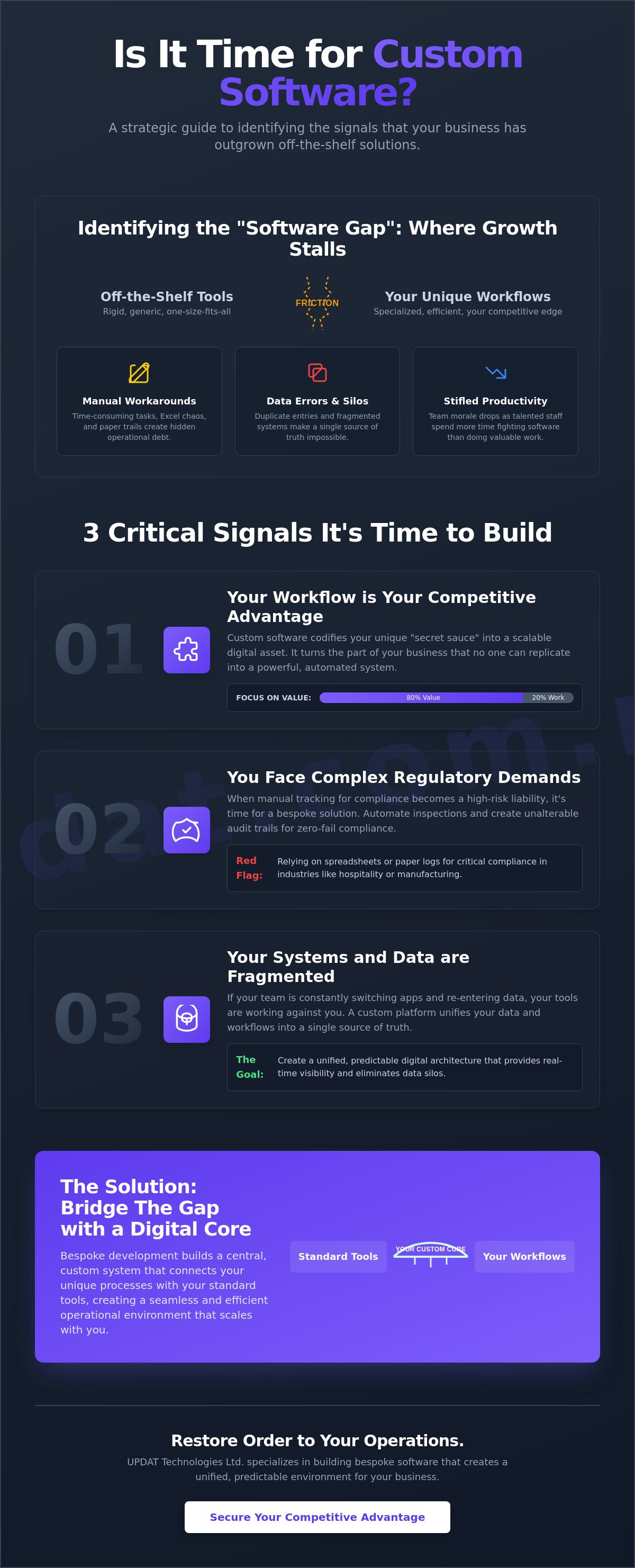
Every growing business eventually hits a wall where standard tools stop feeling helpful and start feeling restrictive. This is the Software Gap. It's the space between what your off-the-shelf software can do and what your specific business model requires to function at peak efficiency. While you might try to bridge this gap with Excel sheets or paper logs, these are temporary fixes that create hidden operational debt. These manual workarounds consume time, introduce human error, and fragment your data, making it impossible to maintain a single source of truth.
The friction isn't just financial; it's psychological. When talented staff spend hours on repetitive data entry because systems don't communicate, motivation drops. Accountability vanishes when data is scattered across three different platforms. It's vital to recognize that outgrowing your current tools is a sign of business success, not failure. It means your processes have become so specialized and effective that generic tools can no longer contain them. Understanding when to build custom software is the first step toward reclaiming your team's focus and energy.
The Myth of the "One-Size-Fits-All" Platform
"All-in-one" platforms promise simplicity but often deliver feature bloat. You pay for the entire suite while only using a fraction of the modules. The remaining features just clutter the interface and confuse your team. More importantly, generic tools force you to bend your winning workflows to fit their rigid architecture. Instead of the software serving the business, the business starts serving the software. This rigidity is a primary reason leaders look for a precise custom software definition to solve their specific bottlenecks without compromising their proprietary methods.
Recognizing the Friction in Your Current Workflows
Friction often hides in plain sight, disguised as "just part of the job." You'll know you've hit the limit when you see these red flags: duplicate data entry across multiple systems, hours spent manually generating reports, and a lack of real-time visibility into your operations. As transaction volumes increase, these small frictions compound into major losses. High-growth environments require a foundation that scales without adding headcount for every new task. This is the core of streamlining business operations with software. If your team spends more time managing the tool than doing the work, you've reached the point when to build custom software to restore order.
3 Critical Signals: When to Build Custom Software
Identifying the specific moment to move beyond standard tools requires a clear-eyed look at your operations. It's a common myth that bespoke solutions are reserved for tech giants with limitless budgets. In reality, any business seeking a higher level of order and precision must eventually decide invest in custom software development to protect their growth. There are three primary signals that indicate you've reached this strategic crossroads.
Competitive Advantage Through Bespoke Logic
If your operational workflow is identical to your competitor’s, you don't have a competitive edge; you have a commodity. Off-the-shelf software forces you to adopt "industry standard" processes that are, by definition, average. Custom software allows you to codify your unique "secret sauce" into an automated system that no one else can replicate. This transforms your proprietary knowledge into a digital asset that grows in value as your business scales. By automating the unique 20% of your business that creates 80% of your value, you secure a position that generic platforms simply cannot support.
Navigating Complex Regulatory and Compliance Landscapes
For industries like hospitality and manufacturing, compliance isn't optional. Relying on paper-based tracking or manual spreadsheets increases the risk of fines and severe reputational damage. When your regulatory burden exceeds what a generic tool can track, it's time to consider digital audit solutions. These bespoke systems ensure zero-fail compliance by automating inspections and creating unalterable audit trails. This level of precision removes the stress of manual audits and ensures your business remains a steady, reliable foundation for long-term growth.
Deep Integration Between Disparate Legacy Systems
Many businesses struggle with a "Frankenstein" architecture of legacy systems that don't talk to each other. You might have an accounting tool from 2020 and a logistics platform that lives on a local server, forcing your team to act as the manual bridge between them. When you spend more time moving data between systems than analyzing it for strategic decisions, you've found the final signal for when to build custom software. A bespoke layer acts as the connective architecture, unifying these disparate tools into a single, high-performance environment. This integration restores order and allows your team to focus on high-value tasks rather than administrative firefighting.
Recognizing these triggers early prevents the operational decay that stalls successful companies. If you see these signals in your daily workflow, exploring bespoke software development is the next logical step toward total operational mastery and predictable growth.
The ROI Framework: Build vs. Buy vs. Hybrid
Evaluating the return on investment for new technology requires moving beyond the initial price tag. Most leaders view the "build vs. buy" decision as a binary choice, but this ignores the most efficient path for modern enterprises: the hybrid model. This approach uses proven SaaS platforms for standard administrative tasks while deploying bespoke code for the core functions that drive your value. Understanding the advantages of custom software within this framework allows you to invest precisely where it impacts your bottom line. You gain the reliability of established tools and the surgical precision of a tailor-made digital architecture.
The cost of inaction often outweighs the development budget of a new system. Manual errors, fragmented data, and administrative bottlenecks act as a silent tax on your revenue. If your team spends 20% of their week fixing data entry mistakes or chasing paper trails, you aren't just losing time. You're losing the ability to scale. A true ROI calculation must include the Total Cost of Ownership (TCO), which accounts for maintenance, updates, and the long-term efficiency gains that come from a unified system. High-performance organizations recognize that when to build custom software is a question of protecting their future margins from the friction of mediocre tools.
Hidden Costs of Off-the-Shelf Subscriptions
Standard SaaS subscriptions often include a "growth penalty" through per-user pricing. As your team expands, your software costs explode without adding any new functional value. You also face the expense of "integration hell," where you pay for third-party bridges to make disparate tools communicate. Switching between five different apps to complete a single task causes a significant drop in productivity. These micro-inefficiencies compound daily, creating a massive operational drain that bespoke solutions eliminate by design.
Future-Proofing Your Digital Architecture
Custom software provides the fluidity needed to adapt to rapid market changes. In 2026, the shift toward API-first development makes bespoke builds more modular and easier to update than ever before. You can build a system today that handles 10x your current transaction volume without needing to 10x your administrative staff. This scalability ensures your digital foundation remains steady as you grow. By choosing when to build custom software based on these modular trends, you create a resilient environment that evolves alongside your business needs, rather than becoming obsolete in three years.
Strategic Readiness: Is Your Business Ready for Custom Development?
Deciding when to build custom software is only half the battle; the other half is ensuring your organization can support the transition. Bespoke development is a partnership that requires internal clarity. If your business is currently in a state of operational chaos, adding software won't fix the underlying issues. Software is an accelerant. If you digitize a broken process, you simply create faster, more expensive chaos. Success starts with a readiness audit to ensure your foundation is steady enough to build upon.
Use this brief Readiness Scorecard to evaluate your position:
• Do you have a documented, repeatable process for your core operations?
• Can you identify a single bottleneck that costs at least five hours of admin time per week?
• Is there a dedicated internal lead who understands the business logic and can provide feedback?
• Are you prepared to iterate on the solution rather than demanding a "perfect" first draft?
A vital part of this journey is the Strategic Architect. This role goes beyond simple coding. It involves a professional who acts as a bridge between your operational pain points and the technical solution. They ensure the software mirrors your winning workflows rather than forcing you to adapt to a rigid template. Many leaders hesitate because they don't have time for a massive IT project. However, bespoke development shouldn't be a "big bang" event. It's a modular process that begins by solving your most expensive problem first, restoring order in weeks rather than years.
Auditing Your Existing Operational Order
Before writing a single line of code, you must map your current "messy" flows. Identify exactly where data gets lost, where paper trails end, and where your team resorts to manual workarounds. Don't try to digitize the entire company at once. Focus on the single most painful bottleneck that restricts your ability to scale. By isolating this friction point, you create a clear target for development. This targeted approach ensures immediate utility and a faster path to operational mastery. If you're ready to move from chaos to order, start by exploring bespoke software development to build your custom roadmap.
Defining Success Metrics and KPIs
Clear goals prevent project creep and ensure a high ROI. You must define what success looks like in concrete numbers. This might mean reducing weekly admin hours by 30% or increasing audit accuracy to 100%. When you have these benchmarks, you gain essential stakeholder buy-in across the organization. Everyone from the warehouse to the boardroom needs to see how the system makes their day easier. The best software is built for the end-user, not the boardroom, because a tool that isn't used provides zero value. Prioritize ease of use and immediate impact to ensure long-term adoption and growth.
Bespoke Development with UPDAT Technologies Ltd.
UPDAT Technologies Ltd. acts as the strategic architect for Maltese national businesses. We focus on removing complexity and restoring order. Our approach doesn't involve replacing every tool you use. Instead, we combine proven SaaS platforms like AuditDAT and TimeDAT with bespoke extensions that target your specific Software Gap. This hybrid strategy ensures you have a steady, reliable foundation for long-term growth while maintaining the unique workflows that give you a competitive edge. By choosing a local partner, you gain a team that understands national regulatory standards and operational nuances. We don't offer generic development. We provide a steady foundation that integrates naturally with your existing environment. Knowing when to build custom software is about recognizing that your business deserves a digital architecture as precise as your physical operations. Custom software is the definitive path from operational chaos to standardized excellence.
The UPDAT Approach: Logic, Precision, and Order
Transitioning from manual tracking to custom software development in Malta requires a partner who values logic and precision. UPDAT Technologies Ltd. bridges the gap between your actual needs and standard capabilities without disrupting daily operations. Our systems create a seamless connection between task management and compliance. For example, ActionDAT provides real-time accountability that paper trails can't match. This transformation replaces fragmented processes with a unified, high-performance environment. We treat software as a strategic asset, ensuring it codifies your proprietary knowledge into a permanent digital structure. This results in a system that scales alongside your ambitions without increasing administrative friction.
Starting Your Transformation
Our process is modular and highly structured. We begin with a Discovery phase to map your architecture, followed by precise Execution. Determining when to build custom software is a strategic pivot that requires expert guidance. You don't need to commit to a massive, all-at-once overhaul. A bespoke solution can be phased to address your most critical bottlenecks first. This ensures immediate utility and predictable momentum. UPDAT Technologies Ltd. provides the keys for you to master your own operational environment, removing the guesswork from scaling. If you've identified the signals that it's time to evolve, take the first step toward total mastery. Restore order to your operations today with a partner who understands the digital architecture of a successful business.
Master Your Operational Environment
Achieving operational excellence requires a shift from managing fragmented tools to building a unified digital architecture. You've learned how to identify the Software Gap and recognize the critical signals for when to build custom software. Whether you're protecting proprietary workflows or navigating complex regulations in Malta, a bespoke approach ensures your systems serve your business logic. By adopting a hybrid model, you combine the reliability of established platforms with the precision of custom code.
Since 2019, UPDAT Technologies Ltd. has focused on restoring order through operational automation. We leverage proprietary platforms like AuditDAT, TimeDAT, and ActionDAT to bridge the gap between standard software and your actual needs. Our experience across the security and manufacturing sectors allows us to act as a strategic architect for your transformation. Don't let rigid off-the-shelf tools stifle your ability to scale. It's time to replace manual workarounds with a steady, high-performance foundation that evolves with you.
Consult with a Strategic Architect at UPDAT to identify your path toward predictable growth and total operational mastery.
Frequently Asked Questions
Is building custom software still worth it with so many SaaS options available?
Yes, because SaaS tools are designed for the masses. They often fail to address the specific proprietary workflows that give your company a competitive edge. Custom development creates a digital asset that you own, eliminating the recurring costs and growth penalties associated with per-user subscriptions. It's about building a foundation that fits your business perfectly rather than bending your processes to fit a generic template.
How long does a typical custom software project take to launch in 2026?
Launch timelines vary based on complexity, but many businesses see their first modular solution within 3 to 6 months. Using a phased approach allows you to solve your most painful bottleneck first. This creates immediate utility while the rest of the system is built. API-first development and cloud-native platforms have streamlined the process, making it faster to deploy secure, scalable digital architecture.
Will custom software be harder to maintain than a subscription-based tool?
Maintenance is different but often more predictable than SaaS. You aren't subject to forced updates that might break your unique integrations. While subscription tools handle their own patches, they don't account for your specific environment. A bespoke solution allows you to control the update cycle, ensuring your operational order remains steady. This long-term control is a key factor when deciding when to build custom software.
Can custom software integrate with my existing accounting or payroll systems?
Integration is a core strength of bespoke development. Custom systems are designed to act as a connective layer between your existing accounting, payroll, and logistics tools. This eliminates the need for manual data entry and reduces the risk of human error. By unifying these disparate systems, you create a single source of truth that provides real-time visibility across your entire operation.
What is the "Hybrid" software model and why is it becoming popular?
The Hybrid model uses standard SaaS for common administrative functions while deploying custom code for your "secret sauce." This approach is popular because it reduces upfront costs and development time. You get the stability of established platforms like TimeDAT for scheduling alongside bespoke extensions that handle your unique proprietary logic. It provides a balanced path to operational excellence without reinventing the wheel for every task.
How do I know if my business process is too unique for standard software?
Your process is likely too unique if you rely on spreadsheets to bridge the gaps between your current tools. If standard software covers only 80% of your needs, the remaining 20% is where your value lives. This manual friction is a clear signal of when to build custom software. If you can't find a tool that mirrors your exact workflow, it's time to build one that does.
What happens if we need to add new features to our custom software later?
Bespoke software is inherently modular and built for future adaptation. Since you own the digital architecture, you can add new features or integrations as your business scales. You aren't limited by a vendor's roadmap or proprietary constraints. This flexibility ensures your system remains a steady foundation for growth, allowing you to respond rapidly to market changes or new regulatory requirements.
How does custom software help with regulatory compliance in Malta?
Custom solutions automate the precise data collection required by Maltese national standards. Platforms like AuditDAT and ActionDAT replace paper-based logs with unalterable digital audit trails. This ensures zero-fail compliance during inspections and reduces the administrative burden on your staff. By codifying local regulations into the software logic, you remove the risk of human error and protect your professional reputation.






%201.svg)
