

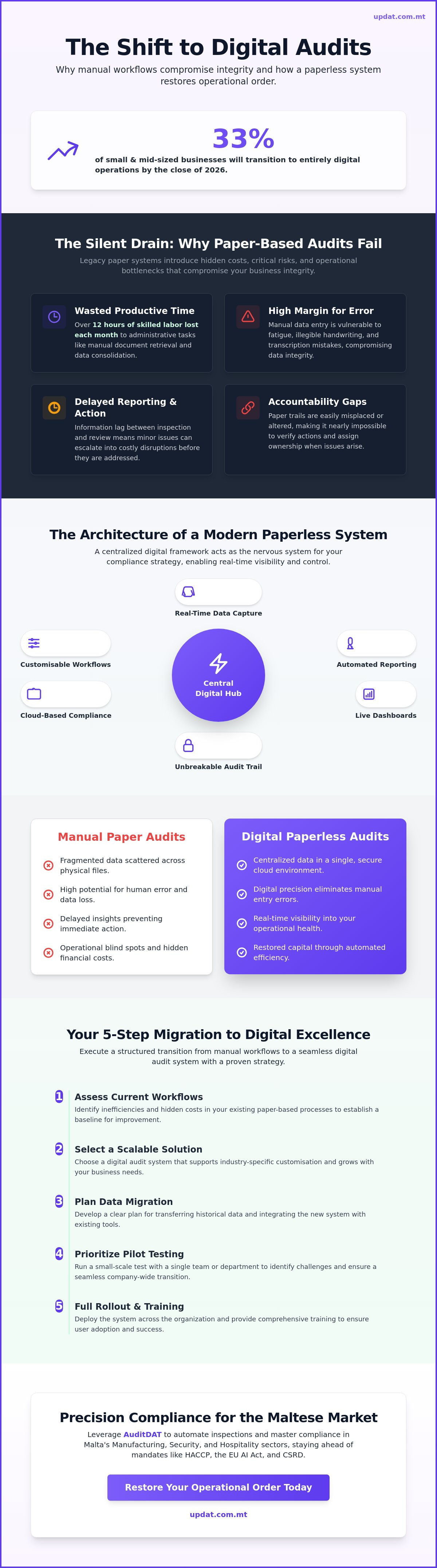
By the close of 2026, 33% of small and mid-sized businesses will have transitioned to entirely digital operations to combat the global decline in the professional accounting workforce. You've likely felt the frustration of fragmented data scattered across physical files or the sting of a human error in manual data entry. These inefficiencies lead to delayed reporting that prevents you from taking immediate corrective action when it matters most. Adopting a high-efficiency paperless audit system allows you to reclaim your time and restore operational order through a centralized digital architecture.
You deserve a system that provides total clarity and removes the complexity of modern compliance. This guide reveals how to eliminate manual errors and gain real-time visibility into your operational health. We'll examine how linking audits to tasks through specialized software like AuditDAT ensures you remain ahead of Malta's evolving audit thresholds and new EU regulatory mandates. From the August 2026 AI Act implementation to the Corporate Sustainability Reporting Directive, you'll learn to master your environment with precision and ease.
Key Takeaways
• Identify the hidden costs of physical storage and eliminate the high margin for error inherent in manual data entry.
• Deploy a centralized paperless audit system to ensure real-time data capture and cloud-based compliance across your entire organization.
• Select a scalable digital solution that supports industry-specific customisation, such as HACCP protocols for Malta's hospitality sector.
• Execute a structured five-step migration strategy that prioritizes pilot testing to ensure a seamless transition from manual workflows.
• Leverage AuditDAT to automate inspections and restore operational order within the local manufacturing, security, and hospitality markets.
The Silent Drain: Why Paper-Based Audits Compromise Business Integrity
Paper is a legacy burden that consumes space, time, and focus. While physical filing cabinets might seem like a standard part of the office landscape, they represent a significant hidden cost. Manual document retrieval forces your highly skilled team to act as filing clerks. If an employee spends just fifteen minutes searching for a specific compliance record, and your organization conducts fifty audits a month, you lose over twelve hours of productive time every month to basic administration. This inefficiency prevents your team from focusing on strategic improvements.
The "human factor" remains the greatest vulnerability in any manual workflow. Data entry on paper is prone to fatigue, illegible handwriting, and simple transcription errors. These mistakes create a high margin for error that can compromise the integrity of your entire reporting structure. Understanding the history of audit technology shows that the shift toward a paperless audit system was born from a need to eliminate these avoidable human failures. Digital precision replaces the guesswork of manual logs.
Delayed reporting is another critical failure of paper-based systems. When an inspector identifies a risk on a physical form, that information often sits on a desk or in an "outbox" for days before a manager reviews it. This lag prevents immediate corrective action. By the time the report is processed, a minor operational hiccup may have escalated into a costly disruption. Fragmented paper files also obscure the "big picture." Decision-makers cannot easily spot trends or recurring failures across different departments when data is trapped on individual sheets of paper.
The Financial Risk of Operational Blind Spots
In the Maltese market, missing documentation isn't just an inconvenience; it's a financial liability. Regulatory bodies in Malta require strict record-keeping, and failing to produce a specific audit trail during a spot check can lead to significant compliance fines. Beyond fines, you must account for the hundreds of Euro spent on administrative hours for manual data consolidation. Every hour spent merging spreadsheets or re-typing notes is revenue lost to unaddressed operational inefficiencies. A digital architecture restores this lost capital by automating the consolidation process.
Accountability Gaps in Manual Workflows
Paper trails are notoriously difficult to verify and remarkably easy to misplace. If a signature is missing or a date is altered, determining the true sequence of events becomes nearly impossible. This lack of real-time ownership means that accountability often dissolves when an issue arises. Without a paperless audit system, tracking recurring problems across different sites or branches is a manual nightmare. You lose the ability to see if a specific piece of equipment fails every three months or if a particular shift consistently misses a safety protocol. Digital systems ensure every action is timestamped and linked to a specific user, creating an unbreakable chain of responsibility.
The Architecture of a Modern Paperless Audit System
A modern paperless audit system acts as the central nervous system for your compliance strategy. It functions as a cloud-based framework that consolidates every inspection, checklist, and corrective action into a single, accessible environment. This architecture moves beyond simple document storage. It enables real-time data capture through mobile devices and tablets, allowing field inspectors to sync findings instantly with the head office. Beyond immediate efficiency, this transition supports the sustainable impact of a paperless office by reducing waste and improving long-term business performance. By implementing digital audit solutions, organizations can restore order to previously chaotic manual workflows.
Reporting becomes an automated byproduct of the audit itself rather than a separate, grueling task. The system generates multi-format reports in PDF or Excel at the touch of a button. Real-time dashboards provide a high-level view of compliance scores across multiple departments or sites. This level of visibility is impossible to achieve with paper logs. If you're looking to eliminate manual oversight, exploring the features of AuditDAT is a logical next step for your digital transformation.
Cloud-Based Centralization and Accessibility
Centralizing data in the cloud creates a single source of truth for your business. It eliminates the risk of version control issues where different departments use outdated versions of the same form. For Maltese businesses with multiple sites, "anywhere, anytime" access ensures that remote inspections are logged and reviewed without physical transport delays. Security remains paramount. These systems utilize enterprise-grade data encryption and secure user-level permissions. You control exactly who can view, edit, or approve audit data, ensuring that sensitive operational information remains protected.
Automated Data Validation and Logic
Modern digital systems enforce a standard of excellence through mandatory fields. An auditor can't submit an incomplete inspection, which guarantees data integrity across the board. Conditional logic further refines the process. If a "fail" is recorded, the paperless audit system automatically triggers follow-up questions or requires photo evidence to document the issue. GPS stamping adds a final layer of verification. It proves that the audit occurred at the correct location and time, providing an airtight audit trail for regulatory bodies. This automated logic ensures your team follows the correct procedures every time, regardless of their experience level.
Evaluating Digital Audit Solutions: A Framework for Strategic Selection
Selecting a paperless audit system requires more than a simple feature checklist. It demands a strategic evaluation of how the software fits into your long-term operational architecture. Scalability is the first pillar. A system that works for a single site must remain stable and responsive as you expand to ten or fifty locations. User experience is equally critical. If the software feels cumbersome, your team will find ways to bypass it, leading to the same data gaps you're trying to eliminate. You need a tool that empowers your workforce, not one that adds a new layer of digital friction.
Customization isn't a luxury; it's a necessity for regulatory compliance. For instance, a hospitality provider in Malta requires specific HACCP digital checklists to meet local health and safety standards. A security firm needs entirely different parameters for site patrols and incident reporting. A generic solution often fails to capture these industry nuances. Additionally, prioritize offline functionality. Many operational environments, such as underground storage facilities or remote construction sites, suffer from poor connectivity. Your system must allow data capture offline and sync automatically once a signal is restored. This ensures no data is lost during the inspection process.
Integration: Moving Beyond Isolated Audits
Most competitors treat audits as isolated events. This creates a disconnect between identifying a problem and fixing it. To restore order, your paperless audit system must link directly to task management tools. When an inspector logs a failure in AuditDAT, the system should automatically trigger a corrective task in ActionDAT. This creates a closed-loop system where issues are resolved, not just recorded. Integrating these audits with workforce management tools like TimeDAT further optimizes operations by aligning staff schedules with inspection requirements. Investing in an integrated business management system ensures your data flows seamlessly across the entire organization without manual intervention.
User Adoption and Interface Design
The best system is the one your staff actually uses every day. Adoption hinges on an intuitive, low-friction mobile interface designed for the field, not just the office. Buttons should be large, navigation should be logical, and the input process must be faster than pen and paper. For Maltese businesses, the availability of local support and training is a decisive factor. Having an expert who understands the local regulatory environment and can provide hands-on training ensures a smooth rollout. This local presence transforms a software vendor into a strategic partner that understands your specific operational challenges.
Executing the Transition: From Manual Workflows to Digital Excellence
Moving from a paper-heavy environment to a high-efficiency paperless audit system requires a structured roadmap to avoid operational friction. It isn't about simply scanning old documents or creating digital versions of flawed forms. It's an opportunity to re-engineer your business logic for maximum precision. Successful implementation follows a systematic five-step approach that prioritizes stability and team buy-in. Skipping these steps often leads to "digital clutter," where the same manual errors are simply moved from a clipboard to a screen.
Inventory
List every physical form, logbook, and checklist currently in use across all sites.
Refine
Evaluate each form for necessity. Don't digitize redundant processes; eliminate them.
Pilot
Launch a 30-day trial with a small, tech-receptive team to identify workflow bottlenecks.
Migrate
Transfer essential historical data into the new system to ensure continuity in compliance records.
Scale
Roll out the full architecture to the rest of the organization once the pilot feedback is integrated.
Change management is the engine of this transition. Resistance usually stems from a lack of clarity, so communicate the tangible benefits to the staff early. Show them how the software removes the burden of manual data entry and "admin heavy" reporting. When the team sees that their workload is actually decreasing, buy-in happens naturally. If you're ready to modernize your operations, start your digital transition with UPDAT today.
Phase 1: Workflow Mapping and Digital Translation
The first phase involves auditing your current audit process. Map the path a document takes from the inspector's hand to the manager's desk and finally to the filing cabinet. Use this map to build your digital workflows. Instead of copying a paper checklist exactly, use conditional logic to hide irrelevant questions and highlight critical ones. Establish clear key performance indicators (KPIs) to measure success. Track metrics like the reduction in missing data fields and the time saved per inspection to prove the ROI of the new system.
Phase 2: Training and Continuous Optimization
Effective staff onboarding is more than a single training session. It requires hands-on demonstrations and accessible support materials. Create a feedback loop where auditors in the field can suggest improvements to the digital forms. If a specific section of a checklist is consistently confusing or slow to complete, refine the template immediately. Use the initial data gathered during the first few months to optimize your reporting templates. This ensures the information reaching decision-makers is exactly what they need to drive growth and maintain compliance.
AuditDAT: Precision Compliance for the Maltese Market
AuditDAT stands as the definitive paperless audit system for the Maltese corporate sector. Developed by UPDAT Technologies Ltd., it addresses the specific operational burdens faced by local hospitality, manufacturing, and security firms. By digitizing the inspection lifecycle, the platform removes the complexity of manual reporting and restores a sense of calm authority to your compliance efforts. It provides a steady foundation for organizations that value logic and precision over the chaos of fragmented data. This system acts as a strategic architect, turning raw inspection data into a clear roadmap for operational mastery.
The platform is designed to handle the high stakes of modern regulatory environments without adding unnecessary friction. It empowers your team to maintain rigorous standards while reducing the time spent on administrative overhead. By choosing a solution built with deep expertise in the local MT market, you ensure that your digital architecture is aligned with both regional expectations and international best practices. UPDAT Technologies Ltd. provides the stability and reliability required for long-term growth in an increasingly digital landscape.
Bespoke Solutions for Diverse Sectors
In the hospitality sector, AuditDAT streamlines HACCP compliance with tailored digital checklists that ensure food safety standards are met without exception, even during high-traffic seasons. Security firms utilize the platform for real-time patrol tracking and incident logging, providing an immutable record of site activity that can be shared instantly with stakeholders. Manufacturing plants benefit from specialized modules designed for quality control and equipment inspections, significantly reducing the risk of costly downtime. If your operational architecture requires a unique approach, UPDAT Technologies Ltd. offers bespoke software development to build custom modules that integrate seamlessly with your existing workflows.
The UPDAT Ecosystem Advantage
The true utility of a paperless audit system is realized when it functions as part of a larger, integrated business architecture. AuditDAT works in tandem with ActionDAT to ensure that every identified failure triggers an immediate corrective task, closing the loop on accountability. You no longer have to manually follow up on audit findings; the system handles the movement of information automatically. Furthermore, linking these audits with TimeDAT allows you to analyze how workforce attendance and scheduling impact your overall compliance scores. This modular approach provides a holistic view of your business performance, enabling you to make data-driven decisions that foster long-term growth.
We invite you to see this strategic architecture in action and discover how it can transform your daily operations. Contact UPDAT Technologies Ltd. today to schedule a tailored demo and take the first step toward a more organized, results-oriented future.
Mastering Your Operational Architecture in 2026
Adopting a high-efficiency paperless audit system is the final step in securing your business integrity against the complexities of the modern regulatory landscape. You've explored how moving away from physical logs restores order and provides the real-time visibility needed to navigate Malta's evolving market with confidence. By centralizing inspections and linking them to automated tasks, you transform compliance from a recurring burden into a strategic asset that drives long-term stability.
UPDAT Technologies Ltd. was founded in 2019 with a specific focus on providing high-level efficiency to the Maltese market. Our proprietary cloud-based platforms, including AuditDAT, TimeDAT, and ActionDAT, create a unified digital architecture that supports your operational growth. For organizations with unique requirements, our bespoke software development capabilities ensure that your systems remain as adaptable as they are reliable. This integrated approach removes the friction of manual oversight and empowers you to lead with precision and logic.
Request a tailored AuditDAT demo to restore order to your compliance workflows and see how our architecture protects your business. You're now equipped with the strategy to master your environment; we're ready to provide the foundation.
Frequently Asked Questions
What is the primary benefit of a paperless audit system?
The primary benefit is the restoration of order through real-time data visibility and the elimination of manual entry errors. A paperless audit system centralizes compliance data, allowing managers to identify operational gaps the moment they occur. This immediate feedback loop prevents minor issues from escalating into major liabilities and ensures that every department adheres to a single standard of excellence.
Is a digital audit system compliant with Maltese regulatory standards?
Digital systems are fully compliant with Maltese standards and often exceed the requirements for statutory record-keeping. They provide the precise, timestamped audit trails required by local authorities during inspections or statutory reviews. By maintaining standardized digital logs, you ensure your business meets the criteria for transparency and accountability mandated by Maltese law and EU directives like the AI Act.
How long does it take to transition from paper-based audits to a digital system?
Most businesses complete the core transition within a few weeks, depending on the complexity of their existing workflows. A structured approach involves mapping current forms and conducting a short pilot phase to refine the digital logic. This measured pace ensures that the system is fully optimized for your specific site requirements before a total rollout across the organization.
Can I use a paperless audit system offline during site inspections?
You can conduct inspections in areas without an active internet connection using offline data capture capabilities. The paperless audit system stores your findings locally on the device and syncs with the cloud once a signal is restored. This functionality is essential for security patrols in remote areas, underground storage facilities, or construction sites with limited connectivity.
Do paperless audit systems integrate with payroll or workforce software?
Integration is a core feature of advanced systems like AuditDAT, which connects with workforce tools like TimeDAT. You can link audit performance directly to employee schedules and task management through ActionDAT. This synergy creates a unified digital architecture where compliance data informs broader operational decisions and workforce analytics without manual data transfer.
How secure is audit data stored in the cloud?
Your data is protected by enterprise-grade encryption and secure, user-level permissions. Cloud storage removes the physical risk of fire, theft, or misplacement associated with paper files. You maintain total control over data access, ensuring that sensitive compliance records and operational insights are only visible to authorized personnel within your organization.
What happens if our internet connection fails during an audit?
If your connection fails, the software continues to function normally by saving data to the device's internal storage. There's no risk of losing progress or data integrity during an unexpected outage. Once your device reconnects to a network, the system automatically uploads the completed audit to the central server for immediate review by management.
Is training required for staff to use a digital audit platform?
Minimal training is required because the interface is designed for intuitive, low-friction use in the field. A brief onboarding session typically covers basic navigation and photo capture features. Because the system uses mandatory fields and logical prompts, it guides the user through the process, ensuring that even staff with limited technical experience can complete audits accurately.






%201.svg)
