
Choosing the most popular software on the market often feels like the safest move, yet it frequently becomes the primary bottleneck for a growing business. When weighing off the shelf vs custom software, many leaders assume a ready-made solution is the fastest path to efficiency. However, the true cost of standard tools often reveals itself through manual data entry errors and the friction of systems that force your team to abandon their proven workflows.
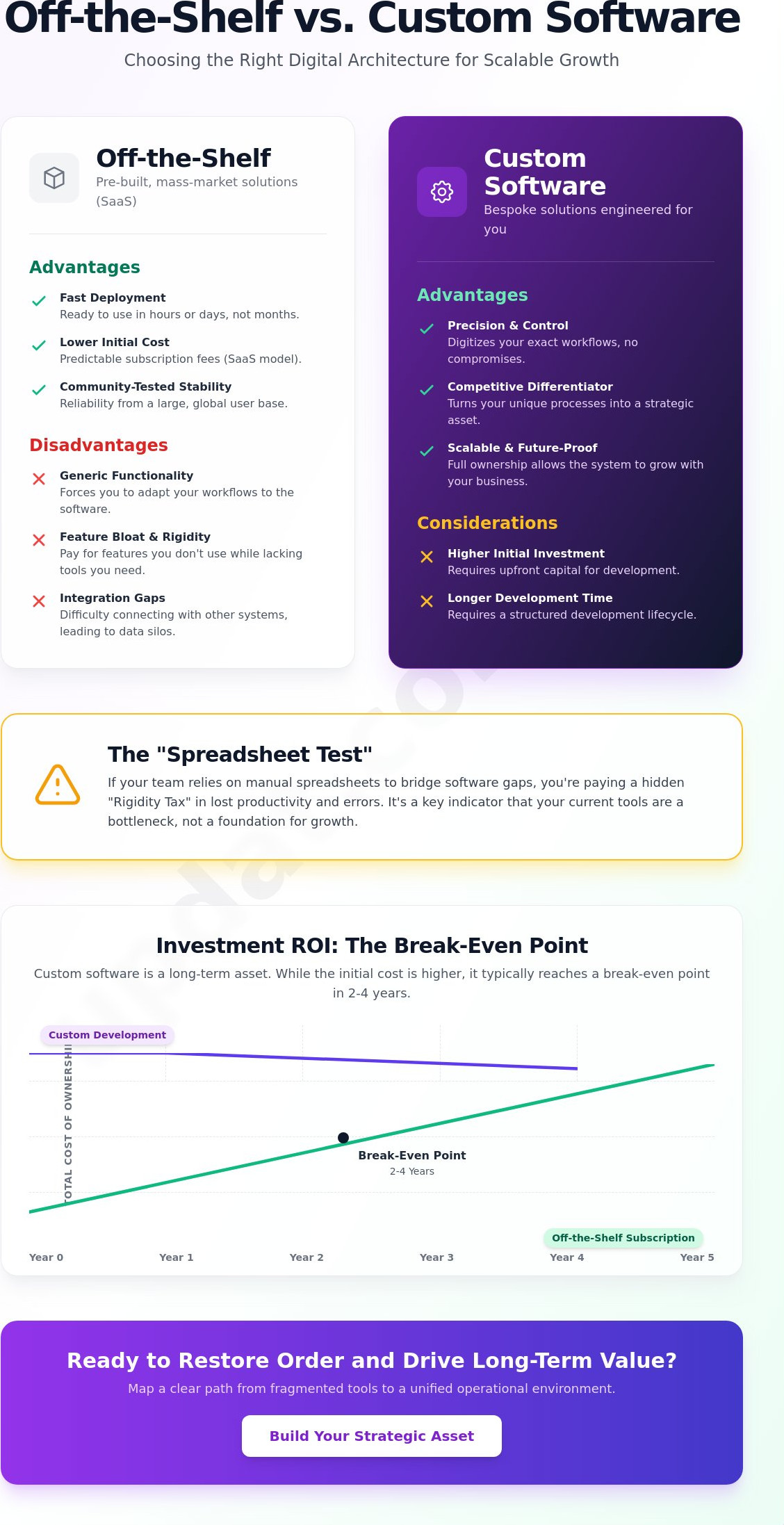
You deserve a digital architecture that adapts to your operations rather than one that demands you compromise your standards. This guide provides the strategic clarity needed to determine which solution restores order and drives long-term value. We'll examine the critical differences between bespoke builds and licensed products, noting that custom systems typically reach a break-even point within two to four years. You'll gain a clear decision framework to help you master your operational environment and build a foundation for scalable, compliant growth.
Key Takeaways
• Master the fundamental differences between mass-market utility and bespoke systems to build a digital architecture that supports your unique operational goals.
• Use our strategic 4-pillar framework to evaluate off the shelf vs custom software based on your specific budget, timeline, and complexity requirements.
• Identify the "Spreadsheet Test" to determine if your current tools are forcing inefficient manual workarounds that stifle business growth.
• Discover how bespoke software development transforms proprietary workflows into a competitive differentiator by automating your organization's unique business secrets.
• Map a clear path from fragmented, manual tools to a unified operational environment through professional workflow consultation and strategic integration.
Defining the Digital Architecture: Off-the-Shelf vs. Custom Software
Software acts as the digital foundation of a modern enterprise. It's the invisible framework that dictates how information flows, how tasks are prioritized, and how value is delivered to your clients. When leaders evaluate off the shelf vs custom software, they aren't just buying a product; they're choosing an operational philosophy. This choice determines whether your team will spend their days fighting against rigid interfaces or working within a system designed to amplify their strengths. The fundamental trade-off is simple: you must choose between immediate availability and long-term operational precision.
What is Off-the-Shelf Software?
Off-the-shelf software, often referred to as Commercial Off-The-Shelf (COTS), consists of pre-built applications designed for mass-market consumption. These tools are typically delivered via a Software-as-a-Service (SaaS) model, allowing for near-instant deployment and predictable subscription costs. Popular examples include generic CRM platforms, standard accounting packages, and basic task management applications. The primary appeal lies in the speed-to-market and the community-tested stability that comes with a large, global user base.
However, the convenience of ready-made solutions often introduces the "Broad Audience" trap. Because these products must appeal to thousands of different companies, they prioritize generic utility over specific excellence. You might find your team performing manual workarounds or using external spreadsheets just to bridge the gaps where the software fails to meet your industry's unique regulatory requirements. You're effectively paying for a bloated feature set while lacking the precise tools necessary for true operational mastery.
What is Custom Software Development?
Custom software is a bespoke digital solution engineered from the ground up to solve an organization's specific challenges. It doesn't ask you to change your proven workflows; it digitizes them. This approach grants you full ownership of the source code, enabling a level of fluidity and adaptation that generic tools can't match. Whether it's integrating with legacy hardware or automating a proprietary business process, bespoke systems provide a scalable architecture that grows alongside your company.
The role of system architecture in custom builds is to mirror your exact business logic. Every button, database field, and automated trigger exists because it serves a function in your operational environment. Navigating this process requires a disciplined approach, often following a structured Custom Software Development Lifecycle. This ensures the final product isn't just a piece of software, but a strategic asset that removes complexity and restores order to your daily operations. By building on your own terms, you eliminate the friction of mismatched tools and create a foundation for sustained efficiency.
Evaluating the Operational Impact of Ready-Made Solutions
Speed remains the most compelling argument for adopting ready-made platforms. In the debate of off the shelf vs custom software, the ability to deploy a solution in hours rather than months offers immediate relief to disorganized teams. These mass-market tools provide a sense of security through community-tested stability. When thousands of organizations use the same code, bugs are identified and patched quickly. You receive a polished product that benefits from the collective feedback of a global user base, ensuring a baseline level of reliability from day one.
The Advantages: Speed and Standardisation
Ready-made solutions excel at handling non-strategic processes. General office productivity, standard accounting, and basic email management don't require unique business logic. By adopting these tools, you gain access to industry best practices embedded directly into the software. The financial barrier to entry is also significantly lower. Most vendors utilize a subscription model that offers predictable monthly costs. This allows small to medium enterprises to access sophisticated technology without the heavy capital expenditure associated with a full-scale development project.
The Disadvantages: Feature Bloat and Integration Gaps
The convenience of ready-made software often comes with a hidden "Rigidity Tax." This is the administrative cost of manual workarounds required when a generic tool cannot accommodate your specific workflows. In specialized sectors like security, hospitality, or manufacturing, this rigidity becomes a bottleneck. You might find that a platform designed for general retail fails to handle complex digital audits or the nuances of high-stakes workforce management. You end up paying for "Feature Overload," where your subscription covers dozens of tools your team never uses, while the specific functionality you need is missing.
Integration gaps represent another significant operational risk. Generic platforms often struggle to communicate with legacy systems or specialized hardware, such as biometric readers or industrial sensors. This lack of fluidity forces employees to perform manual data entry, which introduces errors and drains productivity. Furthermore, you face the risk of vendor lock-in. Your operational data is held within a proprietary framework, making it difficult to extract for specialized reporting or to migrate if your needs change. If you are ready to move beyond these limitations and regain control over your data, you can get started today to explore a more adaptable architecture. Relying solely on popular tools can lead to "SaaS Sameness," where your business operations are restricted by the same limitations as your competitors, preventing you from turning your unique processes into a strategic advantage.
The Strategic Case for Bespoke Software Development
Bespoke software development is a strategic investment in your company’s unique operational architecture. While ready-made tools force you to conform to a standard, custom systems automate your specific business secrets, those proprietary workflows that give you a competitive edge. This approach eliminates the operational cracks where task tracking fails and prioritization becomes guesswork. You aren't just buying a tool; you're building a digital asset that mirrors your exact business logic.
When analyzing off the shelf vs custom software, the long-term return on investment (ROI) often centers on administrative efficiency. A system designed specifically for your logic removes the friction of manual data entry and multi-platform synchronization. You trade a higher initial development cost for massive, recurring savings in labor hours and error reduction. This precision grants you total control over the user experience, ensuring your team works within an environment that empowers them rather than restricts them.
Scalability and Future-Proofing
A primary limitation of generic tools is the feature ceiling. As your headcount grows and your processes become more complex, you often find yourself outgrowing your subscription within three years. Custom code expands alongside your business. You maintain total control over the data security and architectural roadmap, ensuring your foundation remains stable as you scale. Understanding when to build custom software is essential for leaders who prioritize long-term stability over short-term convenience. It removes the need for disruptive migrations and allows for a fluid digital evolution.
Mastering Industry-Specific Compliance
In high-stakes environments, generic software often fails to meet rigorous regulatory standards. Bespoke solutions allow you to tailor digital audits to meet specific Maltese requirements, particularly in the Hospitality and Manufacturing sectors. You can automate complex payroll reporting based on local labor laws and intricate shift patterns that standard software simply doesn't recognize. In the Security sector, this level of precision ensures absolute accountability and data integrity. By building a system that understands your specific legal and operational landscape, you restore order and protect your business from the risks of non-compliance.
Selection Framework: Identifying the Right Path for Your Business
Determining the right path requires a cold, analytical look at your current operations. When choosing between off the shelf vs custom software, most leaders focus solely on the sticker price. This is a mistake. You must evaluate your decision through four strategic pillars: Budget, Timeline, Complexity, and Strategy. If the software manages a standard process like general office communication, buy a license. If it handles complex shift patterns for a security firm or digital audits for a manufacturing plant, building is often the only way to maintain order.
The "Spreadsheet Test" serves as an immediate diagnostic tool for your organization. Look at your team's daily activity. If they spend hours in Excel to bridge the gaps between your existing tools, your current digital architecture is failing. This manual patchwork is a clear signal that you need a custom solution. You aren't just paying for software; you're paying to remove the friction that prevents your team from performing at their peak.
Strategic importance is the final filter. Is this software part of your core value proposition? If your operational efficiency is what makes you better than your competitors in the hospitality sector, don't outsource that logic to a generic vendor. You'll end up paying short-term licensing fees that mask a much higher long-term total cost of ownership (TCO) through lost productivity and missed opportunities.
Decision Matrix: Buy vs. Build
Standard processes with tight deadlines and limited R&D budgets favor buying. Proprietary workflows and the need for high-level data security demand building. Sometimes, a "Hybrid" approach provides the most efficient route. Specialized platforms like AuditDAT or TimeDAT offer the precision of a bespoke build with the deployment speed of a ready-made tool. These systems are architected for high-stakes environments like security and manufacturing where accountability is non-negotiable.
Calculating the Real ROI
True ROI goes beyond the initial price tag. You must factor in training time, ongoing maintenance, and the tangible productivity gains from a streamlined workflow. We define ROI as the delta between administrative hours saved and the total cost of development. Don't ignore the "Cost of Doing Nothing." Failing to upgrade an inefficient system leads to manual errors and potential compliance fines that far outweigh the cost of a modern digital solution. If you're ready to stop patching gaps and start building a foundation for growth, register your account to begin your transition to operational mastery.
Navigating the Transition: From Generic Tools to Operational Mastery
Transitioning from fragmented, manual tools to a unified digital architecture requires more than just a new subscription. It demands a fundamental shift in how you view your business processes. When organizations weigh off the shelf vs custom software, the goal shouldn't just be replacement. The goal is the restoration of order. We act as your strategic architect, identifying where a specialized platform provides immediate stability and where a bespoke build is necessary to protect your competitive advantage. This structured approach ensures that every digital element serves a specific purpose within your operational environment.
Professional consultation is the bridge between chaos and mastery. By mapping your existing workflows, we uncover the hidden cracks where data is lost or tasks are forgotten. Automation then steps in to handle repetitive, low-value activities, freeing your team to focus on high-level strategy. It doesn't just speed things up; it enforces a standard of excellence that manual processes can't match. When your digital architecture automatically flags a compliance gap or optimizes a shift pattern, you've moved from reactive management to proactive mastery. This transformation removes complexity and hands you the keys to your own operational environment.
Audit and Mapping: The First Step to Efficiency
Restoring order begins with a cold, analytical look at your current limitations. We identify specific bottlenecks in your Workforce Management or Compliance Tracking to see where manual friction is slowing you down. UPDAT's consultation process determines if your needs are best met by our specialized platforms or a completely bespoke solution. By digitizing paper-based workflows, we significantly reduce administrative overhead. You eliminate the risk of human error in high-stakes reporting and ensure that your data remains a reliable foundation for long-term growth.
Building for Operational Excellence
A system is only as effective as the team using it. We prioritize user-centric design to ensure high adoption rates across all levels of your organization. This focus prevents the software rejection often seen with rigid, off-the-shelf tools that don't fit the team's reality. By integrating task prioritization directly into the architecture, we stop critical projects from falling through the cracks. This creates a fluid, predictable rhythm that supports the physical and digital architecture of your business. If you're ready to move beyond generic limitations and claim mastery over your operations, request a demo today. Discover how our bespoke and platform solutions provide the steady foundation your business needs to scale with precision.
Master Your Operational Environment
The choice between off the shelf vs custom software is a strategic pivot that defines your business's future fluidity. You've explored how ready-made tools offer speed, while bespoke systems eliminate the manual workarounds that drain your team's energy. Establishing a clear decision framework allows you to invest in a digital architecture that mirrors your proprietary workflows. It's about moving from a reactive state to a position of calm, organized authority.
Since 2019, UPDAT has acted as a strategic architect for businesses navigating Maltese regulatory landscapes. We provide specialized solutions for the Hospitality, Manufacturing, and Security sectors. Our expertise covers both bespoke development and high-level SaaS platforms like AuditDAT. We focus on removing complexity and restoring order to high-stakes environments. You don't have to compromise your proven processes for rigid technology.
Book a consultation with UPDAT to build your strategic software roadmap. Empower your team with a foundation designed for long-term growth and operational excellence.
Frequently Asked Questions
Is custom software always more expensive than off-the-shelf software?
Custom software isn't always the most expensive option when you calculate the Total Cost of Ownership over three to five years. While initial development requires a higher capital outlay, bespoke systems typically reach a break-even point within two to four years compared to recurring licensing fees. When analyzing off the shelf vs custom software, remember that SaaS costs can balloon by 2.5x to 4x when you factor in scaling per-seat fees and integration needs.
How long does it typically take to develop a bespoke software solution?
A standard custom development project typically takes approximately 13 months to reach full deployment. This timeline ensures the system architecture is robust, secure, and perfectly aligned with your operational logic. While off-the-shelf products offer near-instant access, the time invested in a bespoke build results in a foundation that grows with your headcount without requiring a platform migration every few years. It is an investment in long-term stability.
Can off-the-shelf software be customized to fit my specific business needs?
Most ready-made platforms offer limited configuration, such as custom fields or dashboard layouts, but they don't allow for true customization of the core logic. You cannot alter the source code to match a proprietary workflow. This often forces your team to adapt their proven methods to fit the software's limitations, which is the opposite of operational mastery. True bespoke builds provide the fluidity needed for specialized industry requirements.
What are the hidden costs of using generic off-the-shelf software?
The hidden costs of generic software often center on the "Rigidity Tax" and administrative friction. You pay for "Feature Bloat" by subscribing to tools your team never uses while still needing manual workarounds for your specific tasks. Additionally, the shift toward hybrid pricing models in 2026 makes cost forecasting more complex, as many vendors now combine seat fees with AI usage meters and outcome-based billing, leading to unpredictable monthly expenses.
Is bespoke software harder to maintain than a standard SaaS subscription?
Maintaining a bespoke system is a strategic choice that offers total control over your digital environment. Annual maintenance typically costs 15% to 25% of the initial development price, covering security patches and performance optimization. Unlike standard SaaS subscriptions, you aren't subject to forced vendor updates that disrupt your team's workflow. This stability ensures your architecture remains a reliable foundation for long-term growth and Maltese regulatory compliance.
How do I know if my business process is 'strategic' enough to warrant custom development?
Your process warrants custom development if it serves as a competitive differentiator or if it fails the "Spreadsheet Test." If your team lives in Excel to bridge gaps between existing tools, your current software is a bottleneck. In sectors like manufacturing or security, processes that handle unique business secrets or complex regulatory compliance are too strategic to be managed by generic, mass-market utility tools that your competitors also use.
Can custom software integrate with the hardware I already use in my facility?
Seamless hardware integration is a core benefit of bespoke development. Unlike generic tools that struggle with compatibility, custom systems are engineered to communicate directly with your existing facility architecture. This includes industrial sensors, legacy machinery, and specialized biometric readers. This direct connection removes the need for manual data entry, reducing human error and ensuring that your information flows without friction across the entire organization.
What happens to my data if I decide to switch from an off-the-shelf provider?
Switching from an off-the-shelf provider often reveals the risks of vendor lock-in. Your operational data is held within a proprietary framework, and extracting it can be difficult, expensive, or limited to non-relational formats. When comparing off the shelf vs custom software, remember that bespoke solutions grant you full ownership of your data and source code. This ownership provides the ultimate flexibility to adapt or migrate your systems as your business evolves.






%201.svg)
