

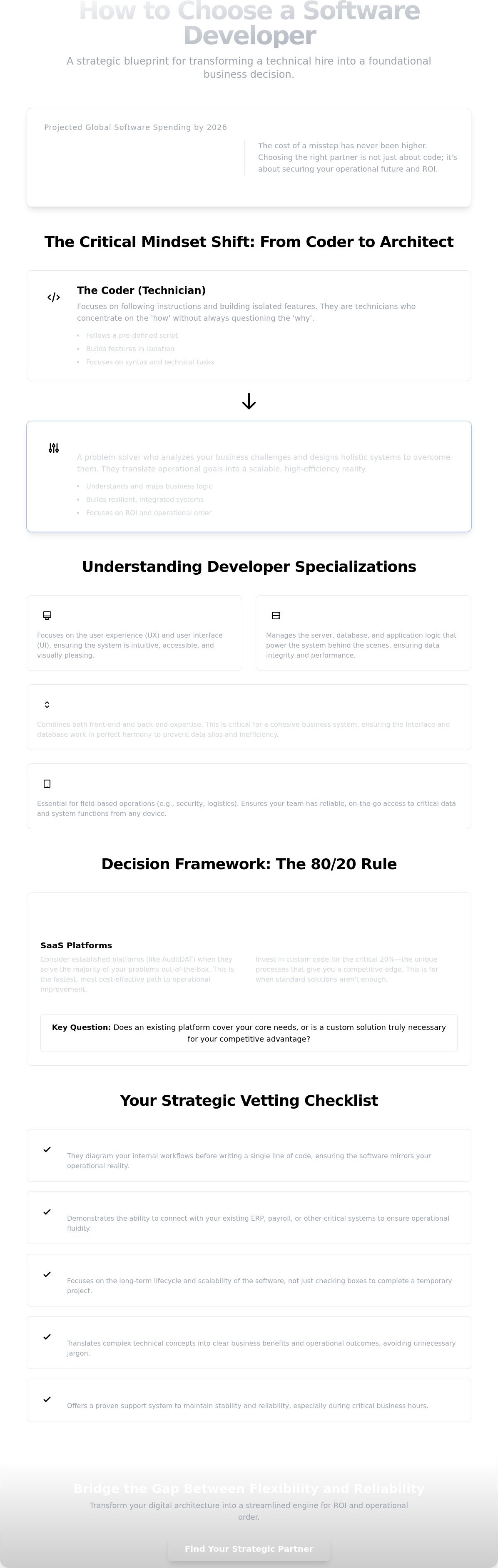
What if your next software project wasn't just a technical hire, but the strategic architectural decision that defines your business foundation? With global software spending projected to exceed $1.4 trillion in 2026, the cost of a misstep has never been higher. You've likely experienced the frustration of missed deadlines or the lingering fear that your new system will become obsolete before it delivers a return. Learning how to choose a software developer is about more than evaluating code; it's about identifying a partner who can translate your operational goals into a scalable, high-efficiency reality.
It's easy to feel overwhelmed by the complexity of cloud-native adoption and the rapid integration of AI. We understand that you need order and clarity, not more technical jargon. This guide promises to hand you the keys to a master selection process, ensuring you find a reliable, long-term technical partner. We will preview the critical steps to distinguish between specialties, maximize your ROI through automation, and leverage strategic advantages like Malta's R&D super-deductions. Prepare to replace operational chaos with a steady, results-oriented framework for growth.
Key Takeaways
• Shift your perspective from hiring a coder to selecting a strategic architect who understands business logic. Learn to prioritize developers who solve operational problems rather than those who simply follow instructions.
• Master how to choose a software developer by evaluating their ability to integrate with existing ERP or payroll systems. This alignment ensures your software investment drives immediate operational fluidity.
• Use the 80/20 rule to decide between bespoke software development and established SaaS platforms like AuditDAT. Determine if custom code is worth the investment when a platform already solves the majority of your needs.
• Audit your potential partner's support structure and portfolio for operational complexity. Ensure they offer the reliable foundation required to maintain system stability during critical business hours.
• Position your business for long-term growth by choosing a partner that bridges the gap between flexibility and reliability. Transform your digital architecture into a streamlined engine for ROI and operational order.
Identifying the Right Expertise for Your Business Operations
Think of a software developer as the strategic architect of your business logic. They don't just write code; they build the digital infrastructure that supports your daily operations. Learning how to choose a software developer requires you to look beyond technical fluency. You need a partner who understands that the primary goal of any project is to restore operational order. Systems should adapt to your business, not the other way around.
Distinguish between coders and developers early in your search. Coders are technicians who follow instructions to build isolated features. They focus on the 'how' without often questioning the 'why.' Developers are problem-solvers who analyze your business hurdles and design systems to overcome them. Industry-specific experience often outweighs generic coding skills. A developer who understands the unique pressures of hospitality or the regulatory needs of manufacturing will build a more resilient system than one who only knows a programming language. They anticipate bottlenecks before they occur. When you understand how to choose a software developer who prioritizes logic over mere syntax, you secure your business's future.
The software development process is most effective when it focuses on removing complexity from your environment. It requires a disciplined approach to mapping out every touchpoint of your service delivery. This foundation ensures the final product mirrors the fluidity of your actual business operations.
Understanding Developer Specialisations
Specialisations dictate how your team interacts with the system. Front-end developers focus on the user experience, ensuring the interface is intuitive and accessible. Back-end developers manage the data and logic that power the application from behind the scenes. For a cohesive business system, prioritize full-stack capability. This ensures that the visual interface and the underlying database work in perfect harmony, preventing data silos that cripple efficiency. Mobile-first development is particularly critical for field-based operations like security. Your team needs reliable access to data while on the move, not just when sitting at a desk. A fragmented system is an unreliable system.
The Role of Business Logic in Software Design
Your developer must master your workflow before writing a single line of code. They should be able to diagram your internal processes as clearly as your operations manager. Without this understanding, bespoke projects often fall victim to feature creep. This happens when unnecessary functions are added, diluting the software's effectiveness and inflating costs. A strategic lead keeps the project focused on your core objectives. Business logic is the digital translation of your physical operational rules. When this logic is sound, your software becomes an invisible engine of efficiency. It automates mundane tasks, removes human error, and provides a clear ROI on your investment. You gain the power to scale without increasing your administrative burden.
Evaluating Technical Proficiency and Strategic Alignment
Technical proficiency is the baseline for any hire, but strategic alignment determines the success of your business architecture. When you research how to choose a software developer, you must look for a partner who adopts a product mindset rather than a project mindset. A project mindset is temporary; it focuses on checking boxes and reaching an end date. In contrast, a product mindset focuses on the long-term lifecycle of the software. This approach ensures the developer builds with future scalability in mind, anticipating how your system must evolve as your business grows. They take ownership of the business outcome, not just the lines of code.
Communication serves as the most reliable indicator of strategic alignment. Evaluate whether the developer speaks in technical jargon or in business outcomes. A true partner translates complex concepts into clear operational benefits. They should explain how a specific database structure improves your reporting speed or how a cloud-native approach reduces downtime. When understanding how to choose a software developer, consider their internal Developer Experience (DevEx) because streamlined workflows on their end translate to more stable deployments for you. High-level efficiency in their own environment is a precursor to the order they will bring to yours.
The Integration Litmus Test
Integration capability is the ultimate benchmark for technical maturity. Your software cannot exist in a vacuum. It must communicate seamlessly with your existing ERP, CRM, or payroll systems. Demand an API-first design. This approach ensures your software is modular and ready to connect with future technologies without requiring a complete overhaul. Seamlessly integrating new tools with your Workforce Management Software in Malta removes the friction of manual data entry. If a developer cannot explain their strategy for data fluidity across your current stack, they aren't the right fit for a complex operational environment.
Strategic Communication and Problem Solving
Identify a developer who proactively spots operational bottlenecks before they become critical failures. The most valuable technical partners are those comfortable saying "no" to inefficient feature requests. They act as a guardrail against feature creep, keeping your system lean and focused on core utility. During your initial consultation, look for a sense of calm authority. They should ask probing questions about your workflow that you haven't considered. This proactive problem-solving demonstrates they are thinking about your digital architecture as a foundation for growth. You aren't just buying a service; you're investing in a steady, reliable foundation. Begin your journey toward operational clarity by registering for a trial today.
Bespoke Development vs. Ready-to-Use SaaS Platforms
A common misconception in digital transformation is that "custom" always equals "superior." When you evaluate how to choose a software developer, you must decide whether to build a unique architecture from scratch or leverage an established foundation like AuditDAT. This is a high-stakes financial decision. Custom development offers total control, but it carries significant maintenance burdens and longer lead times. You're responsible for every update, security patch, and bug fix for the life of the system.
Apply the 80/20 rule to your operations. If a modular SaaS platform satisfies 80% of your requirements, ask yourself if the remaining 20% is worth the exponential increase in cost and time. Often, the "unique" aspects of a business are actually standard administrative hurdles that existing platforms have already solved. Speed-to-market is another critical factor. A custom build can take six months or more to deploy. A SaaS solution can be operational in days. In a fast-moving market, waiting for a bespoke build can result in lost revenue and missed opportunities.
Custom software isn't a requirement for success; it's a tool for specific needs. Many businesses find that a hybrid approach provides the best ROI. They use robust platforms for core functions and reserve bespoke development for the few areas that truly differentiate them in the market. Understanding this distinction is a vital part of learning how to choose a software developer who respects your budget and your timeline.
When to Choose Bespoke Development
Custom builds are necessary when your workflow is a proprietary competitive advantage. If your specific method of service delivery is what sets you apart from competitors, don't compromise on a generic tool. Highly specific regulatory requirements also demand a tailored approach. For these scenarios, Custom Software Development in Malta provides the precision needed to maintain compliance without sacrificing efficiency. It ensures your digital tools mirror your exact operational rules.
The Power of Modular SaaS Solutions
Modular platforms like TimeDAT deliver enterprise-grade features without the heavy lifting of a ground-up build. These systems benefit from shared infrastructure costs and continuous security updates. In 2026, "ready-to-use" doesn't mean "inflexible." Modern SaaS is designed for adaptation, allowing you to configure workflows to match your physical operational environment. You gain a steady, reliable foundation that evolves alongside industry standards, removing the risk of technical obsolescence.
The Strategic Partnership Checklist: Vetting Your Developer
Vetting is the final filter in your selection process. It transforms a list of potential candidates into a reliable technical foundation for your company. To master how to choose a software developer, follow a structured checklist that prioritizes operational stability over surface-level features. You need a partner who understands the digital architecture of a business, not just a vendor who writes code. This process ensures your investment results in a streamlined environment rather than a source of new complexity.
Review portfolios for operational complexity
Don't be distracted by visual design. Look for evidence that they have managed intricate data flows, high-volume transactions, and multi-user environments.
Verify the support structure
Ask specific questions about their response times during critical failures. A partner who vanishes when a system goes down is a liability.
Check for regulatory knowledge
This is non-negotiable for sectors like health and safety where compliance errors carry legal and financial risks.
Interview existing clients
Ask about long-term responsiveness. You want to know how the developer handles updates and bugs six months after the final payment.
• Review the pricing structure: Ensure it is transparent. Look for models that scale naturally with your data volume or user count without hidden fees.
Vetting for Long-Term Stability
Documentation standards are the insurance policy for your digital architecture. Ask to see a sample of their technical documentation. If a developer cannot provide a clear map of the code they write, you become tethered to them indefinitely. A professional partner ensures that another qualified developer could take over the system if needed. Evaluate their financial stability and historical longevity as well. For high-stakes industries like oil and gas, a local Maltese presence provides a layer of accountability and immediate accessibility that offshore teams cannot match. Stability is the prerequisite for growth.
The Proof of Performance
Learning how to choose a software developer requires a commitment to due diligence. Request a demo of a system they built for an industry with similar operational hurdles. Look for case studies that go beyond "customer satisfaction" to provide concrete data. You want to see metrics on administrative time saved or compliance risks reduced. This evidence proves they can deliver Operational Efficiency Software Malta that actually improves your bottom line. A developer who can quantify their impact is a developer who understands business logic. Start building your steady foundation by registering for a trial today.
Why UPDAT is the Strategic Choice for Maltese Enterprises
Selecting a technical partner is a decision that dictates the digital architecture of your business for years. At UPDAT, we position ourselves as the bridge between bespoke flexibility and SaaS reliability. We understand that Maltese enterprises face unique operational hurdles, from strict regulatory compliance to complex workforce management. When you evaluate how to choose a software developer, look for a partner who acts as a strategic architect. We don't just write code; we restore order by removing the friction from your daily workflows.
Our versatility spans across several critical sectors, allowing us to apply proven logic to diverse environments. Whether you operate in hospitality, manufacturing, or facilities management, our systems adapt to your physical operational rules. This cross-industry expertise ensures that we don't just solve immediate problems but build scalable foundations for future growth. Our integrated ecosystem provides the tools necessary to master every facet of your business:
• AuditDAT: Streamline your compliance and inspection processes with digital precision.
• TimeDAT: Master workforce management through automated tracking and reporting.
ActionDAT
Drive accountability by turning operational insights into immediate tasks.
Bespoke Software Development
Create tailored solutions for proprietary workflows that demand total control.
A Result-Oriented Approach to Development
Our process begins with a deep consultative phase. We identify hidden inefficiencies in your current workflow that often go unnoticed during standard operations. This "Master of Operations" persona ensures that every line of code serves a specific business outcome. By understanding how to choose a software developer who values logic above all else, you empower your team to focus on high-value tasks rather than administrative manual work. We provide calm, authoritative support that keeps your systems steady and your data fluid. Our commitment is to the removal of complexity and the restoration of high-level efficiency.
The Next Step in Your Digital Transformation
Moving from paper-based chaos to digital mastery requires a partner who values precision. We invite you to view our operational excellence solutions to see how we can transform your business environment. Stop struggling with fragmented systems that hinder your ROI and create unnecessary administrative noise. UPDAT acts as the strategic architect for businesses that demand clarity, logic, and a reliable foundation for long-term growth.
Mastering Your Digital Architecture
You now possess the framework to move from operational complexity to systemic order. Mastering how to choose a software developer requires you to prioritize business logic over mere syntax. You've learned to distinguish between tactical coders and strategic architects who build for long-term ROI. Whether you leverage the immediate utility of modular platforms or invest in bespoke development, your goal remains the restoration of efficiency.
Founded in 2019, UPDAT focuses specifically on Maltese operational needs. Our proprietary platforms, AuditDAT and TimeDAT, are used across multiple sectors to simplify regulatory compliance and automated reporting. We act as the steady foundation your business needs to scale with precision. Take the final step toward operational excellence today. Book a Strategic Consultation with UPDAT to align your technical requirements with your business goals. Your journey toward a more organized, masterfully controlled environment starts here.
Frequently Asked Questions
How do I choose between a freelancer and a software development agency?
Choose an agency for complex, long-term business systems and a freelancer for small, isolated tasks. Freelancers offer lower initial costs but carry higher risks regarding availability and specialized expertise. Agencies provide a collective team of architects, project managers, and quality assurance specialists. When you research how to choose a software developer for mission-critical operations, the stability and comprehensive support of an agency usually outweigh the savings of an individual.
What are the most important questions to ask a software developer before hiring?
Ask about their specific strategy for system downtime and their protocol for managing technical debt. You must know if they prioritize business logic over mere features. Inquire about their documentation standards and post-launch support structures. A strategic developer will explain how their solution integrates with your existing ERP or payroll tools. Their ability to translate technical steps into clear business outcomes reveals their level of professional expertise.
Should I choose a developer based on their hourly rate or project fee?
Opt for a project fee when the scope is clearly defined and an hourly rate for evolving, complex builds. Fixed prices offer budget certainty but often lack the flexibility needed for innovation. Hourly rates, often called Time and Materials models, allow for fluid adaptation as operational requirements change. Focus on the total ROI rather than the initial cost. A partner who understands how to choose a software developer model that fits your risk profile is essential.
How long does the custom software development process typically take?
Custom software development typically takes between four and nine months depending on the complexity of the digital architecture. A simple Minimum Viable Product might be ready in three months; however, enterprise-grade platforms require extensive testing and integration. Factors like third-party API connections and regulatory compliance checks influence the final timeline. Always build a buffer into your schedule to account for the iterative nature of the professional development process.
Do I need a developer who specializes in my specific industry?
Yes, industry specialization is critical for projects involving complex regulatory rules or proprietary workflows. A developer with experience in your sector, such as manufacturing or facilities management, already understands your specific bottlenecks. They won't waste time learning basic industry logic from scratch. This specialized knowledge leads to a more resilient system that anticipates sector-specific challenges like health and safety compliance or high-stakes data security requirements.
What happens to the software code if the developer goes out of business?
Ensure your contract includes a clause for full code ownership and immediate access to the source repository. Professional developers use platforms like GitHub where you should hold administrative rights. If the developer closes, you can hand the well-documented code to a new partner. Verify that they follow industry-standard documentation practices during the build. This transparency protects your digital assets and ensures your business operations remain steady regardless of the vendor's status.
How do I know if my business is ready for custom software development?
Your business is ready when manual processes or off-the-shelf tools actively hinder your ability to scale. If you spend more time managing data silos than serving clients, it is time for a tailored solution. Review your operational inefficiencies and calculate the cost of human error. A clear need for automation and a desire for a unified digital foundation are the primary indicators that you require a strategic technical architect.






%201.svg)
