
Most Maltese enterprises are currently operating with digital architectures that are fundamentally at odds with their physical workflows. You likely recognize the friction of fragmented data across different platforms, or the frustration of manual payroll errors that drain your management team's time. In a market where 68.3% of local businesses already leverage AI and cloud technologies, staying competitive requires more than just adding new apps; it requires a unified foundation. Implementing the right operational efficiency software malta is the only way to restore order and ensure your business meets the strict requirements of the EU AI Act by the August 2, 2026 deadline.
We understand that maintaining compliance in regulated sectors like hospitality feels like a moving target. This article demonstrates how integrated systems eliminate data silos, automate reporting, and provide the centralized control necessary for sustainable growth. You'll discover how to utilize the Digitalise Your SME grant scheme, which offers up to €235,400 for AI-integrated projects, to fund your transition. We will preview how bespoke software development and tools like TimeDAT and ActionDAT can turn your administrative burden into a streamlined strategic advantage.
Key Takeaways
• Understand the transition from software as a simple tool to essential digital infrastructure that serves as a single source of truth for your entire enterprise.
• Identify the critical pillars of operational efficiency software malta, focusing on the integration of digital audits and intelligent workforce management.
• Compare the performance and training advantages of unified digital architectures over fragmented, siloed platforms to reduce administrative friction.
• Learn how to evaluate management systems against specific local requirements, including Maltese labor laws and industry-specific compliance like HACCP.
• Discover the UPDAT methodology for mapping physical workflows to digital solutions, ensuring tools like AuditDAT and TimeDAT provide total operational visibility.
What defines an integrated business management system in 2026?
In 2026, an integrated business management system functions as a unified digital ecosystem. It connects disparate business functions into a single source of truth, ensuring that every department operates from the same data set. This represents a fundamental shift for Maltese enterprises. Software is no longer just a tool for specific tasks; it has become the core infrastructure of the organization. By centralizing data, businesses eliminate the friction caused by digital fatigue, where employees struggle to manage dozens of disconnected applications.
With the €15 million budget for Call 2 of the "Digitalise Your SME" scheme opening in July 2026, the transition from fragmented tools to robust infrastructure is now financially viable for local firms. Effective systems rely on the principles of Business process management (BPM) to discover, model, and optimize every workflow. This approach ensures that your operational efficiency software malta isn't just a digital filing cabinet. It becomes a dynamic engine that drives measurable results. Cloud-based platforms provide real-time visibility across national operations, allowing directors to monitor site-specific compliance or labor costs instantly.
Beyond ERP: The evolution of operational software
Traditional ERPs often prioritize financial accounting over operational reality. They frequently fail to capture the nuances of field-based audits or complex workforce scheduling. Modern modular systems allow businesses to scale their digital transformation by adding specific capabilities as they grow. This modularity facilitates faster decision-making because management teams no longer wait for end-of-week reports; they act on live data. Selecting the right operational efficiency software malta ensures that these modular components communicate perfectly. Tools like AuditDAT and TimeDAT exemplify this shift toward specialized, yet integrated, operational control that supports operational excellence.
The impact of fragmented workflows on growth
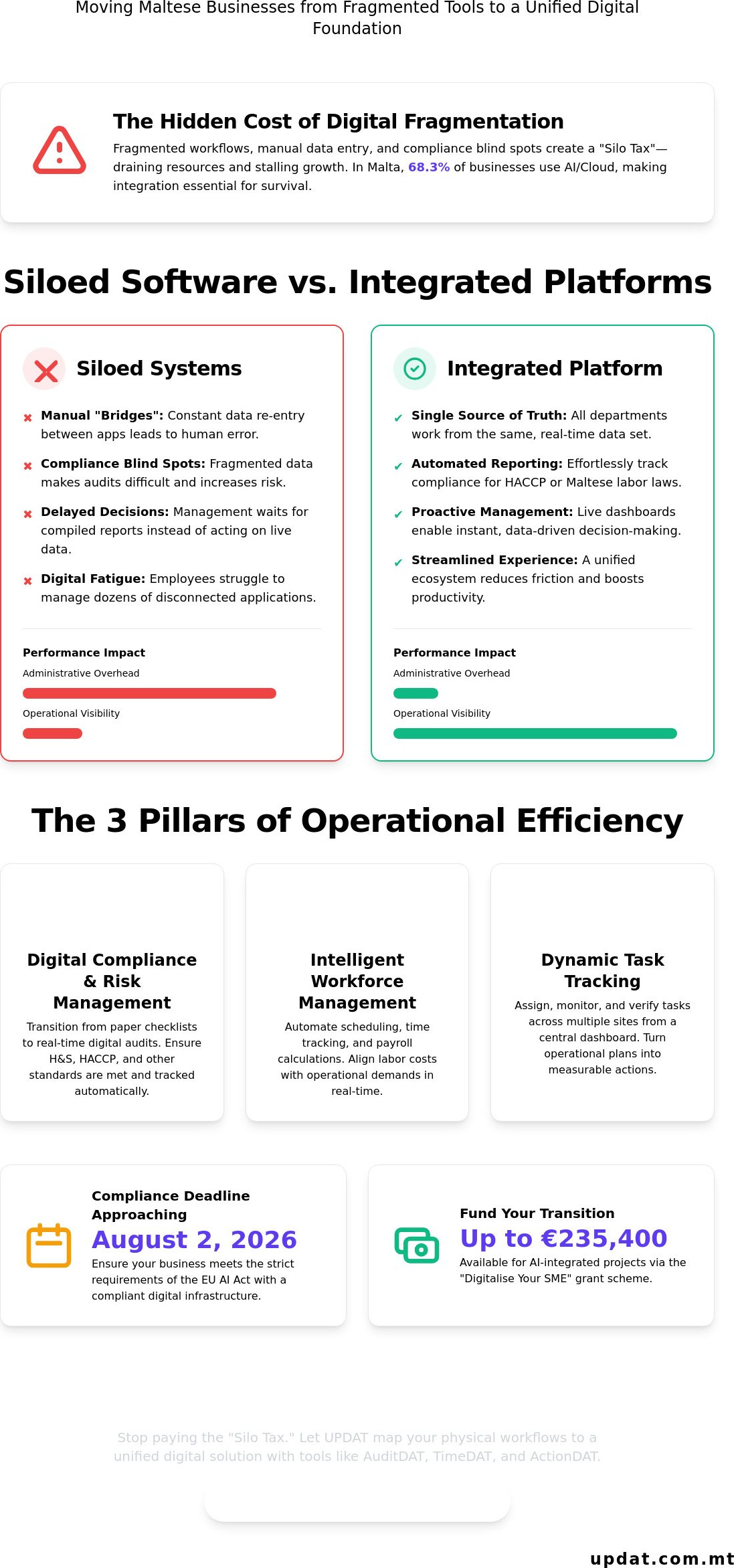
Fragmented workflows stall growth and introduce unnecessary risk. When data lives in separate silos, employees must build "manual bridges" by re-entering information from one system to another. This process is prone to human error and drains administrative resources that should be focused on value-added tasks. Data silos also create dangerous blind spots in compliance and risk management, which is particularly critical as the August 2, 2026 deadline for the EU AI Act approaches. The Silo Tax is the hidden financial and operational cost incurred by maintaining non-integrated software environments.
The three pillars of operational efficiency software
Achieving true operational efficiency requires a structured approach that goes beyond basic productivity hacks. In the Maltese market, where regulatory scrutiny is increasing, businesses must ground their digital strategy in three core pillars. These are digital compliance, intelligent workforce management, and dynamic task tracking. When these elements work in concert, they create a self-correcting business environment where data flows seamlessly from the field to the boardroom. This synergy is the hallmark of effective operational efficiency software malta.
These pillars act as the digital architecture of your organization. They provide the stability needed to scale without adding unnecessary administrative weight. By focusing on these three areas, management can move from reactive firefighting to proactive leadership. Each pillar addresses a specific operational bottleneck while feeding data into a centralized system for total visibility. This creates a loop of continuous improvement that adapts to the shifting demands of the 2026 business landscape.
Digitizing compliance and risk management
Transitioning from paper-based checklists to real-time digital audits is no longer optional. Paper records are slow, prone to damage, and difficult to analyze for trends. By adopting digital inspections, firms ensure that health and safety protocols or HACCP standards are met with precision. Automated reporting is vital for satisfying regulatory bodies in Malta, especially with the upcoming EU AI Act enforcement in August 2026. Using a dedicated tool like AuditDAT allows managers to track compliance instantly across multiple sites. This digital trail provides the transparency required for modern governance, risk, and compliance. It eliminates the guesswork and ensures your business remains audit-ready at all times.
Mastering workforce and task coordination
Intelligent workforce management forms the second pillar. Automating payroll integration through precise attendance tracking eliminates the administrative burden of manual data entry. It ensures that every hour worked is accounted for without the risk of human error. Systems like TimeDAT provide this level of accuracy, connecting staff management directly to operational output. The third pillar involves dynamic task tracking and prioritization. It prevents critical actions from falling through the cracks by using centralized trackers. When an audit identifies a failure, the system should automatically trigger a corrective action. This closed-loop process ensures that problems are not just identified but resolved efficiently. If you are ready to modernize your workflow, you can explore our platform features today to see these pillars in action.
The interaction between these pillars is what drives measurable results. When your operational efficiency software malta links workforce presence to audit completion and task resolution, you achieve a level of control that manual processes cannot match. This integration reduces the time spent on administrative oversight, allowing your team to focus on strategic growth and service delivery.
Siloed software vs. integrated platforms: A performance comparison
Choosing between "Best-of-Breed" specialized tools and "All-in-One" architectures is a pivotal decision for any director. While separate tools might offer niche features, they often create a fragmented digital sprawl that hinders long-term growth. Integrated platforms eliminate this complexity by providing a unified environment where every module shares the same DNA. This architectural choice is central to selecting the right operational efficiency software malta for your organization. It ensures that your digital infrastructure scales alongside your physical operations without creating new bottlenecks.
Staff training represents one of the most significant hidden costs of siloed software. Mastering five different dashboards requires five times the onboarding effort compared to a single, intuitive interface. When employees only need to learn one system, adoption rates soar and administrative friction disappears. Additionally, the hidden costs of API maintenance and third-party connectors can quickly erode any perceived savings from cheaper, individual apps. These connectors often break during software updates, requiring expensive technical intervention to restore data flow. A unified system removes this vulnerability by design.
Scalability across multiple sectors is where integrated models truly excel. Whether you're managing security patrols or hospitality audits, a unified platform adapts to diverse workflows without requiring a new set of integrations. It provides a steady, reliable foundation that supports a growing business rather than a collection of digital patches. This stability is essential for Maltese enterprises navigating the transition to mandatory e-invoicing and stricter data regulations expected by 2030.
Data integrity and reporting accuracy
Integrated systems produce far more reliable workforce analytics because they pull from a single data source. When you rely on manual data consolidation from separate tools, the risk of human error increases exponentially. One missed spreadsheet entry can skew an entire monthly performance report. Unified systems enable high-level efficiency in executive reporting by providing real-time, consolidated views of the entire operation. This allows management to trust their data and make strategic adjustments with confidence. High-quality operational efficiency software malta ensures that your reporting remains accurate and ready for regulatory scrutiny.
Total Cost of Ownership (TCO) analysis
A thorough TCO analysis often reveals that a single platform license is more cost-effective than multiple subscription fees. Managing three or four different vendors leads to administrative bloat and overlapping costs. Centralized support provides a single point of accountability; you don't waste time with vendors blaming each other for integration failures. For a clear look at how this works in practice, you can review UPDAT pricing to understand the value of modular, integrated costs. This transparency allows you to budget effectively for your digital transformation while ensuring your software delivers a high return on investment.
How to evaluate operational software for the Maltese market
Selecting the right operational efficiency software malta involves more than comparing global feature lists. It requires a deep understanding of the local regulatory landscape and the specific operational pressures faced by Maltese firms. You must identify whether a platform can automate your most critical compliance trails, such as HACCP for food safety or Health & Safety protocols for construction and manufacturing. In 2026, software that fails to provide a verifiable audit trail for the Malta Digital Innovation Authority (MDIA) represents a significant liability. Reliable systems turn these regulatory hurdles into automated workflows, ensuring you remain compliant without manual oversight.
Handling local labor laws is another non-negotiable criterion. Maltese payroll involves complex shift allowances, overtime calculations, and specific public holiday rates that generic global software often overlooks. Your chosen system must integrate attendance tracking directly with these local requirements to prevent administrative errors and payroll disputes. Local support is equally vital. Having a partner on the ground who understands the Maltese market ensures that your system remains adapted to local changes. This proximity allows for rapid troubleshooting and provides a level of accountability that international vendors cannot match.
Field-based employees require a mobile-first approach. Whether it's a security guard on patrol or a technician performing equipment maintenance, the software must function flawlessly on mobile devices. This capability ensures that data is captured at the point of activity, providing real-time visibility for management. If a system requires employees to return to a desk to log their work, it's already creating a bottleneck. Real-time data capture is the foundation of modern operational control.
Industry-specific requirements in Malta
Different sectors face unique challenges that your software must address. In hospitality, managing high staff turnover while maintaining strict food safety audits is a constant struggle. Manufacturing firms require precise tracking for quality control and equipment maintenance to avoid costly downtime. Meanwhile, security and facilities management companies rely on real-time patrol tracking and incident reporting to prove service delivery to their clients. Your software should offer modularity that caters to these specific needs, ensuring a perfect fit for your vertical.
The role of bespoke software development
Off-the-shelf systems occasionally fall short of capturing a business's unique competitive advantage. This is where Custom Software Development in Malta becomes a strategic necessity. Customizing your digital architecture allows you to maintain flexibility while ensuring standardized compliance across all departments. It bridges the gap between standard processes and your specific operational nuances. To begin your transition toward a more efficient, integrated digital environment, register your account and explore our modular solutions.
Transitioning to mastery: Implementing integrated solutions with UPDAT
Mastery begins with a clear understanding of your current physical workflow. At UPDAT, we don't simply deploy technology; we architect order. Our methodology starts by mapping your existing processes to identify where friction occurs. This strategic approach ensures that your operational efficiency software malta mirrors your actual business requirements rather than forcing you into a rigid, pre-defined box. By aligning digital tools with physical actions, we restore clarity and provide management with the precision needed to lead effectively.
The strength of our ecosystem lies in how AuditDAT, TimeDAT, and ActionDAT integrate. These modules function as a single, cohesive unit to provide full operational visibility. When an inspection in AuditDAT flags a non-compliance issue, ActionDAT automatically tracks the resolution. Simultaneously, TimeDAT ensures that the right personnel were on-site to perform the task. This interconnectedness eliminates data silos and creates a steady, reliable foundation for long-term growth.
We reduce implementation anxiety through modular adoption. You don't need to overhaul your entire operation overnight. Instead, you can introduce specific modules to solve your most pressing bottlenecks first. This phased approach allows your team to adapt comfortably while building immediate confidence in the system. It transforms the daunting task of digital transformation into a manageable series of strategic wins.
Your roadmap to digital transformation
Step 1: Identifying the primary bottleneck.
We analyze whether your greatest drain on resources is compliance (Audit), workforce management (Time), or task resolution (Action).
Step 2: Digitizing the core workflow.
We implement the primary module to build immediate ROI and demonstrate the tangible impact of organized systems.
Step 3: Expanding integration.
We roll out secondary modules to other departments, creating holistic control and ensuring every part of your business speaks the same digital language.
The measurable impact of operational order
The transition to an integrated platform delivers immediate, measurable results. You save significant administrative time by automating payroll data and compliance reporting, allowing your management team to focus on high-value strategy. Team accountability improves because every task and attendance record is transparent and verifiable. This level of precision is essential for maintaining a competitive edge in the 2026 Maltese market. It's time to stop managing chaos and start mastering your operational environment. Request a tailored demo today to take your first step toward total operational mastery.
Secure your operational future
The transition toward a unified digital architecture is the most significant step a Maltese enterprise can take in 2026. You've explored how moving beyond fragmented tools restores clarity and ensures compliance with upcoming EU regulations. By implementing modular operational efficiency software malta, you transform administrative friction into a strategic advantage. Our ecosystem, featuring AuditDAT, TimeDAT, and ActionDAT, is already trusted by leaders across the hospitality, manufacturing, and security sectors.
We provide Maltese-based support and bespoke development expertise to ensure your system adapts as your business scales. This approach removes the complexity of managing disparate platforms and hands you the keys to your operational environment. The path to digital mastery is now accessible through a structured, modular implementation that respects your unique workflows. Take the next step toward reclaiming your time and focus.
Master your operational environment; Register for a UPDAT account today.
We look forward to helping you build a more resilient and efficient foundation for your future growth.
Frequently Asked Questions
What is an integrated business management system and why is it better than using separate apps?
An integrated business management system is a unified digital ecosystem where all business functions share a single data source. It's superior to using separate apps because it eliminates the "Silo Tax" and the need for manual data re-entry. By centralizing your operations, you ensure every department works from identical, real-time facts. This cohesion reduces administrative friction and prevents the blind spots common in fragmented software environments.
How does operational efficiency software help with regulatory compliance in Malta?
These systems automate the mandatory audit trails required by the Malta Digital Innovation Authority (MDIA). Implementing operational efficiency software malta helps businesses meet the strict documentation rules of the EU AI Act before the August 2, 2026 deadline. It provides a verifiable digital history for health and safety, food safety (HACCP), and data protection. Automated reporting ensures your enterprise remains compliant without constant manual oversight.
Can integrated systems help reduce administrative costs for small and medium enterprises?
Integrated platforms lower administrative overhead by automating repetitive tasks like payroll data consolidation and compliance reporting. Small and medium enterprises can further reduce costs by utilizing the "Digitalise Your SME" grant scheme. This program offers up to 85% funding, with a maximum grant of €128,400 available until December 31, 2026. These financial incentives make high-level digital infrastructure accessible to smaller Maltese firms.
Is it possible to integrate digital audit tools with existing payroll systems?
You can connect digital audit tools directly to your payroll workflows through modular integration. While tools like AuditDAT manage compliance checks, TimeDAT captures precise attendance data that informs payroll calculations. This ensures every hour worked is accounted for and verified against task completion. Connecting these systems eliminates human error in manual data transfers and ensures accurate compensation for your entire workforce.
What industries in Malta benefit most from business process automation?
Hospitality, manufacturing, and security sectors benefit most due to their complex regulatory and workforce requirements. Automation allows hotels to manage high staff turnover and food safety audits simultaneously. In manufacturing, it tracks quality control and equipment maintenance schedules. Security firms use these systems for real-time patrol tracking and incident reporting, providing their clients with transparent, digital proof of service delivery.
How long does it typically take to transition from paper-based systems to an integrated digital platform?
A phased transition typically takes a few weeks. By focusing on your most critical bottleneck first, you'll achieve immediate ROI. A full digital transformation across all departments is best handled in modular stages. This minimizes disruption while your team adapts to new workflows at a steady pace. Starting with a single module like AuditDAT allows for a smoother cultural shift within the organization.
Do integrated systems require extensive technical training for staff?
Integrated systems actually reduce the training burden on your staff. Employees only need to master a single, intuitive interface rather than learning five separate, disconnected dashboards. This unified experience increases daily adoption rates and reduces the time spent on technical onboarding. Modern platforms are designed for ease of use, ensuring field-based workers can log data quickly on mobile devices without needing extensive technical expertise.




%201.svg)
