
Why are you paying monthly per-user fees for a software system that forces your team to work around its limitations rather than the other way around? For many local enterprises, the hidden costs of generic SaaS platforms go beyond the subscription price. They manifest as fragmented data and manual workarounds for Maltese regulations. Investing in custom crm development malta allows you to reclaim control over your digital architecture. It's time to stop fitting your business into a pre-built box and start building a system that mirrors your specific operational flow.
It's frustrating to manage disconnected tools while worrying about the 2026 compliance deadlines for the EU AI Act or the Cyber Resilience Act. We agree that your CRM should be a central nervous system, not just a digital Rolodex. This article explains how bespoke solutions move beyond simple contact management to create a unified, automated environment for Maltese enterprises. You'll discover how to eliminate administrative overhead, secure full data ownership, and integrate industry-specific compliance directly into your daily workflows.
Key Takeaways
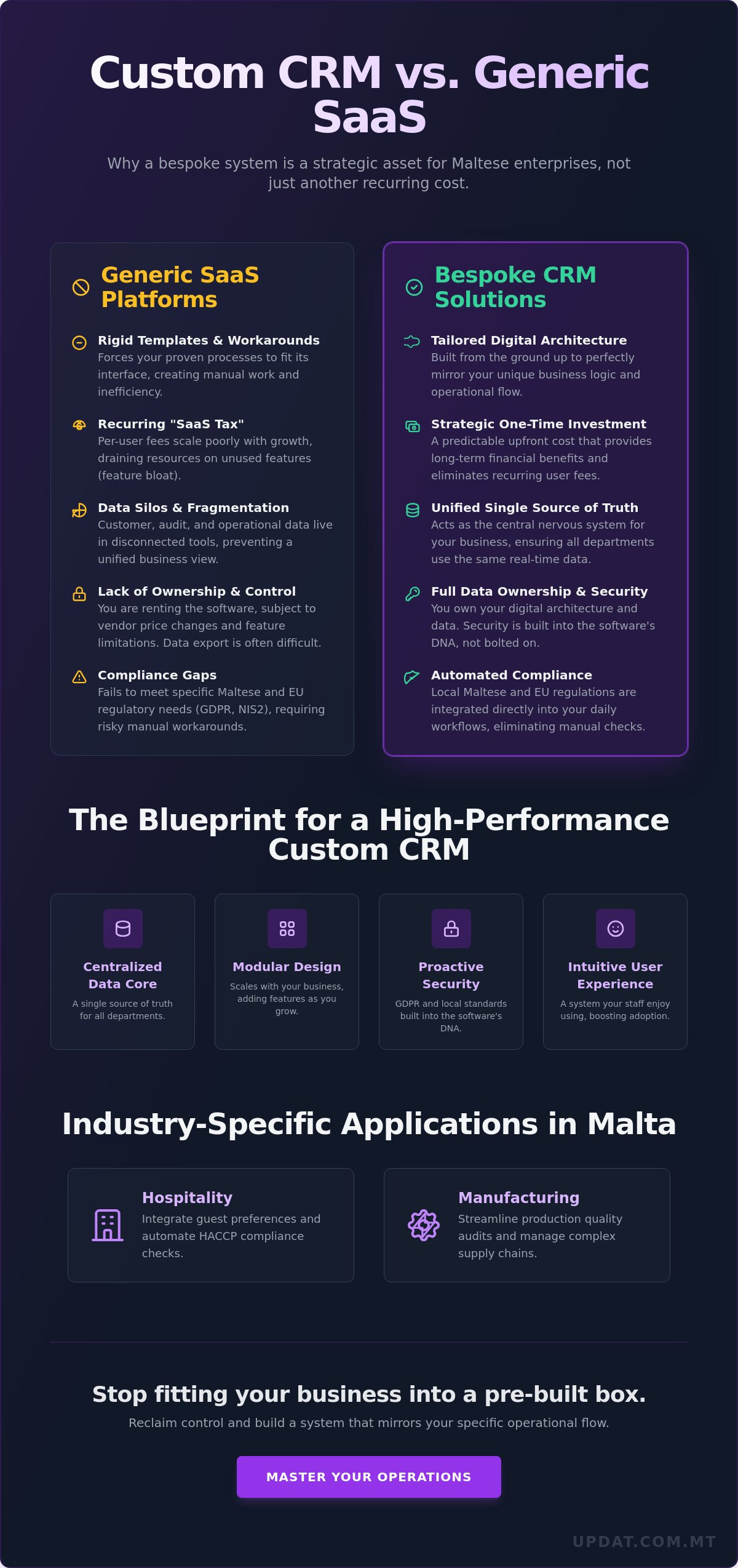
• Identify why generic SaaS platforms often fail to meet specific Maltese regulatory requirements and how custom logic eliminates manual workarounds.
• Discover how custom crm development malta creates a modular digital architecture that acts as a single, reliable source of truth for your business data.
• Analyze the long-term financial benefits of a one-time software investment compared to the recurring costs and "per-user taxes" of off-the-shelf subscriptions.
• Explore real-world applications for the hospitality and manufacturing sectors; integrating guest preferences, HACCP compliance, and production quality audits.
• Understand the strategic value of a local development partner who translates complex operational needs into a high-performance, unified system.
Why Generic CRM Solutions Often Fail Maltese Enterprises
Custom CRM development is the strategic process of architecting a software system from the ground up to match your unique business logic. It's the digital equivalent of a bespoke suit. It fits your specific contours rather than forcing you to adjust to a standard size. In Malta's competitive market, many enterprises find that off-the-shelf Customer Relationship Management (CRM) tools create a "square peg, round hole" scenario. You end up with manual workarounds and fragmented data because the software doesn't recognize your internal workflows or local regulatory requirements.
Generic solutions often lead to dangerous data silos. Your customer information sits in one cloud, while your operational audits or employee hours live in separate, disconnected tools. This fragmentation prevents a unified view of your business. If your team spends hours copying data from one system to another, you aren't using a tool; you're managing a burden. Bespoke software development eliminates this friction by creating a single source of truth. By integrating your CRM with systems like AuditDAT or TimeDAT, you ensure that every department operates from the same dataset.
Hidden costs also plague the SaaS model. Per-user licensing fees might seem manageable for a small team, but they scale poorly as your Maltese enterprise grows. You pay for feature bloat, paying for hundreds of tools you'll never use, while still lacking the specific functions you actually need for your industry. This recurring "SaaS tax" drains resources that could be better spent on innovation. For SMEs looking for specialized administrative solutions, tools like Számlázó Programom demonstrate how a focused approach to invoicing and client management can significantly reduce operational overhead.
The Limitations of Off-the-Shelf SaaS
Rigid templates are the primary constraint of standard SaaS platforms. These systems force you to change proven processes to fit their interface. For Maltese firms, this often means a lack of deep integration with EU-specific compliance standards like GDPR or the upcoming NIS2 requirements. Exporting your data from these proprietary clouds is frequently difficult and expensive. You don't truly own the software architecture; you're simply renting it. This lack of ownership creates a long-term dependency on third-party vendors who can change their pricing or features without your consent.
When "Standard" Isn't Enough
Complex, multi-stage sales cycles often trigger the need for custom crm development malta. If your sales process involves intricate bidding, regulatory checks, or multi-department approvals, a generic tool will fail. You need specialized reporting that standard dashboards cannot generate. A custom CRM isn't just a utility; it's a strategic asset that drives long-term operational mastery. It allows you to automate industry-specific workflows that off-the-shelf tools simply don't understand, giving you the keys to master your own operational environment.
The Architecture of a High-Performance Custom CRM
High-performance systems aren't built on rigid, pre-existing templates. They require a bespoke foundation that aligns with your specific operational goals. When you invest in custom crm development malta, you're designing a digital blueprint that prioritizes efficiency and clarity. This architecture moves beyond simple contact lists to create a sophisticated engine for business growth. A well-architected system focuses on four core pillars:
Centralized Data Core
This establishes a single source of truth. It ensures that every department, from sales to finance, accesses the same real-time data, eliminating the risk of conflicting information.
Modular Design
Your software should be as adaptable as your business. A modular approach allows you to build the essential features now and add complex functionalities as your Maltese enterprise scales.
Security and Compliance
We integrate GDPR and local Maltese standards directly into the software DNA. This proactive security model protects sensitive client data without sacrificing system performance.
User Experience (UX)
Adoption is the metric of success. We design intuitive interfaces that your staff actually enjoy using. This reduces training time and prevents the friction often found in bloated, generic platforms.
By prioritizing these elements, you transform your CRM from a passive database into an active strategic asset. It's about more than just technology; it's a decision regarding strategic partnering for custom CRM that aligns your digital tools with your long-term business vision.
Integrating Operations and Compliance
True operational mastery occurs when your CRM links directly to digital audit solutions. This integration allows for real-time compliance monitoring across all client interactions. Instead of searching through disconnected logs, managers can view a customer's full history alongside relevant quality assurance checks. This visibility restores order to complex workflows and automates the reporting required for Maltese regulatory bodies. It ensures that compliance isn't a separate task but a natural byproduct of your daily operations.
Seamless API and Third-Party Connectivity
Efficiency depends on how well your tools communicate. A custom CRM acts as a bridge between your legacy systems and modern cloud applications. For many Maltese businesses, this means automating the sync between customer orders, payroll, and accounting software. Integrating workforce management software into your CRM ecosystem provides a complete view of labor costs relative to client revenue. You can begin the transition toward a more organized digital environment by creating your account to explore our integration capabilities.
Bespoke Development vs. Off-the-Shelf Implementation
Choosing between a subscription and an asset is a fundamental strategic decision. While off-the-shelf implementation offers a fast start, it often creates long-term dependencies that limit your agility. In contrast, custom crm development malta provides a tailored environment where you own the intellectual property. This ownership is a distinct competitive advantage. It ensures that your core business logic isn't shared with competitors using the same generic platform. You aren't just renting a tool; you're building a proprietary system that reflects your unique operational mastery.
Support structures also differ significantly between these two models. When a generic SaaS platform fails, you're often relegated to a global helpdesk with automated ticketing systems. Working with a local bespoke software developer ensures immediate, high-level expertise. You gain a partner who understands the local business landscape and can provide rapid, personalized solutions. This proximity reduces downtime and ensures your digital architecture remains stable as your business evolves.
The Financial Logic of Custom Software
The total cost of ownership (TCO) for custom software often becomes more favorable over a five-year period. While the initial capital investment is higher than a monthly subscription, the absence of per-user licensing fees creates a clear break-even point. As your team grows, SaaS costs scale linearly, often becoming a significant recurring expense. Custom development is a one-time capital investment that removes the "per-user tax." It encourages company-wide adoption because you don't have to worry about the cost of adding new seats. For Maltese enterprises, this shift from an operational expense to a capital asset strengthens the balance sheet and provides long-term financial predictability.
Operational Flexibility and Long-Term Strategy
Operational flexibility is where bespoke solutions truly excel. In a SaaS model, you're forced to wait for roadmap updates that may never address your specific needs. Custom systems allow you to build exactly what you need, when you need it. This proactive approach is detailed in our guide on off the shelf vs custom software, which explores how tailored logic drives efficiency. You gain the power to adapt your software to new regulations or market shifts instantly. This agility ensures that your technology serves your strategy, rather than dictating it. By focusing on modularity, you can prioritize the features that offer the highest immediate utility for your team.
Industry-Specific Custom CRM Examples for the Maltese Market
Generic CRM platforms often ignore the specific regulatory and operational nuances of Malta’s core sectors. Custom crm development malta allows businesses to embed their industry-specific logic directly into their digital architecture. This creates a system that functions as both a relationship manager and an operational control center. By tailoring the system to your sector, you remove the friction of manual data entry and disconnected reports. You don't have to force your team to adapt to the software; the software adapts to your proven workflows.
Hospitality
Link guest preferences directly to HACCP compliance and staff rosters. This ensures that dietary requirements or room preferences are visible to the right staff at the right time, maintaining high service standards while adhering to safety regulations.
Manufacturing
Track client orders alongside production quality audits and GxP standards in a single view. This integration allows managers to see the status of an order and its compliance history without switching between different tools.
Security
Manage client contracts while monitoring real-time patrol tracking and task prioritization for field teams. This visibility improves response times and provides clients with transparent, data-driven proof of service.
Facilities Management
Consolidate maintenance requests, tenant communication, and site inspections into a unified dashboard. Automated alerts ensure that preventative maintenance is never missed, reducing long-term repair costs and improving tenant retention.
High-Stakes Compliance in Manufacturing and Oil & Gas
Managing complex regulatory documentation is a primary challenge for oil and gas firms and manufacturers. Custom systems integrate GXP compliance into the client management workflow, ensuring that every order meets quality assurance standards before it leaves the facility. Automating these audit trails provides 100% accountability and prepares your business for external inspections instantly. It transforms compliance from a stressful manual task into a silent, background process that protects your operational integrity.
Elevating the Guest Experience in Hospitality
In the hospitality sector, data should anticipate guest needs before they arrive. A custom CRM connects front-of-house sales to back-of-house health and safety standards, creating a seamless flow of information. This visibility reduces administrative time for managers, allowing them to focus on guest satisfaction rather than chasing paperwork. It restores order to busy operations and ensures that your team delivers a consistent, high-quality experience that drives repeat business and positive reviews. To see how these modules can fit your specific business model, register your account today.
Strategic Partnering for Custom CRM Development in Malta
Selecting a development partner is a decision that determines the long-term stability of your digital infrastructure. A local partner provides more than just technical code; they offer a deep understanding of the Maltese business landscape and its specific regulatory pressures. When you engage in custom crm development malta, you're looking for a strategic architect who can translate complex operational needs into a fluid, automated system. This partnership ensures that your software isn't just a static tool but an evolving asset that grows alongside your enterprise.
The approach at UPDAT Technologies Ltd. prioritizes high-level efficiency and the removal of unnecessary complexity. We utilize a no-nonsense development process that focuses on immediate utility and movement. This methodology prevents project creep and ensures that every feature developed serves a direct purpose in your workflow. By maintaining a professional distance and a focus on logic, we guide our clients through the transformation of their business architecture with precision and order.
The UPDAT Technologies Ltd. Bespoke Methodology
Successful implementation relies on a structured and predictable rhythm. We follow a rigorous custom software development lifecycle that moves logically from initial architecture to long-term operational mastery. This process replaces paper-based chaos or fragmented digital files with a unified, professional order. UPDAT Technologies Ltd. acts as the steady foundation for your growth, ensuring that the transition to bespoke software is handled with calm authority. You gain a system where data flows seamlessly between departments, empowering your team to master their own operational environment without the friction of generic templates.
Taking the First Step Toward Operational Excellence
The journey toward a unified digital architecture begins with a clear assessment of your current state. Auditing your existing systems allows you to identify the specific gaps where manual workarounds are draining your resources. UPDAT Technologies Ltd. provides transparent pricing information to assist in your strategic planning and ensure that your capital investment is well-aligned with your business goals. This clarity allows for a grounded, confident approach to modernization that avoids the pitfalls of hidden SaaS costs. It's time to reclaim control of your data and your workflows. Book a demo to see how we restore operational order and build the unified system your enterprise requires for 2026 and beyond.
Architecting Your Operational Future
Transitioning from generic software to a bespoke digital environment is a fundamental shift toward operational mastery. You've seen how custom logic eliminates manual workarounds and how owning your software architecture provides a long-term financial advantage over recurring subscription taxes. By integrating compliance directly into your system, you protect your business against the evolving regulatory landscape of 2026. This is not just about managing contacts; it's about building a steady, reliable foundation for growth.
Since 2019, our team has focused on Maltese operational automation through proprietary platforms like AuditDAT and TimeDAT. Our expertise in high-stakes regulatory compliance ensures that your custom crm development malta project delivers immediate, tangible impact. We help you move beyond fragmented tools to a unified system that reflects your specific industry standards. It's time to reclaim your time and restore order to your daily workflows.
Master your operations with a custom CRM; book your demo today. We look forward to helping you build a more efficient, organized, and profitable enterprise.
Frequently Asked Questions
How long does custom CRM development in Malta typically take?
Development timelines vary based on the modular scope but typically range from three to six months for an initial high-performance version. We prioritize a structured lifecycle that delivers immediate utility while allowing for future iterations. This phased approach ensures your team can begin mastering their new operational environment without waiting for every secondary feature to be completed.
Will a custom CRM be more expensive than a subscription to Zoho or Salesforce?
A custom system involves a higher initial capital investment than a standard subscription, but it eliminates the recurring "SaaS tax." Over a five-year period, the total cost of ownership is often lower because you remove per-user licensing fees. Investing in custom crm development malta transforms your software from a monthly expense into a proprietary business asset that you own entirely.
Can a custom CRM integrate with my existing accounting software?
Yes, bespoke solutions are designed to bridge the gap between your CRM and existing accounting or payroll software. We utilize secure APIs to automate data flow, ensuring that financial records and customer orders remain synchronized. This integration removes the need for manual data entry and reduces the risk of administrative errors across your Maltese enterprise.
Who owns the source code and data in a bespoke CRM project?
You maintain full ownership of the source code and all associated data upon project completion. Unlike off-the-shelf platforms that lock you into proprietary clouds, a bespoke project gives you the keys to your own digital architecture. This ownership provides a significant competitive advantage and ensures you aren't dependent on a third-party vendor's roadmap or pricing changes.
Is it possible to migrate data from my current spreadsheet-based system?
Migrating from spreadsheet-based systems is a standard part of our implementation process. We clean and structure your legacy data before importing it into the new centralized core to ensure a single source of truth. This transition marks the end of fragmented files and the beginning of a unified, professional order for your operational information.
How does custom CRM development help with GDPR compliance in Malta?
Custom crm development malta allows you to integrate GDPR requirements directly into the system's architecture. We build specific data retention policies, access controls, and audit trails into the software DNA to meet local Maltese standards. This proactive security model ensures compliance is automated rather than managed through manual, error-prone checklists.
What kind of ongoing support is provided after the system goes live?
We provide ongoing technical support and maintenance through our local team of experts. You bypass global helpdesks in favor of direct communication with the strategic architects who built your system. This partnership ensures your software remains stable and adapts as new operational challenges or regulatory requirements emerge in the future.



%201.svg)
