
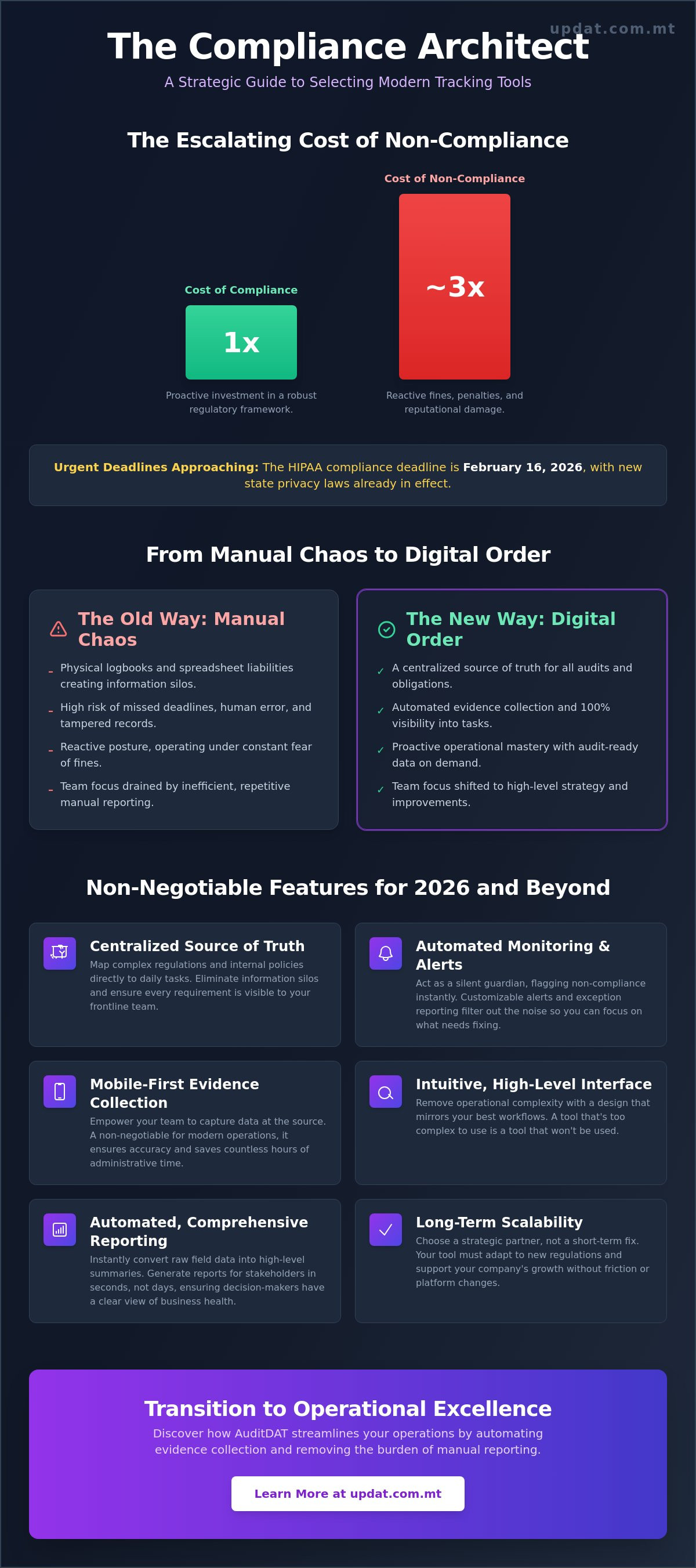
Did you know the cost of non-compliance is now nearly three times higher than the investment required to maintain a robust regulatory framework? With the February 16, 2026, HIPAA compliance deadline and new state privacy laws in Indiana and Kentucky already in effect, the margin for administrative error has effectively vanished. Relying on manual reporting isn't just inefficient; it's a liability that drains your team's focus. Selecting the right compliance tracking tool is the most direct way to stop wasting time on spreadsheets and start focusing on high-level strategy.
It's exhausting to operate under the constant fear of fines or the lack of real-time visibility into your operational risks. You need a system that transforms chaos into a structured digital architecture. This guide shows you how to evaluate and select a platform that restores operational order and ensures regulatory stability for your business. We'll explore how to achieve a centralized source of truth for all audits and automate evidence collection, giving you the mastery over your compliance environment that 2026 demands.
Key Takeaways
• Shift your perspective from reactive monitoring to proactive operational mastery by viewing your compliance tracking tool as a strategic architect for stability.
• Identify the non-negotiable features that eliminate complexity and restore order through intuitive, high-level interfaces.
• Learn how to adapt versatile compliance software to your sector's specific pain points to build a reliable foundation for growth.
• Apply a no-nonsense framework to evaluate potential vendors based on long-term scalability rather than immediate, short-term fixes.
• Discover how AuditDAT streamlines your operations by automating evidence collection and removing the burden of manual reporting.
Defining the Role of a Modern Compliance Tracking Tool
A modern compliance tracking tool acts as a strategic architect for your business. It doesn't just record events; it builds the framework for long-term stability. While some platforms focus solely on digital security protocols, a comprehensive solution like AuditDAT bridges the gap between digital oversight and physical operational reality. This shift from reactive monitoring to proactive operational mastery is essential for any growing enterprise. You aren't just waiting for a breach or a failed inspection; you're designing a system where failure is structurally difficult. By integrating every regulatory obligation into a single source of truth, you remove the ambiguity that leads to non-compliance fines.
Digital tools remove the friction of manual data entry. Automation handles the repetitive collection of evidence, leaving your team free to focus on high-level improvements. Having audit-ready data available at a moment's notice changes the dynamic of inspections. You move from a defensive posture to one of quiet confidence. This is the hallmark of a business that has mastered its environment through the right compliance tracking tool.
From Paper-Based Chaos to Digital Order
Physical logbooks and manual spreadsheets are liabilities. They create silos where information goes to die. In 2026, the risk of missing a deadline is too high to leave to a paper trail. Digitization restores clarity. It ensures every team member knows their exact responsibility at any given moment. This restoration of order isn't just about avoiding penalties. It's about creating a culture of accountability where every action is logged, verified, and accessible. Operational order becomes a competitive advantage. When your processes are transparent, your team performs with greater precision.
Centralising Regulatory and Internal Obligations
Your business operates under a complex web of regulations, standards, and internal policies. Managing these in isolation leads to friction and missed requirements. A centralized tool houses your entire library of obligations and maps them directly to daily tasks. Whether it's a new state privacy law in Kentucky or a specific safety protocol in the oil and gas sector, the system ensures the requirement is visible to the person on the ground. This mapping creates a direct link between high-level governance and frontline execution. You no longer have to guess if your internal policies align with external mandates; the software confirms it for you.
• Eliminate the risk of lost or tampered physical records.
• Ensure 100% visibility into pending tasks and overdue inspections.
• Map complex regulatory updates to simple, actionable workflows.
• Generate comprehensive reports for stakeholders in seconds rather than days.
Essential Features to Evaluate in Your Selection
Selecting a compliance tracking tool isn't just about ticking boxes on a feature list. It's about finding a strategic partner that removes complexity from your daily operations. While enterprise competitors often focus on back-end API connectivity, the real value lies in how the software empowers your staff on the ground. A tool that's too complex to use is a tool that won't be used. You need an intuitive interface that mirrors the efficiency of your best workflows. Mobile-first design is a non-negotiable requirement for 2026. Your team shouldn't have to return to a desk to log an inspection. They should capture data at the source, ensuring accuracy and saving hours of administrative time.
Automated reporting further streamlines this process. It takes the raw data from daily inspections and converts it into high-level summaries for stakeholders. This removes the friction of manual report building. It ensures that decision-makers have a clear view of the business's health without waiting for weekly updates. By choosing a tool that prioritizes both high-level oversight and frontline ease-of-use, you build a steady foundation for long-term growth.
Automated Monitoring and Real-Time Alerts
The system should act as a silent guardian, flagging non-compliance the moment it occurs. You don't need more data; you need actionable intelligence. Look for customizable alert hierarchies that ensure the right people take action without overwhelming the entire organization. This is where exception reporting becomes vital. Instead of reviewing hundreds of compliant entries, the system highlights only what needs fixing. It filters out the noise. This allows you to focus your energy where it matters most. This approach restores order by prioritizing risks before they escalate into fines.
Evidence Collection and Audit Readiness
Manual evidence collection is a significant drain on resources. A robust platform automates this by enabling photo and signature capture directly within the app. These digital artifacts are then linked to specific tasks, creating an unalterable audit trail. This level of transparency provides legal and regulatory peace of mind. It directly supports solutions for governance-risk-compliance by ensuring your data is always inspection-ready. When an auditor asks for proof, you shouldn't be hunting through folders. You should be handing over a complete, verified digital record.
If you're ready to see how these features work in a live environment, you can start your journey toward operational excellence today. Implementing a system that handles the heavy lifting of evidence collection ensures your business remains resilient in an increasingly complex regulatory landscape.
Industry-Specific Applications: Matching Tools to Your Sector
Every industry navigates a unique set of regulatory hurdles. A generic tool designed for IT security often fails to address the physical operational requirements of a factory floor or a commercial kitchen. A versatile compliance tracking tool acts as the digital architecture that adapts to these specific pain points. It provides a steady foundation for growth by removing the guesswork from regulatory adherence. By using a modular solution like AuditDAT, businesses can tailor their oversight to match national and international standards without the friction of a one-size-fits-all approach.
Regulatory landscapes are becoming increasingly localized. New privacy mandates and safety protocols require a system that's fluid enough to update as laws change. For those navigating international requirements like the 2026 UK environmental mandates, you can visit CiDATax SRL for expert regulatory guidance. When your software acts as a strategic architect, it doesn't just record data; it guides your team through the specific nuances of your sector. This level of adaptation is what separates a simple logbook from a professional management system. It ensures your business remains a reliable foundation for long-term expansion, regardless of the industry you serve.
Hospitality and Food Safety (HACCP)
The critical nature of food safety leaves no room for administrative delays. In a fast-paced kitchen, temperature monitoring and hygiene checks must be instantaneous and accurate. Relying on physical paper logs is a liability that invites human error and data tampering. Digital tracking prevents costly food safety breaches by automating the collection process. For those navigating local requirements, consulting a guide on HACCP management software in Malta helps align your digital checklists with the latest 2026 standards. This transition from paper to digital order ensures your brand reputation remains untarnished by preventable incidents.
Manufacturing and Quality Assurance
Precision is the lifeblood of the manufacturing sector. Tracking tools are essential for managing ISO standards and production line inspections with total accuracy. By implementing manufacturing industry solutions, you integrate quality control directly into the physical architecture of your business. This level of oversight ensures every component meets rigorous internal and external benchmarks. Quality control isn't just a hurdle to clear; it is the basis of your long-term reputation. Digitizing these inspections allows you to identify trends and fix bottlenecks before they impact your bottom line.
Hospitality
Automated temperature alerts and digital HACCP logs.
Manufacturing
ISO compliance mapping and real-time production audits.
Facilities Management
Safety inspections and maintenance scheduling.
Oil and Gas
High-risk environmental monitoring and equipment verification.
The Strategic Evaluation Framework: How to Choose Wisely
Evaluating a compliance tracking tool requires a shift from short-term problem solving to long-term architectural planning. Many vendors promise immediate fixes for specific regulatory headaches, yet they ignore how the software will scale with your business. You need a partner that offers more than just a digital login. Look for professional implementation services that align the tool with your existing operational environment. This ensures that the transition from manual processes to digital order is seamless and sustainable. A superior compliance tracking tool removes the friction between high-level governance and frontline execution.
A no-nonsense comparison framework should prioritize vendors who demonstrate transparency from the start. This includes transparent pricing structures that allow you to plan your budget without hidden costs or unexpected fees. When you select a vendor, you are choosing a foundation for your business's future stability. Demand a clear roadmap of how the tool handles evolving regulations and increasing data volumes. This clarity allows you to maintain control over your digital architecture as your compliance obligations grow more complex.
Scalability and User Adoption
Software only works if your team uses it. A tool must be intuitive enough for front-line staff to master without extensive training sessions. If the interface is cluttered or confusing, user adoption will stall, and your compliance data will suffer. We advocate for a modular approach; start with the core features you need today. Grow into more complex modules as your operations expand. The interface should project a sense of "calm authority," guiding the user through tasks with logical precision rather than overwhelming them with unnecessary options. This simplicity is the key to maintaining high-level efficiency across all departments.
Integration with Workforce and Task Management
True operational mastery comes from the synergy between different management systems. Your compliance efforts shouldn't exist in a vacuum. There is a powerful link between regulatory oversight and TimeDAT for workforce management. When you know exactly who is on-site and what tasks they are performing, you can verify that inspections are completed by the right person at the right time. Task tracking tools like ActionDAT ensure that any compliance gaps identified during an audit are closed immediately through assigned, trackable actions. This holistic approach is detailed further in our pillar article on Digital Audit Solutions, which explores how integrated systems restore order.
Ready to build a more resilient business? You can register for your account to begin implementing a framework that supports long-term growth and regulatory stability.
Transitioning to AuditDAT: Achieving Operational Excellence
AuditDAT is the logical conclusion for businesses seeking to replace administrative chaos with digital order. It's not just another compliance tracking tool; it's a sophisticated problem-solver that acts as a strategic architect for your operations. By removing the administrative burden of manual reporting, you empower your staff to focus on high-level strategy. This transition ensures your business remains a steady, reliable foundation for long-term growth. You're moving from a compliance-heavy culture to a compliance-smart environment where every action is deliberate and every record is unalterable.
Achieving this level of operational excellence requires a commitment to removing complexity. Many competitors mention rapid deployment but ignore the fundamental shift required to move away from paper-based systems. We focus on the tangible impact of well-organized systems. When your compliance tracking is automated, you eliminate the friction that leads to human error. This clarity provides the stability needed to scale your operations without increasing your regulatory risk. Your compliance tracking tool should be the silent engine that drives your business forward with precision.
A Strategic Roadmap for Digitisation
Transitioning your business to a digital audit system doesn't have to be overwhelming. You can find a detailed breakdown of the necessary steps in our roadmap guide. A smooth transition begins with a comprehensive initial consultation. This phase is critical for understanding your current system architecture and identifying where manual friction exists. Our no-nonsense approach to implementation focuses on immediate utility. We don't linger in abstract planning; we move quickly to map your regulatory obligations to automated tasks. This ensures your software provides value from day one.
Mastering Your Operational Environment
The ultimate goal of digitisation is to hand you the keys to master your own operational environment. A fully compliant business is one that operates with calm authority and high-level efficiency. You no longer have to fear the sudden arrival of an inspector or the discovery of a missing logbook. Instead, you have a centralised source of truth that reflects the physical reality of your business. This empowerment allows you to lead with confidence, knowing your digital architecture is sound and your evidence is secure.
It's time to restore operational order and embrace the future of automated oversight. We invite you to book a demo to see the platform in action. Discover how professional automation can remove complexity from your business and provide a steady foundation for your 2026 growth strategy.
Mastering Your Digital Architecture in 2026
Designing a resilient digital architecture requires moving beyond the limitations of manual oversight. A robust compliance tracking tool doesn't just record data; it restores operational order and provides a steady foundation for long-term growth. By focusing on intuitive interfaces and real-time alerts, you empower your team to maintain mastery over their environment and eliminate the fear of non-compliance fines.
With over 5 years of experience in Maltese business automation, we understand the specific regulatory nuances of the local landscape. Our dedicated national support and implementation team ensures your transition to digital audits is seamless. For organizations with unique requirements, we offer bespoke development options to tailor the software to your exact industry needs. This localized expertise provides the stability your business needs to scale with confidence.
It's time to replace administrative friction with professional automation. Book a demo of AuditDAT to restore operational order and begin your journey toward total regulatory stability. You've the tools to transform your business into a model of high-level efficiency and long-term success.
Frequently Asked Questions
What is the primary benefit of a compliance tracking tool?
The primary benefit is the restoration of operational order through a centralised source of truth. It eliminates the administrative burden of manual reporting and ensures that every team member follows a standardised process. By using a compliance tracking tool, you replace fragmented spreadsheets with a structured digital architecture that provides total visibility into your operational risks.
How does digital compliance software reduce legal risks?
Digital software reduces legal risks by creating unalterable audit trails and automated evidence collection. It ensures that every inspection is timestamped and verified with digital signatures or photos. This level of transparency protects your business during inspections and provides the necessary documentation to prove adherence to regulations, such as the HIPAA update deadline on February 16, 2026.
Can a compliance tracking tool integrate with my existing payroll system?
Yes, a professional tool can integrate with your existing systems through bespoke software development or standard API connections. This synergy is particularly effective when connecting compliance data with workforce management systems like TimeDAT. Streamlining data across platforms ensures that payroll and task completion records remain consistent and accurate across your entire organisation without manual entry errors.
Is compliance software suitable for small businesses in Malta?
Yes, digital solutions are highly suitable for Maltese small businesses due to their modular and scalable nature. You can start with core audit features and expand the system as your operations grow. This approach allows smaller teams to maintain high-level efficiency without the need for a large administrative department to manage physical paperwork and complex filing systems.
What industries benefit most from digital audit solutions?
Industries with high regulatory oversight, such as hospitality, manufacturing, and facilities management, benefit most from these solutions. Any sector that requires frequent inspections or equipment verification finds value in moving to a digital system. It provides a steady foundation for growth by ensuring that complex safety and quality standards are met consistently across multiple sites.
How does a compliance tool help with HACCP requirements?
A compliance tracking tool simplifies HACCP requirements by automating temperature logs and hygiene checklists. It replaces physical logbooks with real-time digital entries that flag deviations the moment they occur. This proactive monitoring prevents food safety breaches and ensures that your kitchen remains inspection-ready at all times without the friction of manual data entry or lost records.
What should I look for in terms of software security and data privacy?
Prioritise platforms that offer robust encryption, role-based access controls, and unalterable activity logs. With new privacy laws in effect in Indiana and Kentucky as of January 1, 2026, your software must handle sensitive information with extreme precision. Look for vendors who provide transparent data handling policies and can demonstrate a commitment to national and international security standards.
How long does it typically take to transition from paper to a digital compliance tool?
The transition typically takes between two to six weeks, depending on the complexity of your current processes. A strategic roadmap involves an initial consultation to map your existing obligations followed by a phased implementation. This no-nonsense approach ensures that your team adopts the new system quickly while maintaining operational continuity throughout the digitisation process.






%201.svg)
