
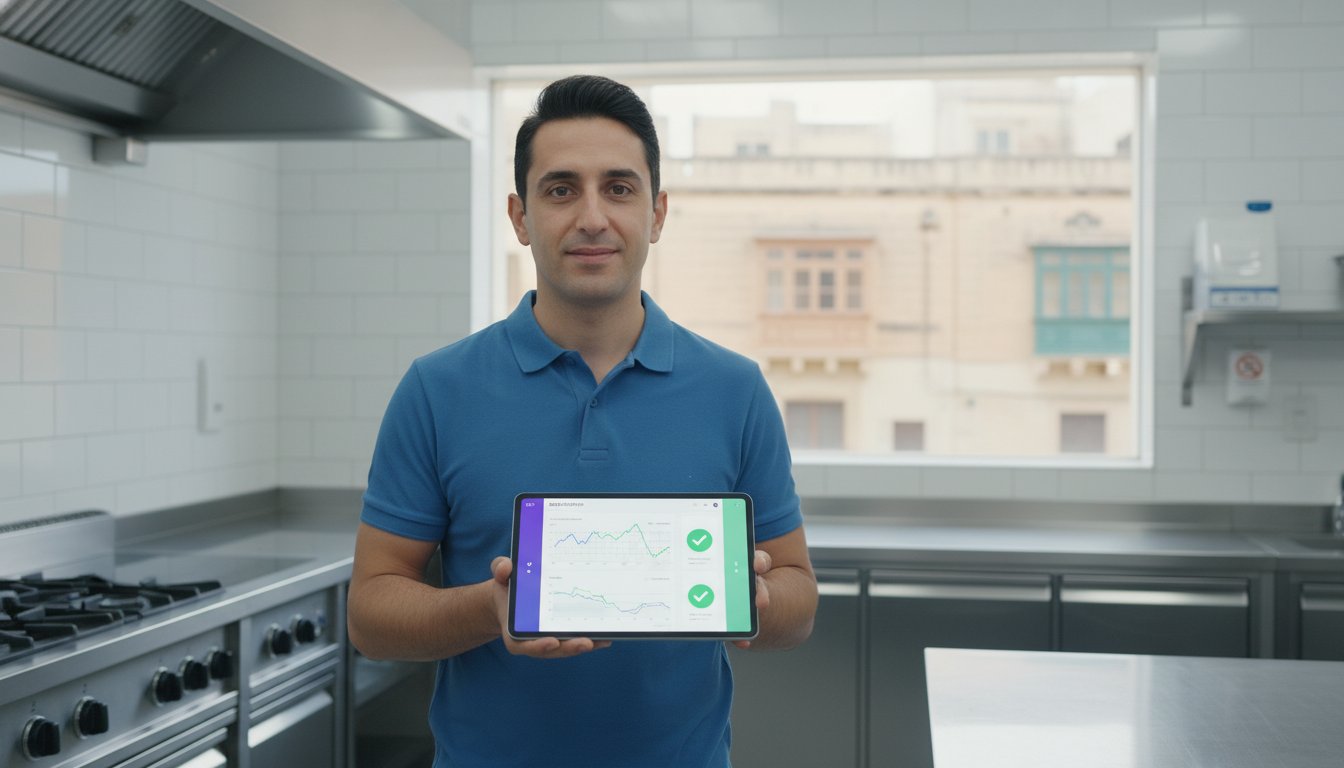
What if the next unannounced visit from the Food Safety and Security Authority wasn't a source of anxiety, but a moment to showcase flawless operational control? For many food businesses across the islands, the shift toward haccp management software malta has transformed compliance from a frantic paperwork exercise into a silent, background process. You likely feel the weight of mounting temperature logs and the constant worry that a single missed signature could lead to a failed audit. It's a common struggle; however, manual systems are no longer the standard for excellence in 2026.
You deserve a system that provides total visibility and reduces administrative hours spent on filing. This guide delivers a structured 2026 digital compliance checklist to help you master the transition from chaotic folders to automated software. We will examine the legal requirements under the Food Safety and Security Authority Act 2025 and show you how to build a fail-safe digital audit trail using local solutions like AuditDAT. It's time to replace the clutter with a precise digital architecture that secures your reputation and your peace of mind.
Key Takeaways
• Understand the regulatory shift under the Food Safety and Security Authority Act 2025 and why manual paper logs are now an operational liability.
• Discover how haccp management software malta automates Critical Control Point monitoring to create a fail-safe, real-time digital audit trail.
• Identify essential software features, such as offline functionality, that ensure staff can maintain compliance in walk-in freezers and areas with poor connectivity.
• Learn a structured framework for transitioning from manual paperwork to digital platforms without disrupting daily kitchen production.
• Explore the strategic advantages of using AuditDAT to centralize safety data and its synergy with TimeDAT for integrated labor-compliance tracking.
The Evolution of HACCP Management in Malta
Food safety governance in Malta entered a new era with the establishment of the Food Safety and Security Authority in October 2025. This centralized body now oversees compliance under the Food Safety Act and the Food Safety and Security Authority Act 2025. At the core of these regulations is the mandatory implementation of Hazard Analysis and Critical Control Points (HACCP). This systemic approach identifies, evaluates, and controls food safety hazards based on seven specific principles. While the legal requirement remains consistent with EU Regulation 852/2004, the method of execution has shifted. In 2026, relying on manual logs is no longer a viable strategy for maintaining operational integrity.
Traditional, paper-based systems often create a false sense of security. They're prone to "ghost-writing," where staff fill in temperature logs retrospectively rather than performing live checks. This lack of real-time accountability leaves your business vulnerable during unannounced inspections. Adopting haccp management software malta allows you to move beyond these vulnerabilities. It replaces static folders with a dynamic digital architecture that ensures every check is performed, recorded, and verified exactly when it happens. This transition isn't just about following the law; it's about restoring order to your kitchen operations.
Why Paper-Based Systems Fail Modern Food Businesses
Manual record-keeping carries a heavy labor cost that many operators overlook. Your team spends hours every week manually recording data, filing sheets, and organizing binders. This time represents a significant drain on productivity that could be better spent on food preparation or service quality. Retrieving historical data during a snap audit becomes a high-stress scavenger hunt when you're digging through months of physical paperwork. Administrative overhead in manual HACCP systems is the hidden cost of managing physical paper trails that offer no real-time protection against food safety breaches. Transitioning to haccp management software malta eliminates these inefficiencies by digitizing every log and making data instantly searchable.
The Legal Landscape: Malta Food Safety Authority Requirements
The current legal framework demands high levels of traceability and preventive maintenance. Inspectors from the Food Safety and Security Authority expect to see verifiable, time-stamped records that prove your business manages risks proactively. Digital systems provide the transparency required by modern regulators. By using AuditDAT, you create a permanent, tamper-proof record of your compliance activities. These systems ensure that your food safety management isn't just a document on a shelf but an active part of your daily workflow. Moving to a digital platform provides the stability and clarity needed to navigate Malta's evolving regulatory environment with confidence.
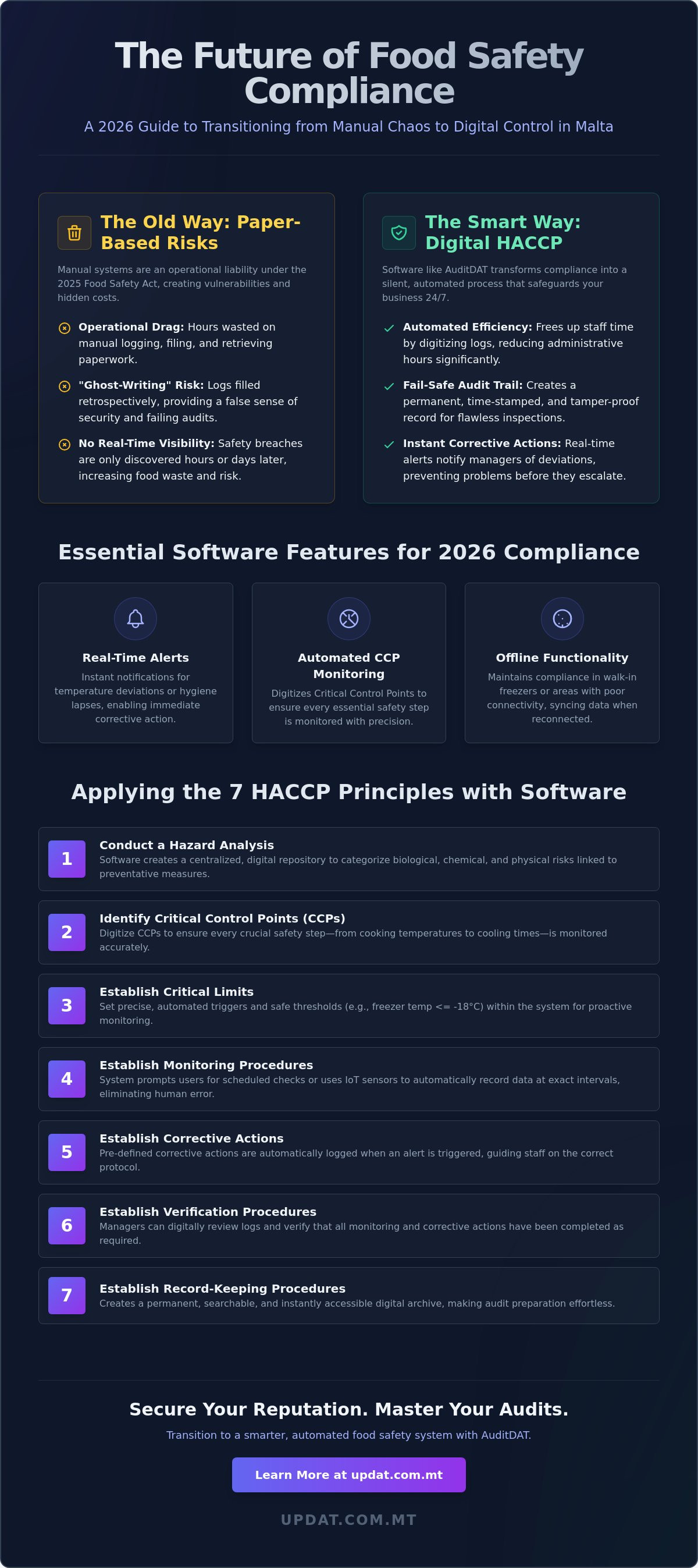
Applying the 7 Principles via Digital HACCP Software
Translating the theoretical framework of HACCP into daily kitchen habits often fails due to the friction of manual entry. Digital haccp management software malta bridges this gap by embedding the seven principles directly into your operational workflow. Hazard analysis becomes a centralized data repository where biological, chemical, and physical risks are categorized and linked to specific preventative measures. This transformation moves your safety plan from a dusty binder into an active, living architecture that protects your business every hour of the day.
Physical safeguards also play a vital role in this architecture; for instance, high-performance water filtration from PrímaVíz helps mitigate chemical and biological risks at the source, complementing your digital monitoring efforts.
Following the official HACCP guidelines requires precise identification of Critical Control Points (CCPs). Software allows you to digitize these points, ensuring that every essential safety step is monitored with mathematical accuracy. Instead of relying on a staff member's memory to check a thermometer at the right time, digital logs record data automatically or prompt a user for input at exact intervals. This level of precision eliminates the human error that typically leads to compliance failures during unannounced health inspections.
From Critical Limits to Real-Time Alerts
Monitoring critical limits is the pulse of your food safety system. AuditDAT streamlines this by setting automated triggers for any temperature deviation or hygiene lapse. If a walk-in freezer rises above its safe threshold, the system doesn't wait for the next manual check to find the problem. It sends instant notifications to kitchen managers and owners immediately. This early detection is a critical safeguard against massive food waste. It allows you to save inventory and address equipment failure before it becomes a total financial loss.
Digital Verification and Documentation
Verification is often the weakest link in manual systems because it relies on retrospective reviews of paper logs. Cloud-based storage changes this by ensuring you are audit-ready 24/7. Inspectors can be presented with comprehensive, automated compliance reports that cover any time period with a single click. Digital signatures within the platform create a transparent record of who performed each check and when they did it. These verifiable, time-stamped entries improve staff accountability by removing the possibility of back-dating logs or "ghost-writing" entries. To see how this architecture fits your specific kitchen layout, you can start building your digital audit trail today.
Checklist: Essential Features of HACCP Software in Malta
Selecting the right haccp management software malta requires a shift in perspective. You aren't just buying a digital logbook; you're investing in a strategic tool designed to eliminate human error and streamline your kitchen's daily rhythm. High-level compliance aligns with global standards like the FAO's toolbox for food safety, but the software must also handle the practical challenges of the local hospitality environment. Use this checklist to evaluate whether a platform can truly support your operational goals.
Mobile-First Interface
Kitchen staff shouldn't be tethered to a desktop. The software must be optimized for tablets and smartphones, allowing for rapid entry during active service.
Offline Capabilities
Walk-in freezers and thick stone walls often block Wi-Fi signals. Ensure the software allows data entry without an active connection and syncs automatically once back in range.
Customizable Audit Templates
Every kitchen is unique. The ability to adapt templates to specific Maltese hospitality workflows is essential for capturing relevant data points.
Automated Task Scheduling
Shift the burden of memory away from your team. The system should push notifications and tasks to staff members, ensuring no CCP check is overlooked.
Integration Potential
A truly efficient system connects with your existing tech stack. Look for software that integrates with workforce management or broader task-tracking platforms to centralize control.
Operational Excellence through User-Centric Design
Simplicity is the primary driver of staff adoption in the fast-paced hospitality sector. If a system is too complex, compliance will drop as staff prioritize service over documentation. Implementing a user-friendly interface ensures that hygiene checks become a natural part of the workflow rather than a chore. High-integrity systems also utilize photo evidence and GPS stamping to verify that checks were performed at the correct location and time. This level of detail provides an undeniable layer of audit integrity that paper logs simply cannot match. Explore how these features apply to your specific environment through our Hospitality Industry Solutions.
Reporting and Analytics for Management
Real-time visibility is the key to proactive management. "At-a-glance" compliance dashboards allow business owners to monitor the safety status of their entire operation from a single screen. This high-level overview identifies gaps before they become liabilities. Trend analysis tools also help you detect failing equipment; for instance, if a fridge temperature is slowly creeping upward over three weeks, you can call a technician before it breaks entirely. For businesses managing multiple locations across the islands, centralized management ensures that standards remain consistent across every site without the need for constant physical travel.
Transitioning to Digital HACCP Without Operational Disruption
Moving your food safety system from physical binders to a digital architecture is a strategic migration, not just a software installation. Successful implementation requires a logical, phased approach that maintains compliance during the switch. By following a structured transition, you ensure that no critical data is lost and your team remains focused on production. Adopting haccp management software malta should simplify your operations, not complicate them with technical friction.
The first step involves a thorough audit of your current paper-based processes. Identify which logs take the most time to complete and where errors most frequently occur. Once you've identified these pain points, map your existing Critical Control Points (CCPs) directly into the digital platform framework. This ensures your digital system mirrors your actual kitchen flow. Before a full roll-out, conduct micro-training sessions; these should be short, 15-minute briefings that focus on specific tasks rather than overwhelming the team with every feature at once.
To guarantee reliability, run a dual-system pilot for exactly seven days. During this week, staff record data on both paper and the digital platform. This period allows you to verify data accuracy and build staff confidence. Once the digital audit trail is confirmed as consistent and accurate, you can fully retire the paper logs. This clean break prevents the confusion of managing two different record-keeping methods simultaneously.
Overcoming Staff Resistance to Technology
Resistance often stems from the fear that new technology will slow down the service line. Address this by focusing on intuitive user experience and the immediate time-saving benefits. Digital systems eliminate the need for manual filing and the repetitive writing of dates and signatures. When staff see that a temperature check takes five seconds on a tablet compared to a minute with a pen and clipboard, adoption rates climb. For managers, integrating these checks with ActionDAT helps prioritize hygiene tasks alongside daily production goals, turning compliance into a seamless part of the workday.
Ensuring Data Integrity During the Switch
Maintaining a continuous record is vital for audit readiness. Import your historical compliance data or ensure your physical binders are archived and accessible for past dates. Timing is also critical; avoid starting your transition during peak seasonal periods or high-volume events when the kitchen is under maximum stress. A strategic move is to appoint a "Digital Champion" within the kitchen team. This individual acts as the first point of contact for peer questions, ensuring that minor technical hurdles don't stall the transition. To begin your migration and secure your operational data, register for your digital compliance account today.
AuditDAT: The Definitive HACCP Solution for Malta
AuditDAT serves as the primary engine for food safety and GxP compliance in the Maltese market. It provides the digital infrastructure needed to navigate the Food Safety and Security Authority Act 2025 with absolute precision. By centralizing hazard data and monitoring tasks, it removes the complexity of manual oversight. This platform is more than a simple logbook; it is a strategic tool for operational excellence. Choosing the right haccp management software malta ensures your business remains resilient against regulatory changes.
The true strength of our ecosystem lies in the integration of specialized tools. There is a unique synergy between AuditDAT and TimeDAT. While AuditDAT manages your food safety logs, TimeDAT tracks labor compliance and workforce attendance. This combination provides a holistic view of your kitchen operations. You can see exactly which staff members were on shift when a critical control point was verified. This integrated approach closes the gap between general workforce management and specialized safety protocols, providing a level of transparency that standalone systems cannot match.
We understand that every Maltese food business has unique requirements. Our team offers bespoke software development to tailor the platform to your specific workflows. This flexibility ensures that the software adapts to your business, rather than forcing your business to adapt to the software. Our Maltese-based support team provides direct assistance. We ensure your systems remain operational and compliant without the delays often associated with international time zones. You gain a partner that is invested in the stability of your local operations.
Why Local Expertise Matters for Maltese Compliance
Working with a local software partner offers distinct advantages for navigating Maltese regulations. We understand the specific expectations of local inspectors and the nuances of the 2025 Food Safety and Security Authority Act. This knowledge allows us to help you customize audit templates that meet local production standards exactly. Reliability is further secured through robust cloud hosting tailored for the local business environment. It ensures your data remains accessible and secure at all times, even during peak operational hours. Local expertise translates into a system that is both legally sound and practically efficient.
The Path to Operational Order Starts Here
The transition from paper-based chaos to a structured, automated system is the most effective way to protect your reputation. You now have the checklist and the roadmap; the final step is implementing the right architecture. Visit the AuditDAT product page to explore the full range of features designed for the hospitality and manufacturing sectors. Take control of your compliance environment and eliminate the anxiety of unannounced inspections. Request a personalized demo today to see how we restore order to your operations.
Securing Your Operational Future with Digital Compliance
Transitioning to a digital architecture is the most effective way to eliminate the risks associated with manual record-keeping. By adopting haccp management software malta, you replace administrative chaos with a structured, real-time audit trail that ensures your business is always prepared for inspection. This shift doesn't just satisfy the requirements of the Food Safety and Security Authority Act 2025; it empowers your team to prioritize operational excellence over tedious paperwork.
AuditDAT remains the definitive choice for local operators, offering a platform that's fully compliant with EU Regulation 852/2004 and supported by an expert team based right here in Malta. Our systems are trusted by leading hospitality and manufacturing professionals to maintain stability and clarity across their entire operation. Don't let inconsistent logs or unannounced health inspections threaten your growth. It's time to implement a solution designed specifically for the rigorous demands of the Maltese market.
Book a Demo of AuditDAT to Automate Your HACCP Compliance today and take the first step toward masterly operational control. We are ready to help you build a safer, more efficient future.
Frequently Asked Questions
Is digital HACCP management software legally accepted in Malta?
Digital records are fully recognized by the Food Safety and Security Authority in Malta. The Food Safety and Security Authority Act 2025 and EU Regulation 852/2004 require systems that are effective and verifiable. Digital logs provide the time-stamped, tamper-proof evidence that inspectors prioritize over easily altered paper sheets. Using haccp management software malta ensures your records meet these high-level standards for transparency and accuracy.
Can HACCP software help me pass an unannounced Food Safety Commission inspection?
Digital systems provide immediate audit-readiness by centralizing all safety data in one accessible dashboard. During an unannounced inspection, you can generate comprehensive compliance reports in seconds rather than searching through physical binders. This instant visibility proves to inspectors that your kitchen maintains consistent standards every day. It eliminates the risk of missing signatures or illegible entries that often lead to warnings or fines.
How much does it cost to implement HACCP software for a small restaurant?
Implementation costs generally depend on the number of users and the depth of customization required for your site. Most professional systems operate on a subscription basis that scales with your business size. While we don't provide specific estimates without understanding your kitchen layout, the investment is offset by the reduction in labor hours spent on manual paperwork. You should evaluate the software based on its ability to prevent inventory loss and administrative overhead.
Does the software work if our kitchen Wi-Fi is unreliable?
Professional compliance software includes offline functionality to handle the connectivity challenges of walk-in freezers and thick-walled kitchens. Staff can perform checks and record data on their mobile devices even without an active Wi-Fi signal. The system stores this information locally on the device. Once the user moves back into a range with connectivity, the software automatically syncs the data to the cloud-based server.
Can I customize the checklists for my specific food manufacturing process?
You can build bespoke templates that match the exact requirements of your manufacturing line or hospitality workflow. AuditDAT is designed to be highly adaptable; it allows you to configure specific hazard points and corrective actions unique to your facility. This ensures the software mirrors your physical environment rather than forcing you into a generic, one-size-fits-all checklist. Customization is a core component of building a reliable digital architecture.
What happens to our data if we lose internet connection during a check?
Your data is protected through local caching mechanisms that prevent information loss during internet outages. The software captures every entry and stores it securely on the mobile device until a connection is re-established. This fail-safe architecture ensures that your audit trail remains continuous and complete. You don't have to worry about gaps in your logs due to local infrastructure failures or temporary downtime.
How long does it take to train kitchen staff on a new digital audit system?
Kitchen staff typically master the basic functions of a digital audit system within 15 to 30 minutes of training. The interface is designed for high-speed kitchen environments, focusing on intuitive navigation and simple data entry. By using short training sessions that target specific tasks, you can transition your entire team without disrupting service. Most users find digital logs significantly faster and easier to complete than traditional paper methods.
Does AuditDAT integrate with other workforce management tools?
AuditDAT integrates seamlessly with TimeDAT to provide a comprehensive view of operational compliance. This synergy allows you to link food safety checks directly to specific staff shifts and labor records. By centralizing these data points, you create a more robust audit trail that covers both hygiene protocols and workforce management. This integrated approach is essential for businesses seeking to achieve total operational order across multiple departments.





%201.svg)
