
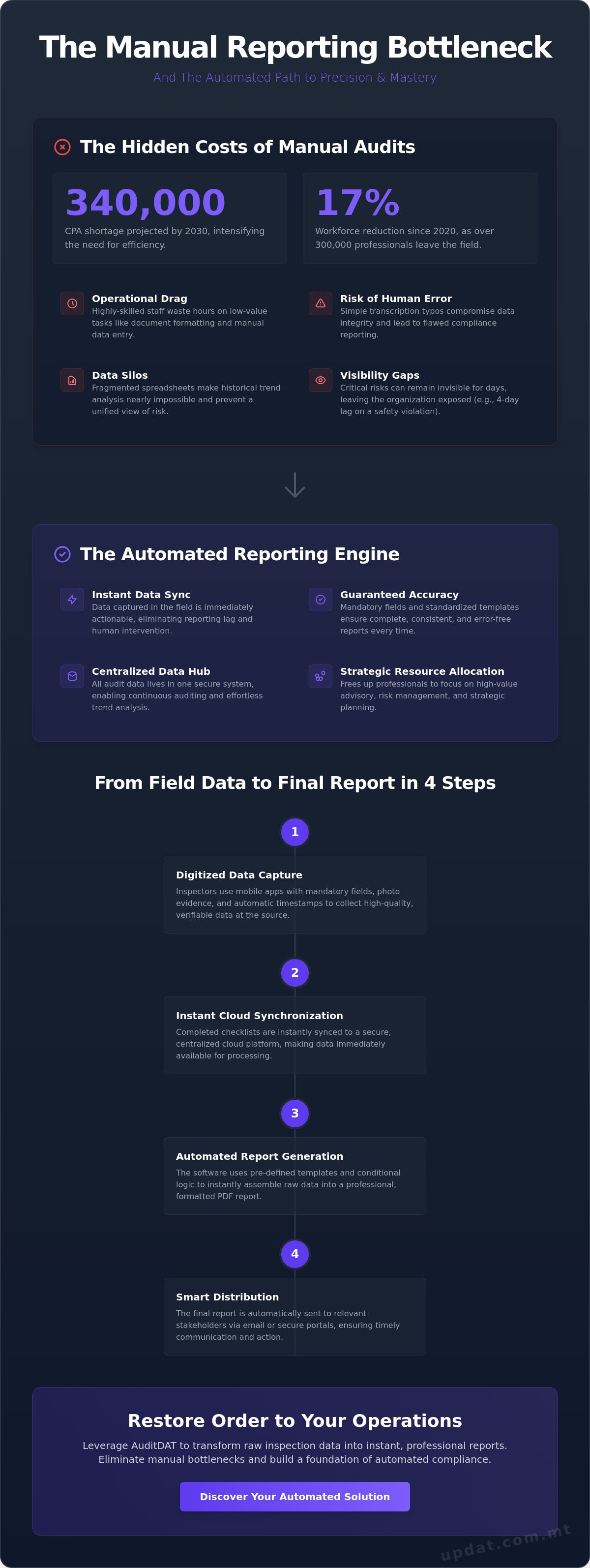
The accounting profession is facing a talent shortage of 340,000 CPAs by 2030, a reality that makes manual administrative processes a liability rather than just an inconvenience. You don't have to accept the friction of losing hours to repetitive data entry or the persistent risk of human error during report compilation. By automating audit reports, you move beyond these operational bottlenecks to establish a foundation of precision and mastery. This strategic shift allows your team to prioritize high-value advisory services instead of managing fragmented spreadsheets.
You deserve a system that delivers instant report generation and standardized data across every department. This guide explains how to eliminate manual data entry and transform your compliance workflows into a streamlined, automated reporting engine. We'll examine the impact of the 2026 EU AI Act deadlines and how tools like AuditDAT facilitate a transition toward continuous assurance. Discover how to reclaim your time and ensure your organization remains a steady, reliable leader in a complex regulatory environment.
Key Takeaways
• Identify and eliminate the administrative drain caused by manual consolidation while bridging the visibility gap in your compliance data.
• Master the mechanics of automating audit reports to synchronize field data instantly and remove the friction of manual PDF formatting.
• Apply a strategic 2026 framework to select automation platforms that balance high-level power with operational ease of use.
• Streamline your transition by auditing current manual workflows to identify bottlenecks and standardizing checklists for total data consistency.
• Leverage AuditDAT as a strategic architect to transform raw inspection data into instant, professional reports that restore order to your operations.
The Hidden Costs of Manual Audit Reporting
Manual data consolidation is a silent thief of operational momentum. When teams rely on paper checklists and manual spreadsheet entry, they create a "reporting gap" where critical risks remain invisible for days or weeks. If an inspector identifies a high-risk safety violation on Monday, but the report isn't finalized until Friday, the organization remains exposed for four unnecessary days. This delay isn't just a matter of convenience; it's a structural failure that compromises safety and compliance standards.
The process of automating audit reports eliminates this lag by ensuring that data captured in the field is immediately actionable. Manual systems are prone to transcription errors, where a simple typo can lead to a complete misunderstanding of compliance status. These inconsistencies compromise data integrity and make it impossible to maintain a reliable audit trail. In a landscape where regulatory timelines are tightening, relying on slow, error-prone manual processes is no longer a viable strategy for long-term growth.
The Drain on Professional Resources
The accounting and audit profession is facing a talent shortage of 340,000 CPAs by 2030. Since 2020, more than 300,000 professionals have left the field, representing a 17% reduction in the workforce. Despite this, many organizations still require highly-skilled managers to spend hours on basic document formatting and PDF generation. This is a massive opportunity cost. When senior staff are buried in low-value administrative tasks, they can't focus on proactive risk management or strategic business planning. This repetitive work doesn't just waste money; it erodes team morale and makes recruitment even more difficult in a competitive labor market.
Data Fragmentation and Compliance Risk
Paper-based audits and local spreadsheets create "data silos" that prevent a unified view of organizational health. Tracking historical trends becomes an arduous task, requiring days of manual data mining rather than seconds of digital filtering. This fragmentation makes it nearly impossible to implement a system of Continuous Auditing, which is essential for modern governance. Manual systems also struggle to meet 2026 data security standards, as physical files and unencrypted spreadsheets lack the access controls and encryption required for sensitive compliance data. Transitioning to a digital architecture isn't just about speed; it's about securing the foundation of your business operations.
The Mechanics of Automating Audit Reports
Audit report automation is the end-to-end digitisation of the compliance lifecycle. It isn't just about taking digital notes; it's about creating a seamless pipeline from the initial observation to the final stakeholder notification. This process eliminates the fragmented steps of traditional reporting, such as transcribing handwritten notes or manually aligning photos in a word processor. By automating audit reports, organisations create a direct link between field activity and executive oversight.
Cloud-based platforms serve as the central nervous system for this workflow. When an inspector completes a check on a manufacturing floor or within a hospitality suite, the data synchronises instantly with a secure server. This real-time movement allows for immediate data processing. The software takes these raw inputs and maps them into a structured, professional PDF output based on pre-defined templates. Once the document is ready, the system handles distribution, sending the report to relevant managers via automated emails or secure client portals. To see how these systems function in a live environment, you can explore the architecture of integrated compliance platforms.
Digitised Data Capture at the Source
The transition begins with mobile inspection apps that replace paper clipboards. These tools do more than just record text; they enforce high standards of data quality. Mandatory fields prevent inspectors from skipping critical questions, ensuring that every report is complete before it's submitted. Photo evidence provides an objective layer of proof, allowing stakeholders to see exactly what the inspector saw. Furthermore, automatic timestamping and GPS logging create a transparent record of accountability. This ensures that audits aren't just done, but are done at the right time and the right location, providing a level of precision that manual systems can't match.
Instant Report Generation and Logic
Modern software uses sophisticated conditional logic to process information as it's gathered. If a safety check fails, the system can automatically highlight the non-compliance in red or trigger an immediate alert to a supervisor. This removes the need for a human reviewer to scan hundreds of pages for errors. Standardised templates ensure that every report, regardless of who conducted the audit, maintains a consistent professional appearance. Automated report logic is the engine of modern compliance, acting as a filter that turns raw data into a prioritised list of actionable insights. This logic allows your team to focus on fixing problems rather than finding them in a pile of paperwork.
Evaluating Audit Automation Platforms: A 2026 Framework
Selecting a platform for automating audit reports requires a balance between technical power and operational ease of use. A system that is too complex will face resistance from field staff; one that is too simple will fail to provide the deep insights required for executive decision-making. You must look for a digital architecture that bridges this gap. While standalone reporting tools can digitise basic forms, integrated compliance management systems offer a superior advantage by connecting audit findings directly to your broader operational workflows.
Offline capability is a non-negotiable requirement in 2026. Field auditing often takes place in environments with unreliable connectivity, such as remote manufacturing plants or basement utility rooms in hospitality venues. A robust platform must allow inspectors to capture data, attach photos, and complete checklists without an active internet connection. The system should then synchronise automatically once a signal is restored. This ensures that no data is lost and that the reporting engine remains fueled by accurate, real-time information from every corner of your business.
Essential Features for Operational Audits
Operational mastery depends on high-level visibility. Real-time dashboards provide a national or even global view of compliance status, allowing you to identify regional trends or recurring failures before they escalate. For manufacturing and hospitality sectors, RFID or QR code integration is essential for location verification. This technology provides "proof of presence," confirming that an inspector was physically at a specific machine or room at a recorded time. Beyond mere data capture, the most effective platforms generate automated "action items" from audit findings. If a check fails, the system immediately assigns a corrective task to the relevant department, ensuring that the report leads to a tangible resolution.
Scalability and Customisation
Generic industry forms rarely capture the unique nuances of a specific business. Bespoke report templates are superior because they allow you to mirror your exact operational logic and brand standards. This level of customisation ensures that your output is professional and relevant to your stakeholders. Security is equally critical. User-based permissions protect sensitive data by ensuring that staff only access the information necessary for their roles. Building a resilient organisation through streamlining business operations with software requires flexible reporting tools that can adapt as your company grows. Look for a solution that acts as a steady foundation for long-term expansion rather than a rigid, short-term fix.
Implementing Automated Reporting Without Operational Friction
Transitioning from paper-based systems to a digital architecture requires a structured roadmap. Start by auditing your current manual workflow to identify the most significant bottlenecks. Pinpoint exactly where data stalls. Is it during the physical transcription of field notes? Or is the delay caused by the manual formatting of PDF reports? By identifying these friction points, you can prioritize the specific features of automating audit reports that will deliver the fastest operational return. This diagnostic phase ensures that the new system solves existing problems rather than creating new ones.
Standardization is the bedrock of digital precision. Before deploying software, refine your inspection checklists to ensure data consistency across the entire team. This prevents fragmented reporting styles and allows the automated engine to process inputs without human intervention. To ensure high adoption rates, phase the rollout starting with a single department or a high-risk audit type. This controlled approach allows you to demonstrate immediate utility while training staff on a digital-first mindset. When employees see that the software removes their administrative burden, resistance turns into advocacy.
Phase 1: The Digital Blueprint
Success begins with a clear map of your reporting hierarchy. Define who needs to receive each report and which specific data points are critical for their decision-making. Consult with digital audit solutions experts to configure templates that mirror your unique operational requirements. During this phase, verify that all national regulatory requirements are hardcoded into the digital forms. This ensures that every automated report is compliant by design, reducing the risk of oversight and providing a steady foundation for your governance strategy.
Phase 2: Deployment and Refinement
Execute a pilot program to test the automated distribution logic in a live environment. This stage is critical for gathering feedback from field auditors regarding the ease of data entry. If the interface isn't intuitive, the quality of the data will suffer. Review the first batch of automated reports for clarity and actionable insight. Does the report highlight critical risks immediately? Is the formatting professional and consistent? Refine the conditional logic and template structure based on these results before expanding the system across the organization. To begin your transition toward a more efficient reporting environment, contact our strategic architects for a workflow assessment.
AuditDAT: Restoring Order Through Automated Compliance
AuditDAT serves as the strategic architect for your reporting workflows, replacing fragmented manual habits with a unified digital engine. By automating audit reports, you eliminate the reporting gap that often leaves Maltese business leaders in the dark regarding critical risks. The platform transforms raw inspection data into instant, professional reports, ensuring that stakeholders receive polished documentation the moment an audit concludes. This speed doesn't sacrifice depth; instead, it provides the clarity needed to maintain high operational standards without the administrative overhead.
Complexity is further reduced through the seamless integration between AuditDAT and ActionDAT. When an inspection identifies a non-compliance issue, the system doesn't just record the failure; it triggers a resolution workflow. ActionDAT allows managers to assign corrective tasks immediately, creating a closed-loop system where every audit finding leads to a tangible improvement. This synergy removes the friction between identifying a problem and solving it, restoring order to even the most complex compliance environments. You gain a level of control that manual spreadsheets simply cannot provide.
Precision Reporting for High-Stakes Industries
In sectors like hospitality, manufacturing, and security, the cost of an oversight is exceptionally high. AuditDAT provides the visual clarity required to manage these risks effectively through automated compliance dashboards. These dashboards offer a high-level view of national operations, allowing you to monitor performance across multiple sites in real time. Having a single source of truth for all national audits ensures that data remains standardized and accessible. You no longer need to hunt through disparate files to prove compliance during a regulatory review. The information is organized, verified, and ready for inspection at any moment.
The Path to Operational Mastery
AuditDAT is more than a digital checklist; it's a reliable foundation for long-term growth. By removing the burden of repetitive administrative tasks, the platform empowers you to reclaim your time and focus on strategic leadership. You can transition from a reactive state of managing crises to a proactive environment where systems are optimized for efficiency. This is the essence of operational mastery. To begin your transformation and see how these tools can restructure your business for the better, visit AuditDAT today. Establish the precision your organization deserves and leave the complexity of manual reporting behind.
Mastering Your Operational Environment
Transitioning from manual data entry to a digital-first architecture is a strategic necessity for any organization aiming for long-term stability. By eliminating the administrative drain of report compilation, you empower your team to focus on high-level risk management rather than repetitive paperwork. Embracing a system for automating audit reports ensures that your compliance data is accurate, standardized, and immediately actionable across all departments. This shift doesn't just save time; it restores the precision and order required to lead in a complex regulatory landscape.
AuditDAT is a Maltese-developed software platform designed specifically to meet local and international operational standards. Currently utilized by leading firms in the hospitality and manufacturing sectors, it provides cloud-based access for real-time national oversight. You can eliminate manual friction and gain a clear, unified view of your business health from any location. Take the first step toward reclaiming your team's time and focus. Restore order to your reporting with AuditDAT and build a resilient foundation for your future growth.
Frequently Asked Questions
How does automating audit reports improve data accuracy?
Automating audit reports improves accuracy by removing the human element from data transcription. Digital forms enforce mandatory fields and photo evidence, ensuring no critical data point is omitted during an inspection. This structure prevents the inconsistencies and illegibility common in handwritten notes and manual spreadsheet entry.
Can automated reporting systems handle HACCP and food safety standards?
Digital systems like AuditDAT are specifically designed to manage high-stakes compliance frameworks like HACCP. You can digitize complex food safety checklists to ensure every temperature check and hygiene protocol is recorded with an automatic timestamp. This creates an immutable audit trail that satisfies both internal standards and external health inspectors.
Is it difficult to migrate from paper-based audits to an automated system?
Transitioning from paper to digital is a structured process that minimizes operational friction when handled correctly. By mapping your existing checklists into bespoke templates, you create a familiar but more efficient workflow for your field team. High adoption rates are achieved by demonstrating how the software removes the burden of repetitive manual reporting.
What are the main benefits of real-time audit dashboards?
Real-time dashboards provide instant visibility into your entire organization's compliance status across multiple locations. You can identify failing trends at specific sites or departments before they become systemic liabilities. This high-level oversight allows for proactive leadership and immediate intervention rather than reactive crisis management.
How does automated reporting help with national regulatory compliance in Malta?
Automated reporting ensures that Maltese regulatory requirements are hardcoded into your daily operations. This provides a single source of truth that's easily accessible during national inspections. Having all documentation organized and verified digitally reduces the stress of proving compliance to local authorities and ensures you're always audit-ready.
Can I customise the look and feel of my automated audit reports?
Customisation is a core feature of professional automation platforms. You can tailor the design of your reports to match your brand standards and specific operational logic. This ensures that every generated PDF is professional, clear, and focused on the data points most relevant to your executive stakeholders.
What happens if a task is failed during an automated audit?
If an inspector records a failure, the system can automatically trigger a corrective task through ActionDAT integration. This ensures that non-compliance is met with immediate resolution rather than just being a recorded note in a file. It effectively closes the loop between identifying a risk and implementing a verified solution.
How do automated audit reports save administrative time for managers?
Managers reclaim hours of administrative time by eliminating the need for manual data consolidation and document formatting. When you're automating audit reports, the software generates professional outputs instantly upon audit completion. This allows leadership to focus on strategic improvements and business growth instead of being buried in tedious paperwork.





%201.svg)
