

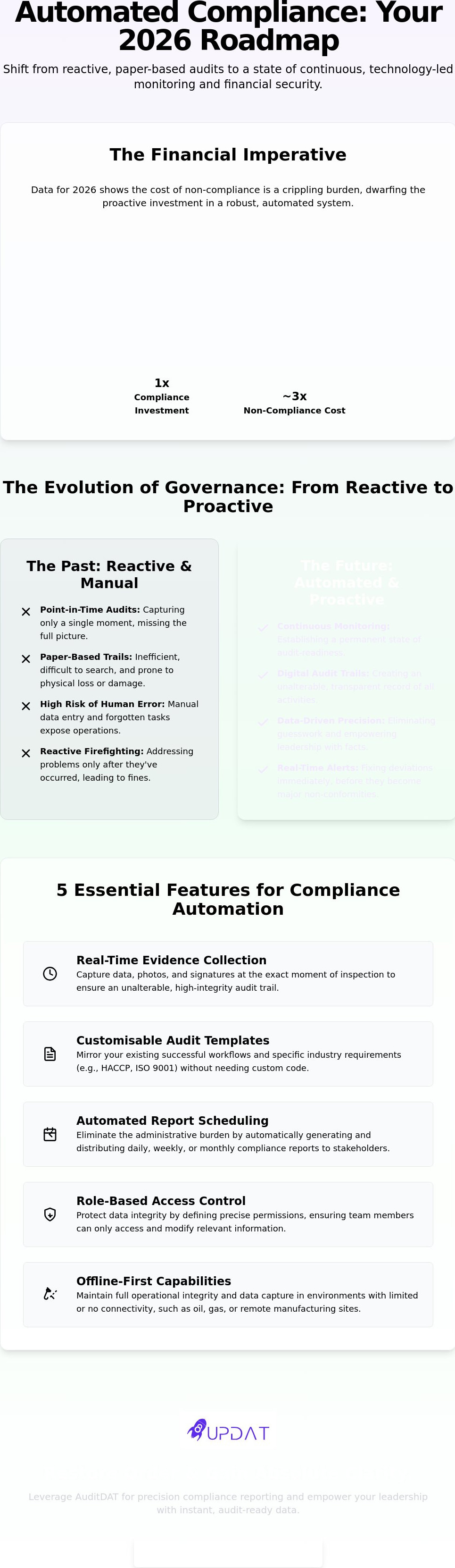
The cost of non-compliance in 2026 is nearly three times the investment required to maintain a robust regulatory framework. It's a heavy burden to carry, especially when your team is still drowning in paper-based audit trails while searching for reliable automated compliance reporting tools. You likely recognize the specific anxiety that surfaces during a surprise inspection, wondering if a single human error has left your operation exposed. It's difficult to track task completion across large teams without losing focus on the strategic architecture of your business.
Restore order and gain absolute clarity in your operations. This guide explains how to select the right technology to eliminate manual errors and maintain a permanent state of audit-readiness. Transition from reactive fixes to a model of continuous monitoring. Leverage platforms like AuditDAT to gain real-time visibility into your compliance status. This article provides a roadmap to generate instant, audit-ready reports at the touch of a button, effectively reducing administrative overhead and empowering your leadership with precise, logical data.
Key Takeaways
• Understand the mandatory shift from point-in-time audits to continuous, technology-led monitoring for 2026.
• Identify five essential features for automated compliance reporting tools to ensure data is captured at the exact moment of inspection.
• Prioritise offline-first capabilities to maintain operational integrity in environments with limited connectivity, such as oil, gas, or manufacturing.
• Execute a seamless transition to digital compliance by auditing manual processes and configuring templates that mirror your existing successful workflows.
• Leverage AuditDAT to handle complex inspections across diverse sectors and restore order to your regulatory documentation.
The Evolution of Governance: Why Automated Compliance Reporting is Mandatory in 2026
Automated compliance reporting tools represent a fundamental shift in how businesses handle regulatory obligations. This isn't a digital filing cabinet. It's the continuous, technology-led collection of evidence and the automatic generation of documentation. This shift moves organizations away from point-in-time audits that only capture a moment in history. Instead, it establishes a state of continuous compliance monitoring. This transition is essential for modern corporate governance principles, ensuring that oversight is constant rather than occasional.
Automation restores operational order. It removes the unpredictable human error variable from critical inspections. When a system captures data automatically, you eliminate the risk of forgotten entries or misplaced logs. This creates a permanent, unalterable digital audit trail. National regulatory bodies increasingly demand this level of precision. Data from 2026 indicates that the cost of non-compliance is nearly three times the cost of maintaining a compliant system. Investing in automated compliance reporting tools isn't just a safety measure; it's a financial imperative.
A digital trail provides absolute transparency. It allows leadership to verify that every task was completed to the required standard. There is no ambiguity. This clarity empowers management to make decisions based on facts, not assumptions. It transforms compliance from a burden into a strategic asset that supports long-term growth and stability across the entire organization.
To explore how these digital frameworks are implemented in specific regions, you can learn more about Be-Safe Technologies Ltd, a UK-based provider of award-winning EHS digital platforms for businesses across Europe.
From Reactive to Proactive Compliance
Reactive compliance is expensive. It leads to heavy fines, reputational damage, and constant administrative firefighting. Managers often find themselves reacting to problems after they've already occurred. Real-time alerts change this dynamic. These tools notify teams of deviations immediately. You can fix a minor temperature drop or a missed safety check before it becomes a major non-conformity. This proactive approach maintains high-level efficiency across multiple sites simultaneously. It ensures every location follows the same rigorous standards without needing a manager on-site at all times.
The End of the Paper-Based Audit
Physical filing systems are a drain on resources. They carry hidden costs like storage space, retrieval time, and the constant risk of physical loss or damage. Searching for a specific record from three years ago shouldn't take hours. Digital transformation is the movement from static records to actionable data. It turns your compliance history into a tool for growth rather than a stack of paper. You can explore how digital audit solutions restore order by replacing manual workflows with precision software.
Evaluating Compliance Automation Tools: 5 Essential Features for Your Shortlist
Selecting the right architecture for your compliance framework requires focusing on functional precision. Generic platforms often offer broad features but lack the operational depth needed for field-based inspections. When vetting automated compliance reporting tools, your shortlist must prioritize systems that bridge the gap between office oversight and floor-level reality. The global compliance software market has reached approximately $68.4 billion in 2026, reflecting a massive shift toward these specialized systems. To ensure your investment delivers order rather than more complexity, look for these five core capabilities.
Real-time evidence collection
The system must capture data at the exact moment of inspection. This eliminates backfilling and ensures the integrity of your digital audit trail.
Customisable audit templates
Flexibility is mandatory. Your tool should allow you to mirror specific industry requirements, such as HACCP for food safety or ISO 9001 for quality management, without requiring bespoke coding.
Automated report scheduling
Remove the manual burden of compiling weekly or monthly compliance packs. The software should generate and distribute these documents to stakeholders automatically.
Role-based access control
Protect your data integrity by defining exactly who can perform, sign off, or edit critical tasks. This creates a clear chain of accountability.
Cross-platform accessibility
Mobile-first design is essential for staff on the floor or in the field. Crucially, your choice must include offline-first functionality. Unlike many competitors that rely on constant cloud pings, a robust tool allows for data entry in areas with limited connectivity, such as manufacturing plants or oil rigs, syncing only when a signal is restored.
You can begin building your digital checklists today to see how these features transform your daily operations.
Dynamic Task Tracking and Prioritisation
Task management is the backbone of any reliable compliance program. Without it, even the most detailed templates become useless. Automated alerts ensure that no inspection falls through the cracks by notifying responsible parties of upcoming or overdue requirements. Integrating an action item tracker directly into the compliance workflow allows managers to assign corrective actions the moment a non-conformity is detected. This immediate movement from detection to resolution is what separates high-efficiency teams from those stuck in reactive cycles.
Advanced Analytics and Executive Dashboards
High-level visibility is a requirement for directors and stakeholders who need to understand the organization's risk profile at a glance. Executive dashboards should provide more than just a pass or fail status. They must offer qualitative operational insights. In 2026, 59.3% of compliance teams are using AI to power trend analysis. This allows you to identify recurring gaps in specific departments or sites before they lead to a regulatory breach. By turning raw data into actionable intelligence, you move from merely surviving audits to mastering your operational environment.
Industry-Specific Requirements: Matching Tools to Operational Realities
A one-size-fits-all approach to Governance, Risk, and Compliance (GRC) often collapses when applied to physical operational environments. While many SaaS-focused platforms excel at mapping digital frameworks like SOC 2 or HIPAA, they frequently ignore the realities of the shop floor or the commercial kitchen. Effective automated compliance reporting tools must adapt to the specific physical movements of your business. This requires a shift from purely digital logs to systems capable of capturing physical evidence in real-time, such as photos or GPS timestamps, directly at the point of activity.
Offline-first capabilities are non-negotiable for sectors like manufacturing or oil and gas. You can't rely on a constant cloud connection when working in a remote facility or a reinforced concrete plant. A tool that fails when the Wi-Fi drops isn't a solution; it's a liability. When evaluating a vendor, verify their expertise in your specific sector by looking for pre-built templates that reflect your actual workflows. Selecting automated compliance reporting tools that understand these nuances is the difference between a bureaucratic hurdle and operational excellence. This ensures your compliance efforts integrate seamlessly with broader business process automation initiatives, creating a unified architecture for growth.
Hospitality and Food Safety (HACCP)
In the hospitality sector, compliance is a daily, high-stakes requirement. You need precise tools for temperature logging, hygiene checklists, and allergen management to satisfy national health authorities. Using specialized HACCP management solutions simplifies these inspections by providing instant access to historical data. Digital reporting replaces messy clipboards with clean, unalterable records that prove your commitment to safety. This level of organization ensures that surprise inspections from health authorities are met with confidence rather than anxiety.
Manufacturing and Quality Assurance (GXP)
Manufacturing environments demand rigorous adherence to GXP and ISO standards. Managing equipment maintenance logs and quality control checks on the production line requires a system that staff can use without disrupting their output. Implementing manufacturing compliance solutions ensures that every safety regulation is met and documented correctly. This precision reduces waste and guarantees that your products consistently meet national safety requirements. It turns compliance into a steady foundation for long-term production growth.
Security and Facilities Management
For security and facilities management, digital audits provide the transparency needed to prove service delivery to end clients. Automating patrol tracking, incident reporting, and fire safety inspections removes the guesswork from site management. Utilizing security sector solutions allows you to generate professional reports at the touch of a button. This level of organization builds trust with clients and ensures your team remains audit-ready at all times. It effectively restores order to complex multi-site operations.
The Implementation Roadmap: Transitioning to Digital Compliance Without Disruption
Transitioning from paper to digital compliance is a strategic shift, not just a technical one. To ensure success, you must follow a structured roadmap that prioritizes operational stability while removing the administrative bottlenecks that slow down your management team. Start by auditing your current manual processes. Identify the specific areas where human error or lost documentation creates the highest risk. Once identified, configure your automated compliance reporting tools to mirror your existing, successful workflows. This approach reduces friction and aids staff adoption by maintaining a sense of familiarity within the new digital framework.
Follow this phased approach to ensure a smooth transition across the entire organization:
• Conduct pilot testing in a single department to iron out workflow kinks before a full-scale national rollout.
• Train staff on the "why" of automation, focusing on how it eliminates repetitive paperwork and makes their daily jobs easier.
• Establish a rhythm of continuous review to refine the automated reporting outputs based on real-world feedback from the floor.
• Monitor adoption rates closely during the first thirty days to identify any areas where additional guidance is needed.
You can set up your first digital workflow now to begin the transition with precision and clarity.
Managing the Cultural Shift
The most common objection to new technology is the fear that staff won't use it. You can overcome this resistance by selecting a platform with an intuitive, no-nonsense user interface. When tools are easy to navigate, they empower employees rather than burdening them. Clear, achievable daily checklists provide staff with a sense of mastery over their environment. It turns compliance from a vague obligation into a structured, manageable task that provides immediate feedback on their performance.
Integrating with Existing Systems
Your compliance tool shouldn't be a siloed island. To achieve a holistic view of your operations, you must connect your audit data to wider workforce management systems. There is significant synergy in linking automated compliance reporting tools with TimeDAT to monitor attendance and task completion simultaneously. This integration ensures that the right people are performing the right checks at the right time. It creates a unified architecture for operational excellence, allowing you to manage both people and processes from a single, reliable source of truth.
AuditDAT: Precision Compliance Reporting for National Operational Excellence
AuditDAT serves as the strategic architect for organizations ready to restore order through digitisation. It moves beyond the theoretical benefits of automated compliance reporting tools, providing a concrete platform to master your operational environment. The software suite balances sophisticated logic with an accessible interface. It's designed to handle complex inspections across diverse sectors, from the high-pressure environment of hospitality kitchens to the precision-heavy floors of manufacturing plants. This adaptability ensures that your compliance framework remains fluid yet structurally sound.
Choosing a national partner provides a significant advantage. We understand the specific nuances of the local regulatory environment and the expectations of national authorities. This proximity allows for a faster, more reliable implementation than generic, offshore platforms can offer. By integrating AuditDAT into your daily operations, you establish a permanent state of audit-readiness that commands respect from inspectors and stakeholders alike. It effectively removes the chaos of manual tracking and replaces it with a steady, predictable rhythm of governance.
Why AuditDAT is the Logical Conclusion of Your Search
The core philosophy behind AuditDAT is the removal of complexity. We believe that compliance shouldn't be a source of administrative friction. Our platform focuses on immediate utility, allowing managers to save significant administrative time that was previously wasted on manual data entry and report compilation. By increasing accountability through unalterable digital signatures and GPS verification, you restore trust in your data. You can book a demo to see exactly how the platform transforms raw inspections into actionable executive insights.
Bespoke Development for Unique Compliance Needs
Some organizations possess highly specialized workflows that require more than a standard template. For these unique requirements, UPDAT offers bespoke software development to build custom logic directly into your reporting framework. This ensures your automated compliance reporting tools handle specific business rules or proprietary quality standards with absolute precision. Building on a reliable foundation allows for long-term growth without the need for constant IT overhauls. It's a proactive approach to technology that ensures your systems evolve alongside your business, maintaining clarity and order at every stage of your expansion.
Mastering Your Operational Environment in 2026
Mastering the regulatory landscape of 2026 demands a fundamental shift from static records to a model of continuous, unalterable evidence. You have explored how the right digital architecture removes the human error variable and restores order to complex multi-site operations. Automated compliance reporting tools are no longer a luxury reserved for large enterprises. They are the essential foundation for any organization seeking to eliminate administrative bottlenecks and maintain a permanent state of audit-readiness across every department.
Our Maltese-based support and development team understands the specific pressures and nuances of your local regulatory landscape. We have already helped leaders in hospitality, manufacturing, and security achieve a proven reduction in administrative overhead by digitising their physical workflows. This transformation replaces the anxiety of surprise inspections with the calm confidence of total operational visibility and unshakeable data integrity. It is time to move beyond the chaos of paper trails and embrace a system built for precision.
Restore operational order with a personalized AuditDAT demo
Take the first step toward a more organized, efficient future today. We look forward to helping you build a steady foundation for long-term growth.
Frequently Asked Questions
What are automated compliance reporting tools?
Automated compliance reporting tools are software systems that continuously collect evidence and generate regulatory documentation without manual intervention. They replace traditional paper logs with digital data points like timestamps, GPS locations, and photos. By using these tools, businesses move from periodic, point-in-time checks to a state of continuous monitoring. This ensures your records are always accurate and ready for a surprise inspection at a moment's notice.
Can automated tools completely replace manual internal audits?
No tool replaces the human oversight required for strategic decision-making, but they do automate the labor-intensive data collection process. Automated systems handle the repetitive task of gathering evidence and verifying daily checklists. This allows your internal auditors to focus on analyzing trends and addressing high-risk deviations rather than chasing missing paperwork. The software acts as a strategic architect, providing the raw data needed for a more effective human-led audit.
How much time can a business save by automating its compliance reporting?
Businesses typically see a significant reduction in administrative overhead by eliminating manual data entry and physical filing. While specific time savings depend on your operation's scale, removing the need to compile weekly reports manually can save managers several hours every week. This efficiency allows leadership to refocus on operational growth. The automation of report distribution also ensures that stakeholders receive critical updates instantly without any additional administrative effort.
Is automated compliance software suitable for small businesses in Malta?
Yes, automation is highly beneficial for small businesses that need to maintain high standards with limited staff. Small operations often face the same regulatory pressures as large enterprises but have fewer resources to manage them. Implementing a scalable tool allows a small team to achieve professional-grade compliance. It provides the structure needed to grow without the burden of increasing paperwork as you expand your site count or service range.
What is the difference between a generic GRC tool and an operational audit tool like AuditDAT?
Generic GRC tools often focus on digital security frameworks like SOC 2, whereas AuditDAT is designed for physical operational environments. AuditDAT excels at managing on-the-ground inspections in sectors like hospitality, manufacturing, and security. It captures physical evidence like photos and GPS data that generic tools often overlook. This operational focus ensures that your automated compliance reporting tools reflect the actual movements of your business rather than just your server logs.
How does automated reporting help in avoiding regulatory fines?
Automated reporting prevents fines by identifying non-conformities in real-time before they escalate into serious breaches. Real-time alerts notify management of missed checks or temperature deviations immediately. Since the cost of non-compliance is nearly three times the cost of compliance, this proactive detection is a critical financial safeguard. Having a permanent, unalterable digital audit trail also demonstrates a commitment to due diligence during official inspections by national authorities.
Do these tools work offline during on-site inspections?
Yes, robust platforms like AuditDAT include offline-first capabilities to ensure continuity in areas with poor connectivity. Staff can complete inspections and capture evidence in basements, warehouses, or remote sites without a Wi-Fi signal. The data is stored locally on the device and automatically syncs with the cloud once a connection is restored. This prevents data loss and ensures that your compliance logs remain complete regardless of your physical location or signal strength.
How secure is the data stored in a cloud-based compliance platform?
Data security is prioritized through encrypted storage and role-based access controls that limit who can view or edit sensitive records. Cloud-based platforms provide a more secure environment than physical filing cabinets, which are vulnerable to loss, fire damage, or unauthorized access. Regular backups and professional-grade hosting ensure your compliance history is protected. This digital architecture provides a steady, reliable foundation for your long-term operational records and long-term growth.






%201.svg)
