

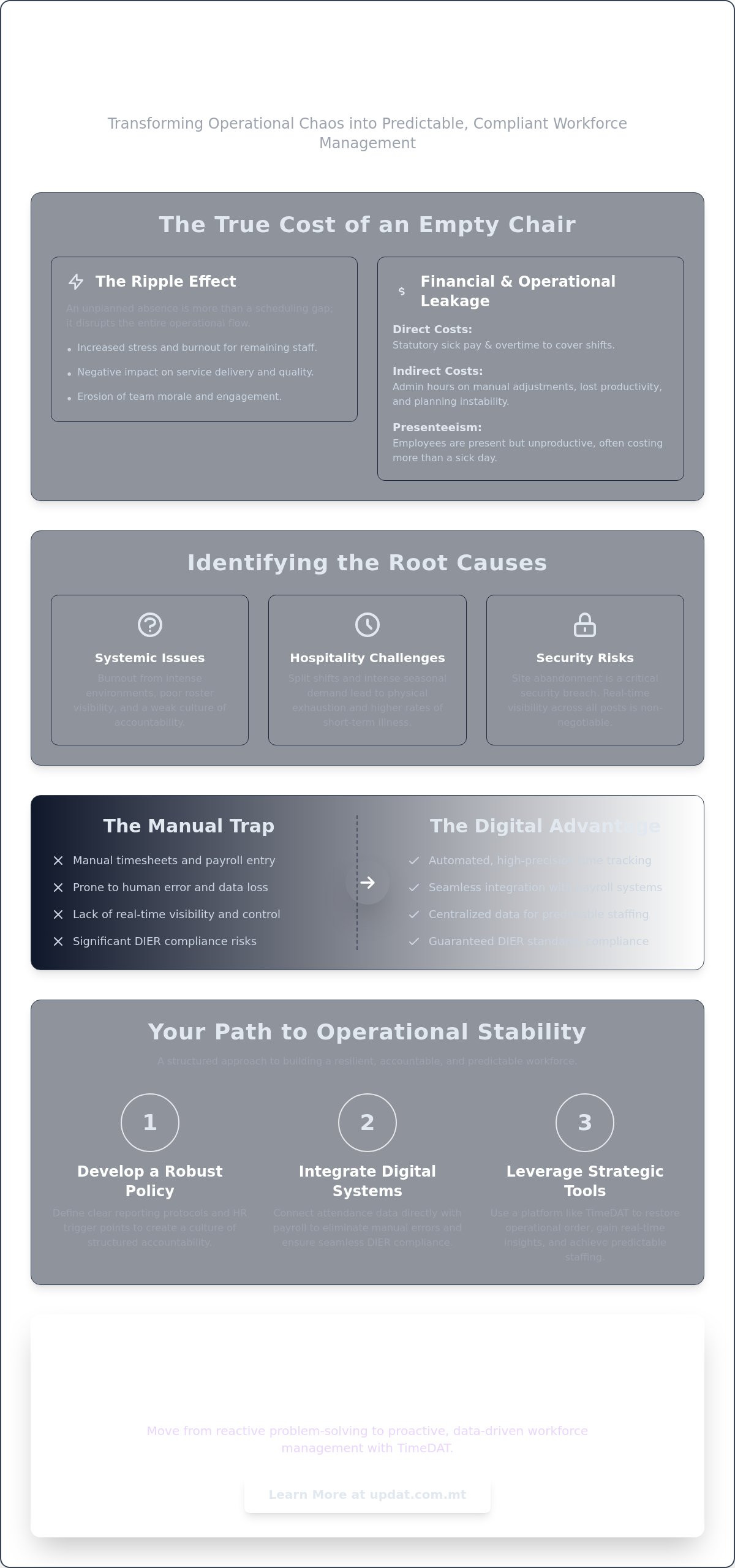
What if the operational chaos of an empty morning shift isn't a personnel issue, but a design flaw in your business architecture? Addressing employee absenteeism in Malta often feels like a constant struggle against manual timesheets and the latest DIER regulations. You've likely felt the frustration of trying to maintain order when staff fail to show up, leaving you to manage an administrative nightmare while trying to ensure payroll remains accurate and compliant.
We understand that manual tracking and lack of visibility create a cycle of unpredictability. This guide provides the keys to mastering your operational environment by identifying, managing, and reducing absenteeism through structured policies and digital accountability. You'll learn how to transform your workflow with automated reporting and clear accountability. We'll explore how integrating systems like TimeDAT restores stability, providing you with the predictable staffing levels and precise data needed for long-term growth.
Key Takeaways
• Differentiate between authorized leave and unplanned disruptions to mitigate the ripple effect on service delivery and staff morale.
• Define clear reporting protocols and HR trigger points to build a culture of structured accountability across your workforce.
• Discover why addressing employee absenteeism malta demands a shift from manual timesheets to high-precision digital management.
• Integrate attendance data with payroll systems to eliminate manual entry errors and ensure seamless compliance with DIER regulations.
• Leverage TimeDAT as a strategic architect to restore operational order and achieve predictable staffing levels for long-term growth.
Understanding the Impact of Absenteeism on Maltese Business Operations
In the Maltese private sector, absenteeism isn't just a missing person on a shift. It's a disruption to the digital and physical architecture of your business. A comprehensive understanding of absenteeism reveals it as a habitual pattern of absence from a duty or obligation. For local managers, addressing employee absenteeism malta requires looking past the individual to the systemic impact. When a staff member fails to arrive, the burden shifts to those present. This creates a ripple effect of increased stress, burnout, and eventual service degradation. While total absence is visible, "presenteeism" often hides beneath the surface. This occurs when employees are physically present but mentally or physically unable to perform at full capacity. It often costs businesses more in lost productivity than a standard sick day. The Department of Industrial and Employment Relations (DIER) provides the legal baseline for these absences, but maintaining order requires going beyond minimum statutory requirements.
The Financial Architecture of Unplanned Absence
Unplanned absences drain resources through both direct and indirect channels. Direct costs include statutory sick pay and the immediate need for overtime pay to cover vacant slots. However, the indirect costs often prove more damaging. Administrative teams waste hours on manual payroll adjustments and shift rescheduling. We call this "operational leakage." It happens when manual tracking systems fail to capture the true cost of lost time. Without a digital foundation, these small inefficiencies compound. They erode your profit margins and destabilize your workforce planning. Predictable staffing depends on removing these hidden complexities.
Regulatory Compliance and DIER Standards
Malta's employment laws are precise. The DIER mandates specific sick leave entitlements, often starting from the first day of employment. Employees must provide medical certification to justify their absence, and employers are responsible for maintaining rigorous records. Failure to document these instances accurately invites significant risk during inspections. Addressing employee absenteeism malta effectively means aligning your internal policies with these legal frameworks. For businesses looking to master their governance, risk, and compliance, moving to a centralized digital record is a strategic necessity. It ensures every hour is accounted for and every regulation is met without the risk of manual error.
Identifying the Root Causes of Absenteeism in Key Local Industries
Addressing employee absenteeism malta involves more than just reviewing sick notes. It requires a forensic look at why specific industries struggle more than others. In Malta, the private sector faces unique pressures that turn small scheduling gaps into major operational failures. While many absences are protected by Maltese law on employee leave entitlements, others are the result of unplanned disruptions that signal deeper organizational issues. These no-shows often occur when employees feel disconnected from the business architecture or overwhelmed by inefficient scheduling. Distinguishing between a legitimate medical need and a lack of accountability is the first step toward restoring order.
Burnout acts as a silent catalyst for absenteeism, particularly in high-intensity environments. When staff members can't see their rosters in advance or find themselves working back-to-back shifts without adequate rest, they're more likely to disengage. Poor roster visibility is a primary driver of this trend. If an employee isn't certain of their schedule until the last minute, their commitment to that shift weakens. This lack of clarity creates a culture of no-shows that destabilizes the entire team and forces remaining staff to pick up the slack. It's a cycle that erodes morale and increases the likelihood of further absences.
Hospitality and Security: The Shift-Work Challenge
The hospitality industry faces intense pressure from split shifts and seasonal demand. These fragmented work patterns often lead to physical exhaustion and a higher rate of short-term sickness. Similarly, in the security sector, personnel tracking is vital. Site abandonment isn't just a payroll problem; it's a significant security risk. Managers need real-time visibility across multiple sites to ensure that every post is manned. Without this digital oversight, a single absence can leave a client's property vulnerable, damaging your professional reputation and breaching contract terms.
Manufacturing and Facilities Management: Process Continuity
In manufacturing, process continuity is everything. A single missing operator can halt an entire production line, leading to expensive downtime and missed delivery deadlines. Addressing employee absenteeism malta in this context means building a system where accountability is automated. For facilities management, absenteeism directly impacts service level agreements (SLAs). If cleaners or maintenance staff don't show up, the client sees the failure immediately. We view accountability as a tool for empowerment. When employees have clear, digital access to their schedules through systems like TimeDAT, they gain a sense of ownership over their time. You can begin restoring this sense of order by registering for a digital workforce management account today.
How to Develop a Robust Attendance Policy for Your Workforce
A policy shouldn't be a static document gathering dust on a shelf. It's the operational blueprint for your workforce. Addressing employee absenteeism malta requires a shift from vague expectations to concrete, digital protocols. Every employee must understand how their presence impacts the business architecture. Transparency is the foundation of this system. When you track leave and approvals in a visible, digital environment, you remove the ambiguity that often leads to disputes or perceived unfairness. This clarity empowers your team to manage their own time while respecting the needs of the operation.
Implement return-to-work interviews as a standard procedure for every unplanned absence. These aren't interrogations. They're brief, structured meetings designed to confirm an employee is fit for duty and to offer support if needed. This practice signals that every absence is noticed. It also allows managers to identify underlying issues, such as health concerns or workplace friction, before they become chronic patterns. By making these interviews a routine part of your operational excellence strategy, you foster a culture of mutual respect and high-level accountability.
Setting Clear Reporting Protocols
Establish a direct and "no-nonsense" reporting chain. Employees shouldn't just send a text to a colleague or leave a vague voicemail. They must contact their immediate supervisor through a designated channel. Define the required notice period for unplanned absences clearly. For a shift starting at 07:00, a two-hour notice period is a practical requirement. This gives the manager time to adjust the roster and prevent service degradation. The supervisor plays a critical role here. They act as the first point of contact, ensuring the reporting protocol is followed and immediate operational gaps are filled.
Trigger Points and Fair Intervention
Define what constitutes "excessive" absenteeism for your specific business. This might be a specific number of days or a pattern of absences, such as frequent Mondays or Fridays. Set clear trigger points for HR intervention. For example, three unplanned absences in a rolling six-month period could trigger a formal review meeting. This process balances disciplinary action with welfare support. It's about identifying whether the issue is a performance problem or a genuine need for flexibility. Maintain a professional distance during these interventions. Focus on the impact on the business while ensuring employee wellbeing is addressed through logical, structured steps.
Implementing Digital Systems to Restore Operational Order
Manual tracking is a liability. It relies on retrospective data that is often prone to human error and manipulation. Restoring operational order requires a real-time digital architecture that provides immediate visibility into your workforce. Addressing employee absenteeism malta effectively means seeing the problem as it happens, not weeks later during a frantic payroll cycle. By moving away from paper-based systems, you eliminate the administrative bottlenecks that drain your management's time and energy. Digital systems transform attendance from a mystery into a manageable data point.
The Transition from Paper to Cloud
Paper timesheets are more than just a nuisance; they're a source of operational leakage. They require manual entry, which inevitably introduces errors into your financial records. TimeDAT centralizes attendance data for Malta-based teams, providing a single source of truth for every shift worked. It removes the complexity of timesheet approval by automating the verification process. Managers no longer need to hunt down missing signatures or clarify illegible handwriting. This transition saves significant administrative time, allowing your leadership to focus on strategic growth rather than manual data entry.
Real-Time Visibility and Task Prioritization
When an absence occurs, the clock starts ticking. Digital systems enable real-time roster adjustments that allow you to cover shifts instantly. You can send automated notifications to available staff, filling gaps before they impact service delivery. Beyond just filling a slot, ActionDAT ensures that critical tasks are prioritized when you're short-staffed. If a team member is missing, the system directs the remaining workforce toward high-priority obligations first. This ensures that your most vital operations continue without interruption. For deeper insight into system integration, read our Workforce Management Software in Malta guide.
Data analytics act as an early warning system for your business. By analyzing attendance trends, you can spot absenteeism patterns before they escalate into crises. You might discover that certain departments experience higher rates of unplanned leave on specific days, or identify employees who are consistently hitting HR trigger points. This information allows for proactive intervention and more informed decision-making. You can start building this foundation today. Register for a digital workforce management account to gain full control over your operational visibility.
Mastering Your Operational Environment with TimeDAT
TimeDAT acts as the strategic architect for your business operations. It provides the digital foundation needed to move from reactive management to proactive mastery. Addressing employee absenteeism malta becomes a streamlined process when you replace manual guesswork with high-precision data. This isn't just about tracking hours. It's about building an environment where every shift is optimized and every absence is managed through a logical, automated framework. By centralizing your workforce data, you remove the complexity that often leads to operational decay.
Managing complex rosters across diverse sectors like security, hospitality, or manufacturing often feels like a logistical puzzle. TimeDAT simplifies this by providing a unified, real-time view of your entire workforce. It allows you to adapt to changing demands while maintaining a steady, reliable foundation for long-term growth. When you have total visibility, addressing employee absenteeism malta shifts from a source of frustration to a manageable operational variable. You gain the power to design a more resilient organization that isn't derailed by a single missing staff member.
Automated Payroll and Reporting
Month-end payroll shouldn't be a source of administrative stress. TimeDAT removes the friction by automating the collection and verification of attendance data. Digital time tracking eliminates the inaccuracies inherent in manual logs, ensuring that every calculation is precise and verifiable. This automation significantly reduces administrative overhead, allowing your HR and finance teams to focus on high-value tasks. It also ensures that your business remains fully compliant with DIER regulations and tax requirements. You gain the peace of mind that comes from knowing your records are accurate, standardized, and ready for any potential inspection.
A Scalable Solution for Maltese Growth
Whether you're a growing SME or a large enterprise, the platform scales to meet your specific needs. It provides the flexibility required for the evolving Maltese market, adapting as your workforce expands. Taking a proactive approach to workforce management is the only way to ensure stability in a competitive landscape. You're not just filling gaps; you're designing a more efficient business architecture. By implementing a tailored solution, you hand yourself the keys to master your own operational environment. Restore order to your business today and eliminate the chaos of unplanned absences. Book a Demo to see how TimeDAT transforms your approach to workforce accountability.
Mastering Your Workforce Architecture
Restoring order to your business requires moving beyond reactive scheduling and manual guesswork. By implementing a digital framework, you transform unpredictable absences into manageable data points that drive efficiency. Successfully addressing employee absenteeism malta depends on a strategic combination of robust reporting protocols and real-time operational visibility. Transitioning from manual logs to a 100% cloud-based system ensures your business remains resilient against shift disruptions while maintaining seamless DIER compliance and payroll integration. This architectural shift removes the friction from your daily operations.
Trusted by leaders in Malta's hospitality and manufacturing sectors, TimeDAT provides the precision needed to eliminate operational leakage and administrative fatigue. You now have the tools to replace complexity with a steady, reliable foundation for long-term growth. It's time to empower your management team and reclaim total control over your staffing levels through automated accountability and clear digital standards. Restore order to your workforce with TimeDAT; book your demo today. Take the first step toward a more predictable and efficient future for your enterprise.
Frequently Asked Questions
What are the legal requirements for sick leave in Malta?
Statutory minimum sick leave is two working weeks per year for employees not covered by a specific Wage Regulation Order. As of April 23, 2026, all workers in Malta are entitled to sick leave from their first day of employment on a pro-rata basis. It's vital to check if your industry has a specific WRO that mandates higher entitlements. Accurate record-keeping is a legal necessity for DIER compliance and operational stability.
How can I track employee attendance without using paper timesheets?
Transitioning to cloud-based workforce management software like TimeDAT eliminates the need for manual logs and paper timesheets. This system centralizes attendance data and provides real-time visibility into your team's movements. It automates the verification process, removing the risk of human error and administrative bottlenecks. Digital tracking ensures every hour is accounted for accurately, which is a critical step in addressing employee absenteeism malta effectively.
What is the Bradford Factor and should I use it for my Maltese business?
The Bradford Factor is a formula used to measure worker absenteeism by weighing frequent short-term absences more heavily than long-term sickness. It's a useful tool for identifying disruptive patterns that destabilize rosters. Many Maltese businesses use this metric to trigger HR interventions. Implementing this within a digital system allows for objective tracking without the complexity of manual calculations or subjective bias from management.
Can I legally ask for a medical certificate on the first day of absence in Malta?
Employers in Malta generally maintain the right to request a medical certificate from the first day of an employee's absence. DIER regulations require certification to justify statutory sick pay claims. You should clearly define this requirement in your attendance policy to avoid ambiguity. This practice ensures that every absence is professionally verified, helping you maintain a high level of operational order across your entire workforce.
How does workforce management software help reduce absenteeism?
Software reduces absenteeism by providing total roster visibility and clear accountability. When employees can access their schedules digitally, they feel more empowered and less prone to no-shows caused by confusion. Systems like TimeDAT also alert managers to attendance patterns early. This allows for proactive support or intervention before small disruptions escalate into major operational failures that threaten your business stability and service delivery.
What should be included in a return-to-work interview?
A return-to-work interview should confirm the employee is fit for duty and identify any underlying causes for the absence. Discuss the impact of their absence on the team and review their attendance record against established trigger points. It's a professional check-in, not an interrogation. This process signals that every absence is noticed and provides a structured path for addressing employee absenteeism malta at the individual level.
How can I manage absenteeism in the hospitality sector with high turnover?
High turnover in hospitality requires real-time visibility and rapid roster adjustments. Use automated notifications to fill vacant shifts instantly and prevent service degradation. Centralizing your data allows you to spot trends across split shifts and high-intensity periods. By moving away from manual logs, you reduce the administrative burden on managers who are already stretched thin by seasonal demand and frequent personnel changes.
Is there a way to automate the reporting of employee hours for payroll?
Integrating TimeDAT with your existing payroll system allows you to automate the transfer of verified attendance data. This removes the friction of month-end processing and eliminates common manual entry errors. The system calculates hours based on actual digital clock-ins, ensuring total payroll accuracy and DIER compliance. It's an efficiency gain that restores order to your financial administration while significantly reducing the administrative burden on your management team.





%201.svg)
