
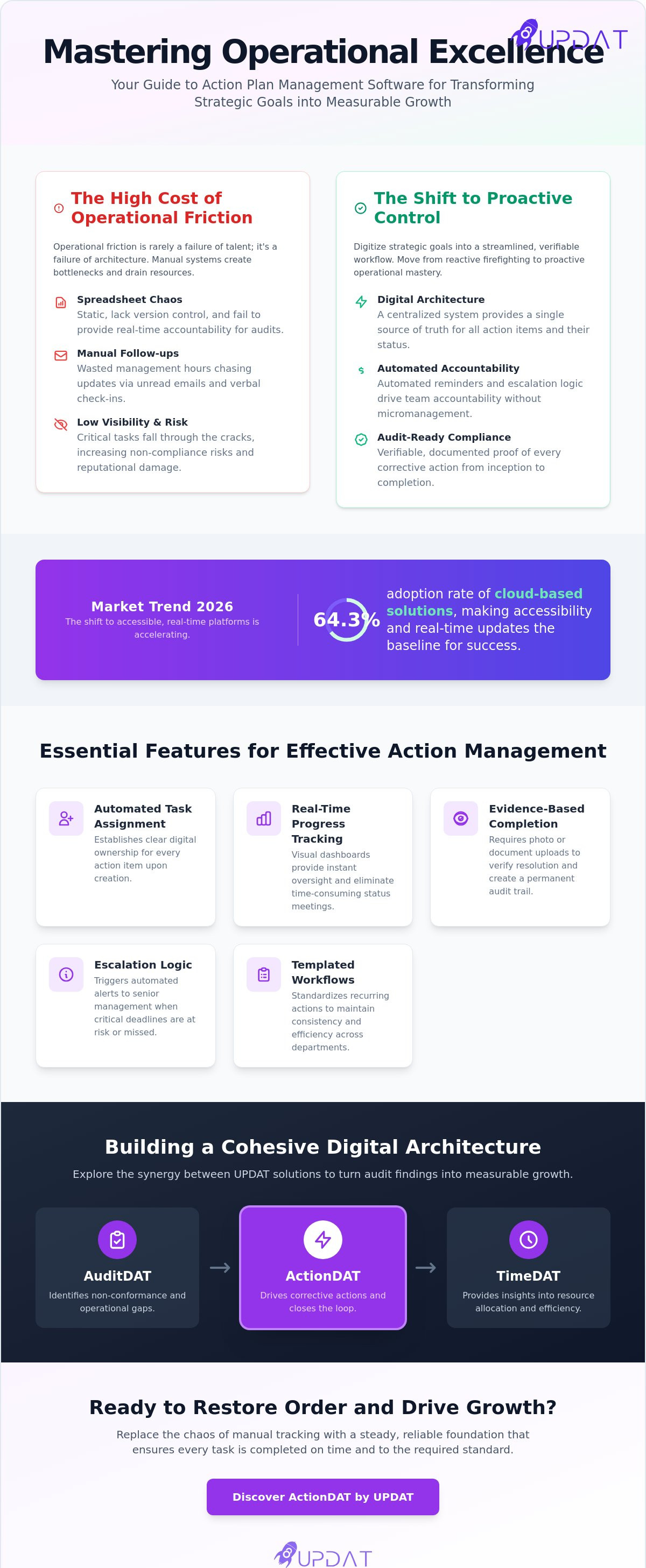
Operational friction is rarely a failure of talent; it is almost always a failure of architecture. You likely understand the frustration of seeing critical tasks fall through the cracks or wasting hours on manual follow-ups just to verify project status. It's difficult to maintain momentum when visibility is low and audit compliance feels like a constant scramble. Selecting the right action plan management software is the strategic move that transforms these bottlenecks into a streamlined, digital workflow.
We'll guide you through the process of choosing a system that eliminates complexity and restores order to your business processes. You'll discover how to achieve centralized oversight and automated reminders that drive team accountability without the administrative burden. This guide previews the essential features and market trends for 2026, including the 64.3% adoption rate of cloud-based solutions. By the end, you'll have a clear roadmap to master your operational environment and ensure no critical action is ever overlooked again. We focus on providing the logic and precision needed to turn your audit findings into measurable growth.
Key Takeaways
• Master the transition from reactive firefighting to proactive operational control by digitizing strategic goals into trackable, granular tasks.
• Identify the core features of action plan management software that eliminate manual follow-ups and provide real-time visibility through digital dashboards.
• Determine if your organization requires a standard SaaS platform or a bespoke solution to manage unique workflow complexities and existing system integrations.
• Execute a structured implementation roadmap that audits existing bottlenecks and standardizes response templates for improved team accountability.
• Explore the synergy between ActionDAT, AuditDAT, and TimeDAT to build a cohesive digital architecture for high-stakes business environments.
The Strategic Role of Action Plan Management Software in 2026
Operational friction is often the result of a disconnect between strategy and execution. Action plan management is the systematic process of turning high-level strategic goals into granular, trackable tasks. Without this digital architecture, even the most robust strategic planning software remains a theoretical exercise. In 2026, the focus has shifted toward proactive operational mastery, moving away from the traditional "firefighting" mentality that once defined business management. Organizations now recognize that true stability comes from a system that anticipates needs rather than reacting to failures.
Manual spreadsheets are no longer sufficient for professional environments. They fail to provide the real-time accountability required by modern regulatory standards. Because spreadsheets are static documents, they lack version control and automated reminders, making it nearly impossible to prove compliance during a surprise audit. Transitioning to specialized action plan management software ensures that every business correction is documented and verifiable from inception to completion. This digital transformation provides a level of precision that manual methods simply cannot replicate.
This commitment to precision should extend to your financial records as well. Professional firms like CTC Tax & Accounting provide the specialized bookkeeping and tax compliance services required to ensure your business architecture remains robust and audit-ready.
From Audit Findings to Executable Tasks
Digital audits serve as the primary diagnostic tool for assessing business health. When AuditDAT identifies a gap or a non-conformance, it creates an immediate requirement for corrective action. This triggers a "loop-closing" effect where every identified risk is paired with a tracked action item. By maintaining a single system of record, management ensures that findings don't just sit in a report but instead drive tangible improvements across the organization. This integration transforms passive data into active business growth, ensuring that every non-conformance is a stepping stone toward a more resilient operation.
The Cost of "Falling Through the Cracks"
The administrative burden of manual follow-ups is a significant drain on resources. Chasing updates via unread emails or verbal check-ins wastes valuable management time and increases the risk of critical tasks being overlooked. In the Maltese regulatory landscape, the cost of non-compliance can be severe, involving both financial penalties and long-term reputational damage. Investing in action plan management software is a commitment to operational excellence. It replaces the chaos of manual tracking with a steady, reliable foundation that ensures every task is completed on time and to the required standard. This approach doesn't just manage tasks; it builds a culture of reliability and professional pride.
Essential Features for Effective Action Management
Effective action plan management software distinguishes itself by transforming static to-do lists into dynamic, compliance-driven workflows. It replaces ambiguity with digital ownership. When a system assigns a task, it establishes a clear line of responsibility that verbal agreements can't match. This digital architecture ensures that every team member knows exactly what they're responsible for and when it's due.
Modern platforms prioritize visibility and verification. With 64.3% of organizations adopting cloud-based solutions, accessibility and real-time updates have become the baseline for operational success. You should look for these core features to restore order to your business:
Automated Task Assignment
Establishes digital ownership for every action item immediately upon creation.
Real-Time Progress Tracking
Provides visual dashboards that eliminate the need for time-consuming status meetings.
Evidence-Based Completion
Requires photo or document uploads to verify task resolution and create a permanent record.
Escalation Logic
Triggers automated alerts to senior management when critical deadlines are missed.
Templated Workflows
Standardizes recurring actions to maintain consistency across different departments or sites.
Accountability Through Automated Reminders
Automated nudges reduce the administrative burden on managers. They eliminate the need for constant micro-management and manual follow-ups. Clear deadlines provide a psychological framework for team members to prioritize their workload effectively. This visibility fosters a culture of team accountability where progress is public, measurable, and verifiable. It's about empowering staff to manage their own output within a structured system.
Advanced Reporting and Analytics
Data-driven decision-making is the hallmark of high-level efficiency. Advanced reporting allows you to identify bottlenecks before they derail a project. You can generate "audit-ready" reports in seconds, providing immediate proof of compliance to regulatory bodies. This level of insight mirrors the best practices found in Gartner's strategic planning guide, where execution is as vital as the plan itself. Using analytics to justify resource allocation ensures your operations remain agile. Research indicates that projects managed with structured, data-heavy approaches have a 20% higher success rate. If you're ready to bring this level of precision to your business, you can set up your account today.
Evaluating Business Needs: SaaS vs. Bespoke Solutions
Operational architecture is not one-size-fits-all. Your choice between a Software-as-a-Service (SaaS) model and a bespoke build depends on the specific digital friction you intend to eliminate. Standardized workflows are the primary candidates for SaaS solutions like ActionDAT. These platforms offer a pre-built framework designed for rapid deployment and immediate utility. If your business processes follow industry-standard compliance paths, a ready-to-use platform provides the most direct route to order.
Integration requirements often dictate the final decision. Effective action plan management software cannot function in a vacuum. It must communicate with your existing HR and payroll systems to ensure task assignments are logical and enforceable. If your current tech stack relies on modern APIs, a SaaS solution will likely integrate with minimal friction. However, legacy systems or highly proprietary databases may necessitate a custom-built bridge to maintain data integrity. The global software market is projected to reach $926.34 billion by 2026, reflecting a massive shift toward these integrated digital ecosystems.
Scalability remains a critical metric for long-term success. Cloud-based project management solutions currently account for 64.3% of market adoption, reflecting a clear preference for flexible, accessible systems. The project management software market is expanding rapidly, with a projected CAGR of up to 12.9% through 2036. As your business grows, your software must adapt without requiring a total overhaul of your operational logic. Consider the future trajectory of your organization before committing to a specific architecture.
When to Choose a Ready-to-Use Platform
Immediate implementation allows you to capture value from day one. Standardized best practices are inherently built into SaaS platforms, providing a steady foundation for SMEs in Malta. These organizations often prioritize cost-effectiveness and speed over total customization. Integrating these plans with TimeDAT ensures that action items are assigned to staff who are actually on-site and available. This synergy prevents the common pitfall of assigning critical tasks to employees who are on leave or off-shift.
The Case for Bespoke Software Development
Bespoke software development is the strategic choice for organizations with unique, high-stakes requirements. Some sectors, such as oil and gas or advanced manufacturing, operate under specialized regulatory frameworks that generic tools cannot accommodate. Owning your operational architecture provides a level of precision and control that off-the-shelf products lack. It allows for the creation of a system that mirrors your exact business logic. Review our detailed guide on custom software development in Malta to understand how tailored solutions support complex, long-term growth strategies.
Implementation Roadmap: Transitioning to Digital Action Plans
Transitioning to a digital architecture is a deliberate shift, not a sudden event. It requires a structured approach to ensure that the restoration of order is permanent and measurable. Moving from fragmented spreadsheets to a centralized system involves more than just a software installation; it requires a strategic realignment of how your team handles accountability. Follow these five steps to ensure a seamless transition.
Step 1: Audit manual processes.
Identify exactly where tasks currently stall or communication breaks down. Pinpointing these bottlenecks allows you to configure the software to solve your most pressing friction points first.
Step 2: Define core templates.
Standardize your response types. Creating universal templates for recurring issues ensures that every department speaks the same operational language and follows the same quality standards.
Step 3: Conduct team training.
Focus on the "why" rather than just the "how." Explain that the system exists to protect the team from the stress of overlooked tasks and the chaos of manual follow-ups.
Step 4: Pilot the software.
Deploy the action plan management software in a single department before a full-scale rollout. This allows you to iron out any workflow kinks in a controlled environment.
Step 5: Review analytics.
After 30 days, analyze the data to identify performance trends. Use these insights to refine your workflows and celebrate the tangible wins, such as reduced response times or 100% task completion rates.
Overcoming Resistance to Change
Resistance often stems from a fear of increased surveillance or a perceived "big brother" environment. You must frame the software as a tool for empowerment. It removes the stress of ambiguity by providing clear expectations and documented proof of hard work. When everyone's responsibilities are visible and fair, the need for intrusive, manual check-ins disappears. User adoption is the primary KPI for software success. Focus on making the platform a helpful ally in the employee's daily routine rather than a burden.
Integrating with Daily Operations
Digital tools must live where the work happens. Integrate software updates into your daily huddles or shift handovers to maintain momentum. Mobile access is essential for floor-based or field staff who don't spend their day at a desk; they need to log evidence and close tasks in real-time. This ensures that the system supports governance, risk, and compliance without disrupting the natural flow of work. By embedding the software into existing habits, you turn compliance into a background process rather than a separate chore. If you're ready to modernize your operational roadmap, you can register for an account to begin your digital transition.
Restoring Order with ActionDAT by UPDAT
ActionDAT serves as the digital architect for high-stakes operational environments. It is not merely a task tracker; it is a system of record designed to instill mastery and clarity within complex business structures. By centralizing every corrective task, it removes the ambiguity that leads to operational friction. Management gains a steady, reliable foundation for long-term growth, knowing that every strategic directive is being executed with precision.
The true power of this platform lies in its seamless synergy with the broader UPDAT ecosystem. When AuditDAT identifies a non-conformance or a safety gap, ActionDAT immediately creates the necessary workflow to resolve it. This closed-loop system ensures that no finding is ever left unaddressed. Integrating this with TimeDAT adds another layer of efficiency by ensuring that tasks are assigned based on actual workforce availability. This integrated digital architecture allows you to manage your business with a sense of calm authority, replacing chaotic follow-ups with automated, verifiable progress.
Choosing a partner with deep Maltese roots provides a distinct strategic advantage. UPDAT offers local support and a nuanced understanding of the specific regulatory landscapes that businesses in Malta navigate daily. We don't just provide action plan management software; we act as strategic architects who help you build a more resilient organization. Our team is available to ensure your digital transition is smooth, professional, and aligned with your unique operational logic.
Why UPDAT is the Strategic Choice for 2026
We are committed to removing the administrative complexity that stifles productivity. Our platform is built for adaptability, serving diverse sectors including hospitality, manufacturing, and security with equal precision. While ActionDAT provides a robust out-of-the-box framework, we recognize that some organizations require a more tailored approach. For these unique needs, our bespoke software development services allow you to own a custom-built digital environment that mirrors your exact business processes. This flexibility ensures that your software grows alongside your ambitions, providing a steady foundation for years to come.
Next Steps to Operational Excellence
Operational excellence is a proactive choice. You don't have to wait for the next audit or a critical failure to begin restoring order to your workflows. Implementing a structured action plan management software today protects your business from future risks and empowers your team to perform at their best. We invite you to see the tangible impact of well-organized systems firsthand. A tailored demonstration will show you exactly how our tools can eliminate your specific bottlenecks and provide the clarity you need to lead with confidence. Book a demo to see how ActionDAT can restore order to your business and take the first step toward mastering your operational environment.
Securing Operational Excellence for the Future
Transitioning to a digital architecture is the most effective way to eliminate operational friction and restore order. You now have the roadmap to select the right action plan management software, whether you require a standardized SaaS platform or a bespoke solution tailored to unique industry needs. By prioritizing features like automated escalation and evidence-based completion, you ensure that accountability becomes a permanent fixture of your business culture. It's about moving beyond simple task tracking to achieve true operational mastery.
ActionDAT provides the stability and clarity needed to govern your business with confidence. As a Maltese-founded solution, we combine localized expertise with cloud-based reliability for real-time tracking across all departments. The seamless integration with AuditDAT and TimeDAT creates a unified ecosystem where every audit finding leads to a verified resolution. This systematic approach transforms compliance from a manual burden into a strategic advantage for long-term growth.
Master your workflows and request a demo of ActionDAT today to begin your journey toward total operational order. Building a resilient, audit-ready business is well within your reach.
Frequently Asked Questions
What is the difference between a task manager and action plan management software?
Action plan management software provides a compliance-driven framework rather than a generic to-do list. It links every task to specific strategic goals or audit findings, ensuring each action has a verifiable reason and an permanent audit trail. While task managers focus on individual productivity, this software focuses on organizational accountability and regulatory alignment across complex workflows.
How does action plan software help with regulatory compliance in Malta?
The software creates a permanent, tamper-proof record of every corrective action taken by your team. This is essential for meeting Maltese regulatory standards in sectors like hospitality or manufacturing, where you must prove that non-conformances were resolved. It transforms audit findings into a history of compliance that is ready for inspection by authorities at any moment.
Can ActionDAT integrate with our existing audit and workforce systems?
Yes, ActionDAT is designed to work in synergy with AuditDAT and TimeDAT to create a unified digital ecosystem. It can also interface with existing HR or payroll systems through modern APIs to ensure data remains consistent. This integration ensures that action plans are triggered by real-world findings and assigned to staff members who are currently on shift.
Is this software suitable for small businesses or just large enterprises?
It is highly effective for both, as operational friction affects organizations regardless of their size. Small businesses benefit from standardized best practices and reduced administrative burden, while large enterprises utilize advanced escalation logic and multi-site reporting. The platform acts as a steady foundation that scales alongside your business as it grows.
How long does it typically take to implement an action plan management software platform?
Standard SaaS implementations often take just a few days to configure and deploy across a specific department. Bespoke solutions require a longer timeline that depends on the complexity of your unique requirements and integration needs. A structured rollout ensures that your team adopts the new action plan management software without disrupting daily operations.
What kind of reporting can I expect from ActionDAT?
You can generate real-time dashboards and detailed, audit-ready reports that track completion rates and identify operational bottlenecks. These reports provide a high-level overview of business health while allowing you to drill down into specific task histories. It provides the data needed to justify resource allocation and prove accountability to stakeholders with absolute precision.
Is there mobile support for staff who are not at a desk?
Full mobile support allows field-based or floor-based staff to manage their tasks from any device. Users can upload photos, attach documents, and close action items in real-time while they are on-site. This ensures that evidence is captured immediately and that the system reflects the current state of operations without the need for manual data entry later.
How does the software handle recurring tasks or standard operating procedures?
The platform utilizes templated workflows to automate recurring tasks and standardize SOPs across different departments. Once a template is defined, the system triggers action items based on a schedule or specific event triggers. This ensures consistency across your digital architecture and prevents critical maintenance or compliance checks from falling through the cracks.






%201.svg)
