

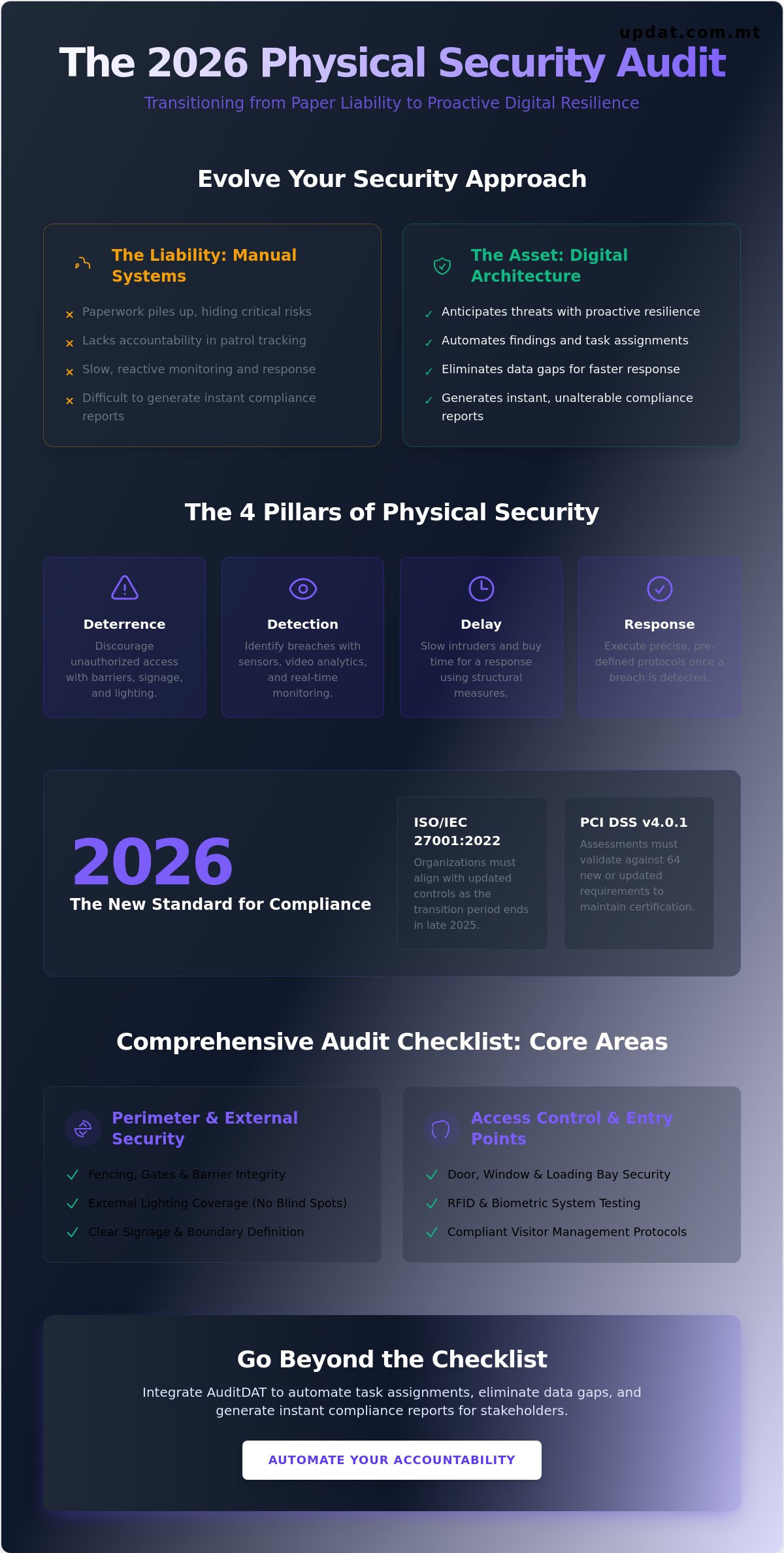
By 2026, a paper-based security plan is more of a liability than a safeguard. You've likely felt the weight of manual audits where paperwork piles up and critical vulnerabilities remain hidden in the clutter. It's difficult to maintain a physical security audit checklist when patrol tracking lacks accountability or when stakeholders demand instant compliance reports. You need a system that reflects the speed of modern threats.
This guide provides a professional-grade framework designed to eliminate these complexities and restore operational order. You'll learn how to master your facility's safety by identifying risks before they escalate. While technology advances, the core principles of protection remain steady. We'll show you how to transition from reactive monitoring to proactive resilience using a method that automates findings and task assignments. From meeting ISO 27001:2022 requirements to validating the 64 new controls in PCI DSS v4.0.1, this guide ensures your site remains compliant and secure. We'll walk through the essential components of a repeatable system that turns security from a checklist into a strategic asset.
Key Takeaways
• Redefine security as a dynamic architecture to better anticipate and mitigate modern operational threats.
• Utilize a modular physical security audit checklist to systematically evaluate perimeter integrity and interior zones.
• Replace manual, paper-based systems with digital alternatives to eliminate data gaps and improve response times.
• Execute a precise 8-step roadmap that simplifies team coordination and scope definition for every audit.
• Integrate AuditDAT to automate task assignments and generate instant compliance reports for your stakeholders.
The Architecture of Protection: Defining the Physical Security Audit
A physical security audit is much more than a simple walkthrough of your facility. It's a strategic evaluation of your organization's physical assets and the specific protocols designed to protect them. Think of it as a structural stress test for your operational environment. In a landscape where threats shift as quickly as the technology used to counter them, relying on a static security posture is a dangerous illusion. True protection requires a dynamic approach that evolves alongside your business.
When you initiate a security assessment, you do so with a sense of calm authority. You aren't just reacting to a previous breach; you're building a foundation of order and stability. The primary objectives are clear: mitigate risk, ensure full regulatory compliance, and prioritize personnel safety. This process isn't just about locking doors. It's about creating a resilient architecture where every vulnerability is documented, analyzed, and systematically addressed. A well-executed security strategy provides the clarity needed to lead with confidence.
The Core Pillars of Physical Security
Effective Physical security relies on a layered defense-in-depth strategy. These four pillars form the basis of any professional physical security audit checklist:
Deterrence
Using physical barriers, signage, and lighting to discourage unauthorized access before it begins.
Detection
Leveraging advanced sensors, video analytics, and real-time monitoring to identify breaches as they occur.
Delay
Implementing structural measures, such as reinforced glass or delayed-egress hardware, that slow down intruders and buy time for a response.
Response
Executing the precise, pre-defined protocols triggered once a vulnerability is identified or a breach is detected.
Why 2026 Demands a New Audit Standard
The transition periods for major international standards like ISO/IEC 27001:2022 ended in late 2025. Now, every organization must align with these updated controls to maintain certification. Similarly, all assessments in 2026 must validate against the 64 new or updated requirements in PCI DSS v4.0.1. A modern physical security audit checklist can't be a static piece of paper; it must account for the convergence of physical and digital risks.
By moving toward digital integration, you remove the complexity of national compliance. Tools like AuditDAT allow you to automate findings and assign tasks immediately. This shift from a "check-the-box" mentality to result-oriented security is essential for maintaining stakeholder trust. Automated reporting provides a transparent, unalterable record of your safety posture, ensuring that your facility remains a steady foundation for long-term growth.
The Comprehensive Physical Security Audit Checklist: Core Pillars
A strategic physical security audit checklist functions as a blueprint for operational stability. It breaks down complex environments into manageable, modular segments that allow for rapid scanning and execution. Perimeter security is the first line of operational defense. By organizing your assessment into core pillars, you ensure that no vulnerability remains overlooked and every asset receives the appropriate level of scrutiny.
Perimeter and External Site Security
Begin your audit at the outermost boundary of the property. Inspect fencing, gates, and natural barriers for structural integrity, ensuring they meet the standards outlined in CISA's physical security guidelines. Evaluate external lighting coverage to eliminate blind spots or concealment areas that could hide unauthorized movement. You must also audit signage and wayfinding to ensure boundaries are clearly defined for both employees and visitors. With the global physical security market valued up to $129.39 billion in 2026, the focus on robust external protection has never been more critical for asset preservation.
Access Control and Entry Point Management
Move inward to evaluate how individuals enter and exit your facility. Verify that all doors, windows, and loading bays are monitored and secured with functional hardware. Test RFID and biometric access points for latency or failure, as these systems are now central to modern identity management. Many organizations are shifting toward mobile credentials and touchless access to improve fluidity. Review your visitor management systems to ensure data compliance and accuracy. To maintain this level of precision across multiple sites, you can digitize your security framework to replace aging manual logs with real-time tracking.
Surveillance and Detection Systems
Technical systems provide the visibility required to maintain order. Confirm that CCTV coverage aligns with high-risk zones and entry paths, leaving no gaps in the visual record. Video surveillance remains a dominant force, accounting for over 51% of industry revenue in 2025. Test alarm triggers and notification pathways to ensure security personnel receive alerts without delay. To enhance your detection capabilities with advanced sensor technology, you can discover smartdetect AG and their specialized Swiss-engineered solutions for buildings and outdoor areas. Finally, audit the storage and accessibility of your surveillance footage. You must ensure it meets national safety standards and remains available for forensic review if a breach occurs.
The human element completes the architecture of protection. A thorough physical security audit checklist must address staff training, visitor logs, and ID protocols. Technology alone cannot secure a facility if personnel aren't trained to recognize tailgating or social engineering attempts. Establish clear protocols for ID verification and ensure that every employee understands their role in the broader security strategy. This blend of technical precision and human awareness creates a steady, reliable foundation for long-term growth.
Transitioning from Paper to Digital: Why Manual Checklists Are a Liability
Relying on a paper-based physical security audit checklist in 2026 is a strategic risk that your organization shouldn't ignore. Manual systems are inherently static; they create a dangerous lag between identifying a vulnerability and taking corrective action. In a high-stakes environment, lost data and delayed responses aren't just administrative hurdles. They're open invitations for breaches. Transitioning to a digital framework isn't just an upgrade. It's the removal of administrative complexity that allows you to restore operational order and lead with authority.
The Hidden Costs of Manual Compliance
Manual compliance carries significant invisible costs that erode your efficiency. Your team likely spends hours on redundant data entry and report consolidation. This administrative burden distracts your security personnel from their primary duty: protection. Beyond the time lost, paper systems lack the unalterable audit trail required for modern regulatory inspections. As of 2026, standards like ISO/IEC 27001:2022 and PCI DSS v4.0.1 demand a level of precision that manual logs simply can't provide. Handwritten notes are easily lost or misinterpreted, creating cracks where unaddressed security vulnerabilities can fester.
The Digital Advantage: Real-Time Operational Order
Digital transformation provides the real-time visibility needed to manage a modern facility. By using a digital physical security audit checklist, you gain the ability to generate instant reports for stakeholders. This transparency builds trust and ensures that everyone is aligned on the current risk profile. Digital systems also introduce a new level of accountability through automated time-stamping and photo evidence. Every finding is backed by undeniable proof, leaving no room for ambiguity during an internal or external audit.
Centralized data storage allows you to move beyond reactive fixes. You can analyze historical trends to identify recurring weaknesses across your physical architecture. This data-driven approach turns your security posture into a proactive shield. If you're ready to eliminate the chaos of paperwork, you can explore how AuditDAT streamlines the entire lifecycle of your security assessments. This shift ensures your facility remains a steady foundation for long-term growth while maintaining full compliance with national safety standards. By digitizing your workflow, you empower your team to focus on strategic protection rather than manual data entry.
Executing the Audit: A Strategic 8-Step Roadmap
Success in operational protection depends on a disciplined execution of your assessment. You don't simply wander through a facility; you follow a structured path that turns observations into actionable intelligence. By following this 8-step roadmap, you ensure your physical security audit checklist delivers tangible improvements rather than just a list of problems. This process transforms your security posture from a reactive effort into a steady, reliable foundation for growth.
Step 1: Define the scope.
Identify exactly which areas, systems, and protocols require evaluation. Clarity here prevents wasted time and ensures high-risk zones receive priority.
Step 2: Assemble the team.
Bring together experts from security, IT, and facilities management. Assigning clear roles ensures every pillar of protection is scrutinized by a professional.
Step 3: Conduct the walkthrough.
Move through the site using a digital template. This captures data at the source and prevents the information loss common with paper-based notes.
Step 4: Load-test the systems.
Don't assume your alarms work. Trigger sensors and measure the latency of your response protocols to verify they meet national safety standards.
Step 5: Document findings.
Use mobile devices to attach visual evidence directly to your notes. Photos provide undeniable proof for stakeholders and clear guidance for remediation teams.
From Inspection to Implementation
The audit doesn't end when you finish the walkthrough. True mastery of your environment comes from what you do with the data you've gathered. Steps 6 through 8 focus on converting findings into operational order.
Step 6: Analyze vulnerabilities.
Evaluate the data to identify high-priority risks. Focus on issues that present the greatest threat to personnel safety or regulatory compliance.
Step 7: Generate the report.
Produce a comprehensive compliance document. Stakeholders need a clear, professional summary of the facility's current standing.
Step 8: Close the loop.
Turn every vulnerability into a task. Assign these to specific team members to ensure accountability and track progress until the risk is eliminated.
Establishing a Repeatable Audit Rhythm
Security isn't a one-time event. You must determine the frequency of your audits based on your specific industry risk levels. High-traffic facilities or those in the oil and gas sector may require more frequent assessments than standard office environments. Use your historical data to predict and prevent future breaches. This proactive approach allows you to adapt as threats evolve, ensuring long-term stability. To maintain this level of precision without the administrative overhead, you can register for a digital audit platform and begin restoring order to your facility today.
By integrating these steps into your routine, you create a dynamic architecture of protection. You can explore more about restoring operational order and compliance through modern digital solutions. This systematic approach ensures that every audit contributes to a safer, more efficient organization.
Beyond the Checklist: Automating Accountability with AuditDAT
AuditDAT serves as the strategic architect for your digital compliance efforts. It doesn't just digitize your physical security audit checklist; it transforms it into a living data set that drives operational change. By centralizing every inspection point within a unified platform, you eliminate the risk of fragmented information and lost reports. You gain a single source of truth that reflects the actual state of your facility in real time, allowing you to lead with a sense of calm authority.
The true power of this system lies in the seamless synergy between AuditDAT and ActionDAT. While AuditDAT identifies vulnerabilities through rigorous inspections, ActionDAT ensures accountability by converting those findings into tracked tasks. This integration closes the loop between discovery and resolution, a critical step that manual systems often miss. For professionals in Security and Facilities Management, this means less time chasing status updates and more time focused on high-level strategic protection.
Restoring Order to Your Security Operations
Modern facilities require adaptable tools that mirror their own complexity. AuditDAT provides customizable templates that you can tailor to your specific site requirements, whether you're managing a single office or a global network of industrial sites. Its mobile-first design empowers your team to conduct on-the-ground audits with maximum efficiency. Every observation is captured instantly, and automated notifications ensure that no identified vulnerability goes unaddressed. This level of precision removes the administrative weight of manual data entry and restores order to your daily operations.
The Path to Operational Excellence
Digital audits do more than just record data; they empower your workforce to maintain the highest safety standards. By providing clear frameworks and undeniable accountability, you create an environment where excellence is the baseline. You can achieve full 2026 compliance with standards like ISO 27001:2022 and PCI DSS v4.0.1 without the crushing administrative burden of paper-based logs. The result is a more resilient organization that's prepared for the challenges of a shifting threat landscape. To see how these tools can transform your facility, you can Book a Demo to see AuditDAT in action and take the first step toward mastering your operational environment.
Mastering your facility's safety requires moving beyond static documents. By integrating a digital physical security audit checklist into your routine, you turn compliance into a strategic advantage. You've been handed the keys to a more organized, secure, and efficient future. Use them to build a foundation that supports your long-term growth and protects your most valuable assets with confidence.
Mastering the Future of Operational Protection
Operational stability depends on your ability to adapt to a shifting threat landscape. You've seen how a modular physical security audit checklist removes complexity and restores order to your facility. By moving away from manual liabilities and following a strategic 8-step roadmap, you position your organization as an authoritative leader in safety. Digital transformation isn't just a trend; it's the essential foundation for meeting 2026 compliance standards with absolute precision.
Leaders in Security and Facilities Management already rely on AuditDAT to secure their environments and protect their most valuable assets. Automated reporting saves hours of administrative time every week, while a 100% digital audit trail ensures you're always prepared for rigorous regulatory inspections. You now have the keys to eliminate vulnerabilities and lead your team with grounded confidence.
Streamline your compliance and request an AuditDAT Demo today.
Take full control of your operational architecture. Build a safer, more efficient future for your organization starting today.
Frequently Asked Questions
What is a physical security audit checklist?
A physical security audit checklist is a structured framework used to evaluate the integrity of a facility's physical barriers, technical systems, and operational protocols. It ensures that every layer of defense, from perimeter fencing to internal access controls, is systematically inspected. This tool helps identify vulnerabilities before they can be exploited, allowing you to maintain a steady foundation of order and safety.
How often should I conduct a physical security audit?
You should conduct a physical security audit at least once a year, though high-risk facilities often require quarterly assessments to maintain peak operational protection. Frequent audits are necessary whenever significant changes occur in your environment, such as new construction or major staff restructuring. Regular intervals ensure that your safety measures remain aligned with evolving threats and 2026 national standards.
Can I use digital software for ISO 27001 physical security compliance?
Yes, digital software is highly recommended for meeting the rigorous physical security requirements of ISO/IEC 27001:2022. Modern platforms automate the collection of evidence and provide the unalterable audit trails required for certification. This approach removes the complexity of manual record-keeping and ensures that your compliance posture is always ready for external inspection without administrative delays.
What are the most common vulnerabilities found during security audits?
Common vulnerabilities include poorly maintained perimeter fencing, inadequate external lighting, and outdated visitor management logs that lack real-time accuracy. A physical security audit checklist often reveals "tailgating" at entry points and technical failures in surveillance systems that haven't been load-tested. Identifying these gaps allows you to assign remediation tasks immediately to restore operational order and mitigate risk.
How do I transition from paper checklists to a digital audit system?
You transition by selecting a mobile-first platform that allows you to import your existing protocols into customizable digital templates. Start by digitizing your current physical security audit checklist and training your team on the new software interface. This shift eliminates administrative overhead and enables real-time data capture, including photo evidence and time-stamping, during site walkthroughs.
Is a physical security audit different from a risk assessment?
Yes, a physical security audit evaluates the effectiveness of existing controls, while a risk assessment identifies and prioritizes potential threats to the organization. The audit acts as a verification process to ensure your current systems are functioning as intended. Both are essential components of a safety strategy, but the audit focuses on the tangible architecture and execution of protection.
What role does staff training play in a physical security audit?
Staff training is a critical pillar of any audit because human awareness is your final line of defense against unauthorized access. An audit should evaluate whether personnel understand access protocols and emergency response procedures in real-world scenarios. Even the most advanced technical systems can fail if employees aren't trained to recognize social engineering attempts or security breaches.
How does AuditDAT help with national compliance in Malta?
AuditDAT helps organizations in Malta maintain compliance by providing standardized templates that align with both local regulations and international safety standards. It streamlines the reporting process for stakeholders and ensures that all documentation meets the specific requirements of national inspectors. The platform provides a steady foundation for growth by automating the entire lifecycle of security assessments and task tracking.






%201.svg)
