

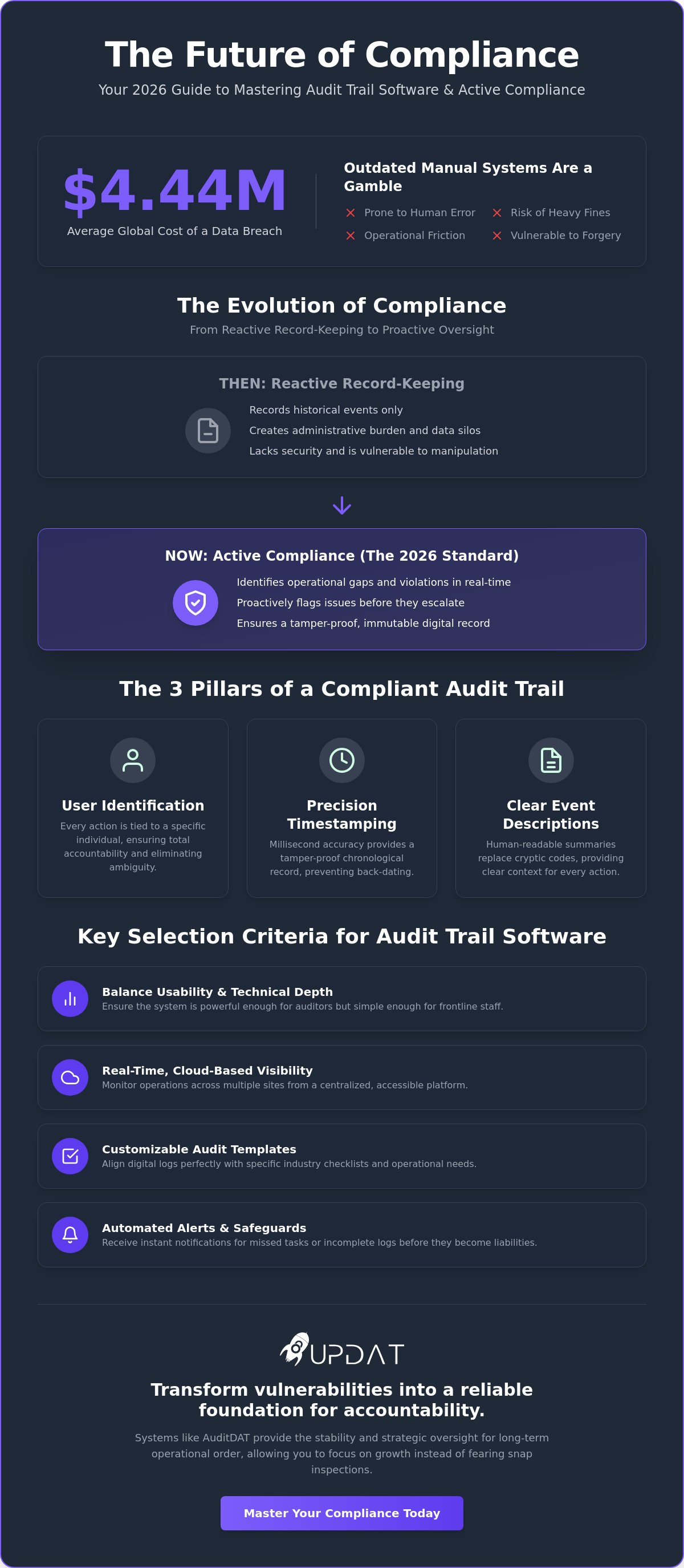
The average global cost of a data breach reached $4.44 million in 2025. You likely recognize that relying on manual paper trails or fragmented spreadsheets is a gamble your organization cannot afford. These outdated methods are prone to human error. The fear of facing a snap inspection with incomplete logs creates unnecessary operational friction and the risk of heavy fines. You deserve a system that transforms these vulnerabilities into a reliable, automated foundation for accountability.
This guide empowers you to master the complexities of modern regulatory tracking. You will discover how to select the right audit trail software for compliance to ensure total operational integrity and maintain a tamper-proof record of every business activity. We explore the new "Govern" function within NIST CSF 2.0, discuss the impact of the EU AI Act, and provide a clear roadmap for moving from periodic reporting to the continuous monitoring models that 2026 auditors now demand. It is time to replace administrative burden with the peace of mind that comes from a centralized, high-level architecture of order.
Key Takeaways
• Understand the 2026 shift toward Active Compliance, where systems move from recording history to flagging potential violations before they occur.
• Balance operational ease of use with technical data depth to ensure your reporting remains both comprehensive and accessible across multiple sites.
• Examine how digital inspections serve as an automated supervisor in sectors like hospitality to maintain high-level operational standards.
• Follow a practical five-step roadmap to mitigate staff resistance and navigate the transition from manual paper trails to digital systems.
• Identify the core features of audit trail software for compliance that provide a steady, reliable foundation for long-term operational order.
Defining Audit Trail Software for Compliance in 2026
An Audit trail functions as the digital architecture of your business operations. It provides a chronological, tamper-proof record of every single event that occurs within your system. By 2026, the standard has shifted from reactive record-keeping to Active Compliance. This means your software no longer just records history; it identifies operational gaps in real-time. This proactive approach allows you to rectify issues before they escalate into costly violations or failed inspections.
Meeting international standards like ISO 9001 or navigating local Maltese regulations requires more than just a basic list of actions. You need a technical truth model. While simple system logs might show that a change occurred, professional audit trail software for compliance provides the necessary context. It links specific actions to unique users and defined workflows. This transforms raw data into verifiable evidence that stands up to the most rigorous regulatory scrutiny.
The Core Components of a Compliant Audit Trail
A reliable system relies on three pillars to maintain operational order and ensure accountability across your organization:
User Identification
Every action must be tied to a specific individual. This ensures total accountability and prevents the ambiguity of shared logins or anonymous entries.
Timestamping
Digital integrity requires millisecond precision. This level of detail is now the standard for preventing back-dating and ensuring the chronological accuracy of your logs.
Event Description
Modern systems move beyond cryptic error codes. They provide human-readable summaries of every action, such as "Manager A approved the safety checklist at Site B."
Why Paper-Based Records Fail Modern Audits
Relying on manual paper trails is an unnecessary risk that modern businesses can't afford. The hidden costs are significant. You face administrative bloat, physical storage limitations, and the constant threat of loss or damage. Perhaps most importantly, paper lacks the security features required to prove authenticity in a digital-first economy. Digital signatures and encrypted logs are the only recognized methods for ensuring your records haven't been manipulated or forged.
Digital immutability is the technological guarantee that a record cannot be altered or deleted once it's created. Without this foundation, your compliance strategy is vulnerable. Systems like AuditDAT provide this stability by creating a permanent, unchangeable history of your business activities. This restoration of order allows you to focus on long-term growth rather than the fear of missing documentation during a snap inspection.
Selection Criteria: Evaluating Audit Trail Software for Your Organisation
Choosing the right audit trail software for compliance requires a strategic balance between technical depth and operational usability. Many organisations fall into the trap of selecting overly complex systems that frontline staff struggle to navigate. If your team finds the interface cumbersome, data entry becomes inconsistent. This compromises the integrity of your entire compliance framework. You need a solution that offers a high-level architecture of order while remaining accessible to every user, from the warehouse floor to the boardroom.
Real-time visibility is no longer a luxury. Cloud-based access ensures that reporting remains consistent across multiple sites, allowing managers to monitor activities as they happen. This fluidity is essential for maintaining standards in fast-paced environments. Look for platforms that offer customisable audit templates. These allow you to mirror specific industry checklists, ensuring that your digital logs align perfectly with your unique operational requirements. Automated alerts are equally vital. They serve as a digital safeguard, flagging missed tasks or incomplete logs before they become regulatory liabilities. Solutions like AuditDAT are specifically designed to provide this level of strategic oversight and operational excellence.
Scalability and Integration Capabilities
Your software must grow alongside your business. A rigid system that requires a total overhaul every time you expand is a drain on resources. Effective audit tools should integrate seamlessly with your existing infrastructure. For instance, connecting your audit trails with workforce management tools like TimeDAT creates a unified record of who was on-site when specific actions occurred. API availability is another critical factor. It ensures your compliance data can flow into broader business intelligence tools, allowing for sophisticated analysis of long-term trends and risks.
Security and Data Retention Standards
Security is the foundation of any compliant system. End-to-end encryption is mandatory to protect sensitive data from external breaches. You must also implement Role-Based Access Control (RBAC). This ensures that only authorised personnel can view or export sensitive audit reports, maintaining a strict hierarchy of information. Following the Generally Accepted Principles and Practices for Securing Information Technology Systems is a proven way to establish a robust security posture.
Retention policies vary by regulation and jurisdiction. Under HIPAA, audit logs must be retained for at least six years, while the Sarbanes-Oxley Act (SOX) mandates a seven-year period for financial records. In the Maltese context, you must align these digital policies with local VAT and corporate record-keeping requirements. A sophisticated system automates these retention schedules, purging or archiving data according to your specific legal obligations. If you are ready to transition from fragmented logs to a unified system of record, you can start building your compliant workspace today.
Industry-Specific Compliance: Beyond Financial Logs
Audit trails are frequently pigeonholed into IT or finance departments. In 2026, they serve as a digital supervisor in high-stakes operational environments. This role goes beyond simple data logs. It establishes a technical truth for physical actions. The strategic value of Auditing Third-Party Access extends to operational platforms where external vendors or contractors interact with your critical safety systems. Using professional audit trail software for compliance ensures every interaction is recorded with millisecond precision, creating a reliable foundation for long-term growth.
In the hospitality sector, digital inspections have replaced the unreliable clipboard. Instead of hoping a staff member checked the cold storage, you have a verified, timestamped record. Manufacturing quality control relies on these trails to verify safety protocols at every stage of production. This prevents defects and ensures worker safety. Similarly, the security industry utilizes them for patrol tracking and incident logging. It proves accountability during high-pressure events and provides peace of mind to stakeholders.
HACCP and Food Safety Compliance
Automating temperature logs and hygiene checklists ensures food safety standards are met without human error. During unannounced health inspections, instant report generation saves hours of administrative panic. You can view HACCP management solutions designed specifically for the hospitality industry. These tools turn compliance from a reactive burden into a steady, reliable system. They empower your team to focus on service while the software handles the architecture of order.
Health, Safety, and Environmental (HSE) Audits
Real-time tracking of risk assessments and equipment maintenance logs is essential for modern HSE management. These audit trails support ESG and sustainability goals through transparent, verifiable reporting. By capturing every safety check, you ensure compliance with the latest Governance and Risk standards. This structured approach to audit trail software for compliance provides the clarity needed to lead your industry with confidence. It transforms complex regulatory requirements into digestible, actionable data points.
Overcoming Implementation Hurdles in Digital Transformation
Implementing audit trail software for compliance is often met with a specific type of friction: staff resistance. Many employees view new tracking technology through the lens of surveillance. This "big brother" fear usually stems from a lack of clarity regarding the software's purpose. To overcome this hurdle, you must reframe the narrative. Position the system as a tool for operational order that protects the team from blame and human error. When staff understand that digital logs provide a factual defense during inspections, the cultural shift begins. Reframing the system as a shield rather than a spotlight is the first step toward restoration of order.
Breaking down data silos is another critical challenge. Many organizations struggle with fragmented information stored in separate spreadsheets or physical binders. These silos prevent a holistic view of operational health and create gaps in your compliance history. Choosing an integrated business management system ensures that every department operates from the same technical truth. This connectivity allows you to move from reactive firefighting to proactive management, ensuring that your digital architecture supports long-term growth.
The 5-Step Digital Transition Roadmap
A smooth move from paper to digital audits requires a structured approach. Don't rush the deployment. Follow this sequence to restore order without disrupting daily workflows:
Audit your current manual process
Identify the specific bottlenecks and "cracks" where data is lost or filing becomes an administrative burden.
Define your compliance hierarchy
Establish who reports to whom and determine exactly which data points need to be visible at each management level.
Pilot the software
Test the digital audit solution in a single department to gather real-world feedback and identify friction points.
Iterate based on feedback
Refine your digital checklists to ensure they match the physical reality of the site and the practical needs of your staff.
Standardize and scale
Once the pilot succeeds, roll out the system across the organization to create a unified, tamper-proof record of all activities.
Building a Culture of Accountability
Transformation succeeds when you prioritize user-centric design and comprehensive training. Software that is difficult to use will inevitably be bypassed. Choose a platform that favors rapid scanning and high-level efficiency. This allows your team to complete their compliance tasks quickly and accurately. Accountability shouldn't be synonymous with punishment. Use the data generated by your audit trail software for compliance to recognize and reward high-performing teams. When staff see that their diligence is documented and valued, engagement increases. Transparency breeds trust within a modern workforce. It replaces the chaos of missing paper trails with a steady foundation for LONG-TERM operational excellence. If you're ready to remove complexity from your operations, register for your account and begin your digital transition today.
AuditDAT: Mastering Operational Integrity and Compliance
AuditDAT acts as the strategic architect for Maltese businesses seeking a structured approach to operational order. It provides the digital foundation required to master the complexities of modern regulatory tracking. By choosing a partner like UPDAT Technologies Ltd., you gain access to local expertise that understands the specific nuances of the national market and its regulatory landscape. The software features a no-nonsense interface designed for rapid scanning and high-level efficiency. It removes the friction from regulatory inspections, allowing you to present a technical truth with confidence. Using professional audit trail software for compliance ensures that your business remains a steady, reliable foundation for long-term growth.
Complexity often leads to error. AuditDAT simplifies the oversight process by consolidating fragmented logs into a single, authoritative record. This restoration of order empowers managers to focus on strategic decisions rather than administrative troubleshooting. Whether you are preparing for an ISO audit or a local health and safety inspection, the platform provides the clarity and precision needed to demonstrate total operational integrity.
Key Features of the AuditDAT Platform
Customisable inspection templates
Tailor the software to your specific industry requirements. This ensures your digital checklists match the physical reality of your site, whether you operate in hospitality, manufacturing, or security.
Instant reporting and analytics
Transform raw data into actionable business insights. The platform generates comprehensive reports that identify trends and highlight potential compliance gaps in real-time.
Cloud-based reliability
Ensure your audit trail software for compliance is always accessible and secure. Cloud architecture eliminates the risks associated with local hardware failure and provides a tamper-proof record from any location.
Restoring Order with UPDAT Technologies Ltd.
Operational excellence is achieved when your systems work in harmony. AuditDAT integrates seamlessly with the broader suite from UPDAT Technologies Ltd., including TimeDAT for workforce management and ActionDAT for task execution. This connectivity closes the gap between workforce presence and operational accountability. It provides a unified view of your business architecture that off-the-shelf products cannot match.
Every business has unique requirements that standard software might overlook. Our bespoke software development options ensure your solution is custom-tailored to your specific workflows. This eliminates redundant tasks and ensures the software adapts to your growth rather than hindering it. You can book a demo to see how AuditDAT can transform your compliance workflow and restore high-level order to your operations today.
Securing Your Operational Future with Active Compliance
Mastering your regulatory environment requires a shift from passive record-keeping to a strategic architecture of order. You've seen how the right audit trail software for compliance transforms unannounced inspections from a source of anxiety into a routine validation of your excellence. By prioritizing real-time visibility and integrating your audit logs with specialized tools, you create a tamper-proof history that guards your business against human error. This technical truth becomes the foundation of your professional reputation and operational stability.
Founded in 2019, UPDAT Technologies Ltd. remains dedicated to Maltese operational excellence with specialized solutions for the hospitality, manufacturing, and security sectors. Our integrated suite provides the stability and clarity you need to scale without added complexity. It's time to replace fragmented paper trails with a unified system that empowers your team and secures your long-term growth. We're ready to help you build a more resilient and transparent organization.
Request a Personalised AuditDAT Demo today and take the first step toward total operational integrity.
Frequently Asked Questions
What is the difference between an audit trail and an audit log?
An audit log is a raw list of system events, whereas an audit trail is a chronological, contextual record designed to track the lifecycle of a specific transaction or activity. While logs record technical data, trails provide a narrative of who, what, when, and how to prove accountability. This distinction is vital for regulatory scrutiny, as it transforms simple data points into a verifiable history of operational decisions.
Is audit trail software mandatory for businesses in Malta?
While not every business is legally required to use a specific software, many Maltese regulations governing VAT, financial services, and health and safety mandate the maintenance of accurate records for several years. Implementing audit trail software for compliance is the most reliable way to meet these standards. It ensures your records are tamper-proof and ready for unannounced inspections by providing a steady, reliable foundation for your reporting.
How can audit trail software help with GDPR compliance?
Audit trails support GDPR by documenting exactly how personal data is accessed, modified, or deleted within your systems. This technical truth model allows you to prove your data protection measures to regulators with millisecond precision. In 2026, auditors expect to see these real-time dashboards rather than periodic reports. It demonstrates proactive governance and accountability, ensuring that your data processing remains transparent and fully compliant with current standards.
Can digital audit trails be used as evidence in legal disputes?
Digital audit trails are highly effective as evidence in legal disputes because they provide an immutable, timestamped record of actions. To be admissible, the records must be tamper-proof and created through a consistent, documented process. This level of digital integrity protects your organization from false claims and provides a factual basis for internal investigations or court proceedings. It replaces the ambiguity of manual notes with a precise, unchangeable record of truth.
How much administrative time can a business save by switching to digital audits?
Businesses typically save significant administrative hours by automating data collection and report generation. Instead of manually filing paper logs or chasing staff for missing signatures, managers can generate comprehensive reports in seconds. This automation removes the burden of manual filing and allows your team to focus on high-value operational tasks. By restoring order to your administrative processes, you eliminate the friction that often slows down organizational growth.
What happens if our internet goes down during a digital audit?
Modern cloud-based solutions like AuditDAT often include offline capabilities that allow users to continue recording data even without a connection. Once the device reconnects to the internet, the data syncs automatically with the central server to maintain a continuous record. This ensures that your audit trail remains unbroken and that no critical events are lost during temporary network interruptions. It provides a steady, reliable foundation regardless of your current connectivity status.
How do I ensure my staff actually uses the audit trail software correctly?
Ensuring correct usage starts with a user-centric design that mirrors the actual tasks your staff performs on-site. When the interface is intuitive and requires minimal data entry, adoption rates increase naturally across the organization. You should also reframe the software as a tool that protects employees by proving they followed correct procedures. This builds a culture of accountability and empowerment rather than one of surveillance, ensuring long-term success for your digital transformation.
Can AuditDAT be customised for very specific niche industries?
AuditDAT is designed as an adaptable architecture that can be tailored to meet the specific requirements of any niche industry. Whether you need bespoke checklists for chemical processing or specialized incident logs for maritime security, the platform allows for deep customization. This ensures that your audit trail software for compliance reflects the unique operational realities of your business. Our team acts as a strategic architect to help you build a system that fits your exact needs.






%201.svg)
